Vergulde Draeck was a small class of VOC vessel referred to as a jacht. The vessel had been purchased by the company in 1653. Its second voyage to Batavia turned out to be its last. It departed Texel on 4 October 1655. After a stay at the Cape from 9 to 12 March 1656, the vessel was on the last leg of its voyage to Batavia when, on 28 April 1656, it was wrecked on the Western Australian coast.
The ship’s journals are not known to have survived, but two letters from the survivors of the wrecking made their way back to Batavia with the steersman and six sailors on board the ship’s schuit (a small boat or yawl). This raised the alarm, and several ships were sent by the VOC to search for the wreck and survivors. None were successful. The Maritime Journals Archive Project reproduces many of the surviving known records that relate to the loss of Vergulde Draeck and subsequent rescue expeditions. An introduction to each of these journals is provided below.
The wreck of Vergulde Draeck
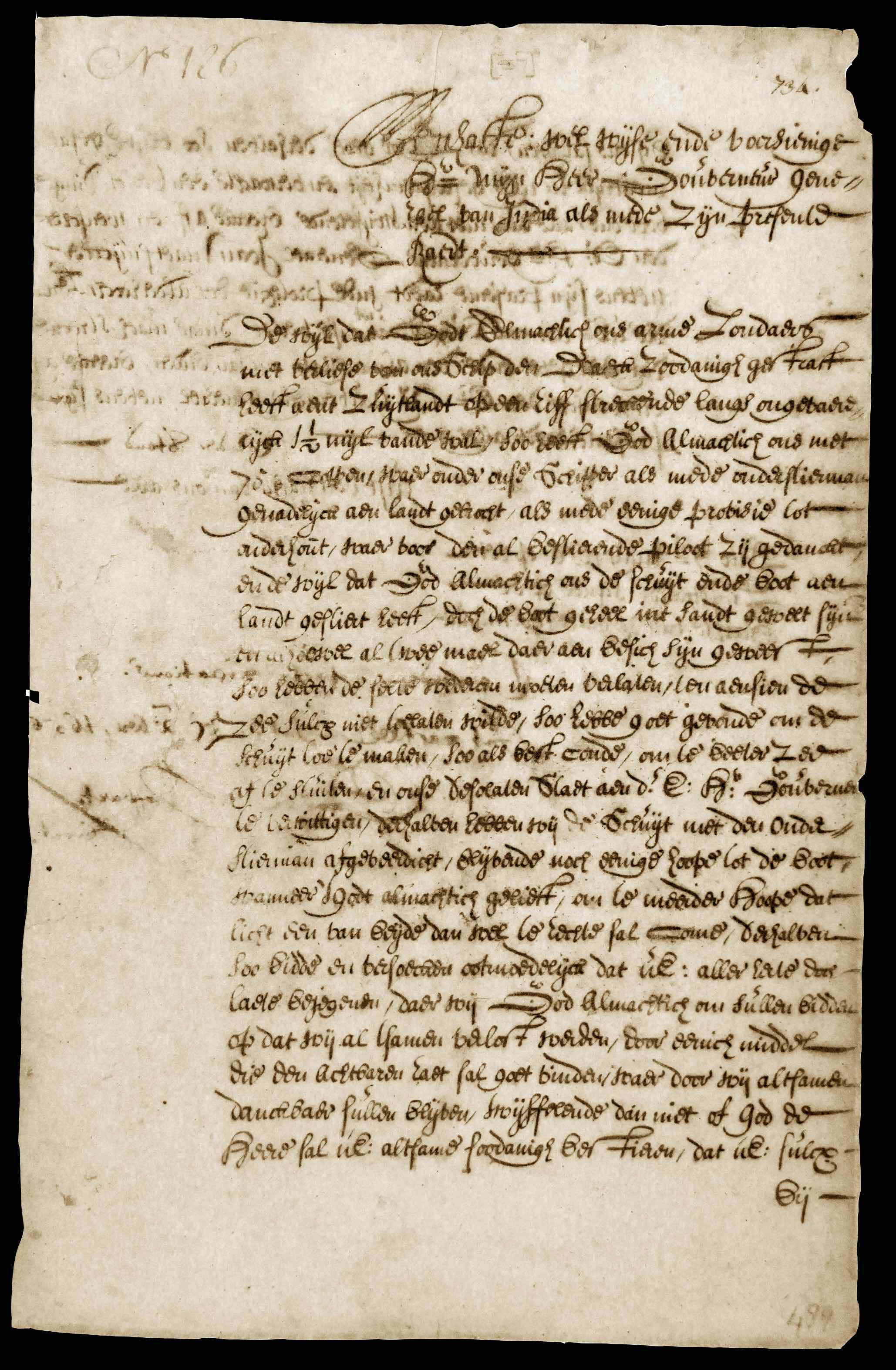
Follow this link to view the letter from the survivors of the wreck of Vergulde Draeck, accompanied by Adriaan de Jong’s transcription and translation.
These two letters were written on the shores of the Southland opposite the wreck of Vergulde Draeck and are dated 7 May 1656. They arrived in Batavia on 7 June, when the schuijt from the Vergulde Draeck arrived with the under-steersman and six sailors with the:
sorrowful news that the abovementioned fine jacht had run aground on the coast of the Southland, on 28 April during the night in the beginning of the morning watch, on a reef, stretching out in the sea for one and a half mijl, at the latitude of 30 2/3°. Of the 193 people, only 75 landed safely (among whom skipper Pieter Albertsz and the mentioned under-steersman). From the ship, which immediately burst when touching ground, nothing was saved, and only very few provisions were thrown by the waves on the beach. The remaining 68 persons were further trying to recover the boat, which was buried in the sand…
Although the letters were known to be in the Western Cape Archives they were only recently located (Jarvis 2015). Translation and transcription is by Adriaan de Jong.
Rescue efforts

‘1656 Vergulde Draeck VOCBtavia’
Follow this link to view the resolution of the Governor General and Council of the Indies for Wednesday 7 June 1656, accompanied by Lous Zuiderbaan’s transcription and translation.
This copy resolution of the Governor General and Council of the Indies for Wednesday 7 June 1656 notes the arrival of the schuit of Vergulde Draeck with seven survivors, including the understeersman. It also mentions that the ship carried 78,600 guilders in cash and that 68 people were marooned on the Southland, and that the Governor General and Council immediately commissioned the fluit Witte Valk and the jacht Goede Hoop to sail to rescue the survivors and recover the Company’s goods.
Unfortunately, the ships sailed in the southern hemisphere winter and encountered storms on the coast of the Southland. The Witte Valk failed to make a landing and search for survivors; however, the Goede Hoop did make landing and searched several miles inland but saw neither wreck nor people. Instead, they lost eleven of their own men. Firstly, three, who seem to have lost their way in the bush; and, after that, another eight, who were sent ashore with the boat to look for them and never returned. Their boat was found on the beach smashed to pieces, suggesting the crew likely perished with it. That was the end of the first search.
Following the fluit Witte Valk and the jacht Goede Hoop expeditions the Governor General and Councillors in Batavia did not have suitable ships available to carry out another search for possible survivors. They left it for the Commander of the VOC outpost at the Cape of Good Hope, Jan van Riebeeck, to make another attempt. This was undertaken by the fluit Vink in April 1657, again with no success.
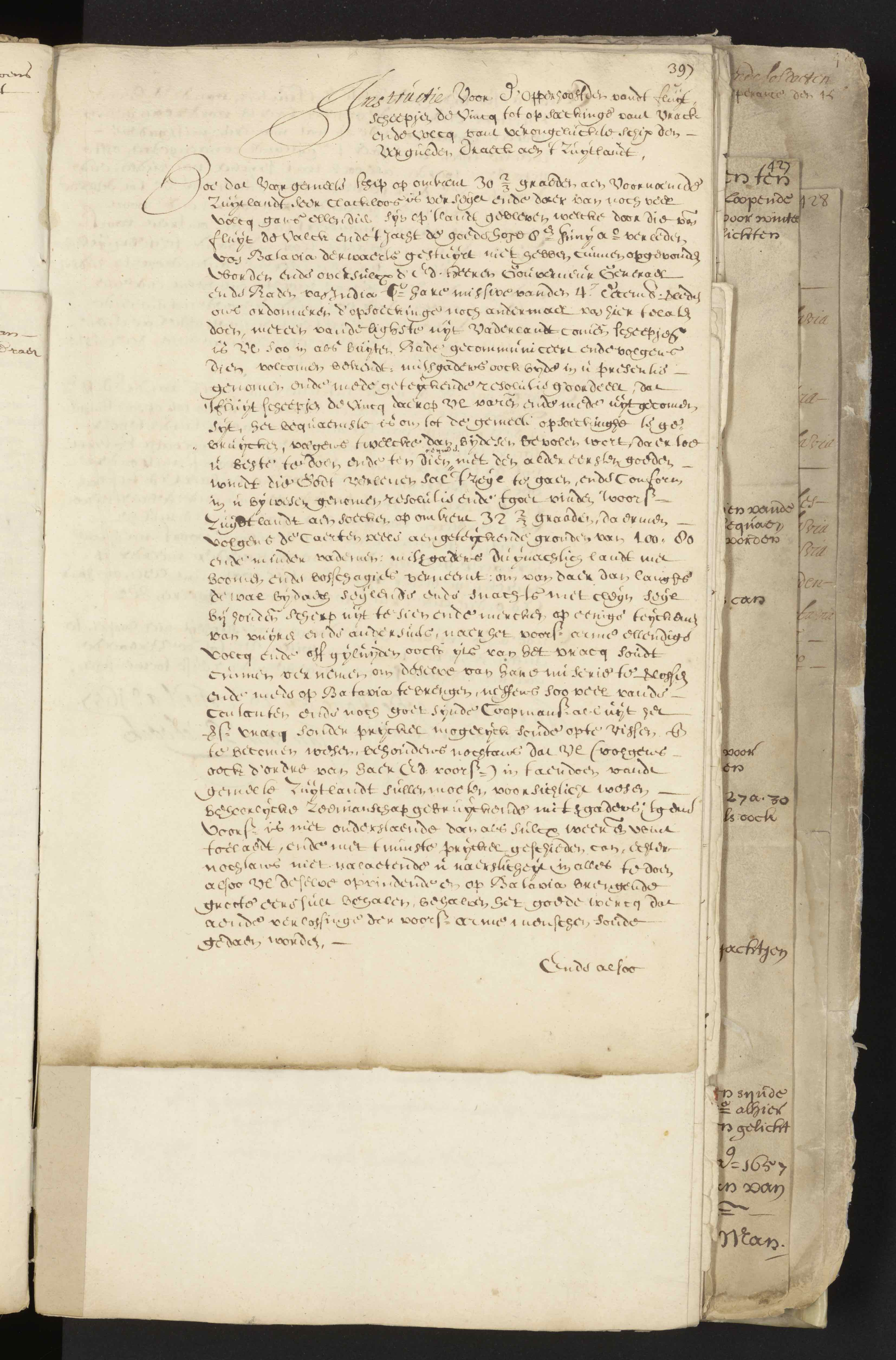
Letter of instruction to the officers on board the fluyt Vink from the Commander Jan van Riebeeck at the Cape of Good Hope, dated 26 April 1657, to look for the survivors of Vergulde Draeck and salvage as much cargo as possible without risk.
Credit: Nationaal Archief, the Netherlands (NL-HaNA_1.04.02_3991_0847-848).
Follow this link to view the instructions to the officers on board Vink, accompanied by Adriaan de Jong’s transcription and translation.
In December 1657 it was resolved to send two vessels from Batavia to the Southland to search for the wreck and any survivors. The fluit Wakende Boei (also known as Wackende Boey), carrying a crew of 40, was skippered by Samuel Volkersen; and the galjoot Emmeloord, with a crew of 25, had as skipper Aucke Pieters Jonck. Fortunately, the journals of these two skippers have survived.
The first six weeks of the trip went according to the instructions although Volkersen had to wait for the Emmeloord (also known by Emeloort) which was in poor shape and could not sail as close to the wind as the Waekende Boei. On 14 February the Waekende Boei sailed away from the Emmeloord; Jonck believed this was intentional, given the skipper and merchant of the Waekende Boei had earlier complained the Emmeloord was not keeping up. Both ships navigated the coastline independently of one another.
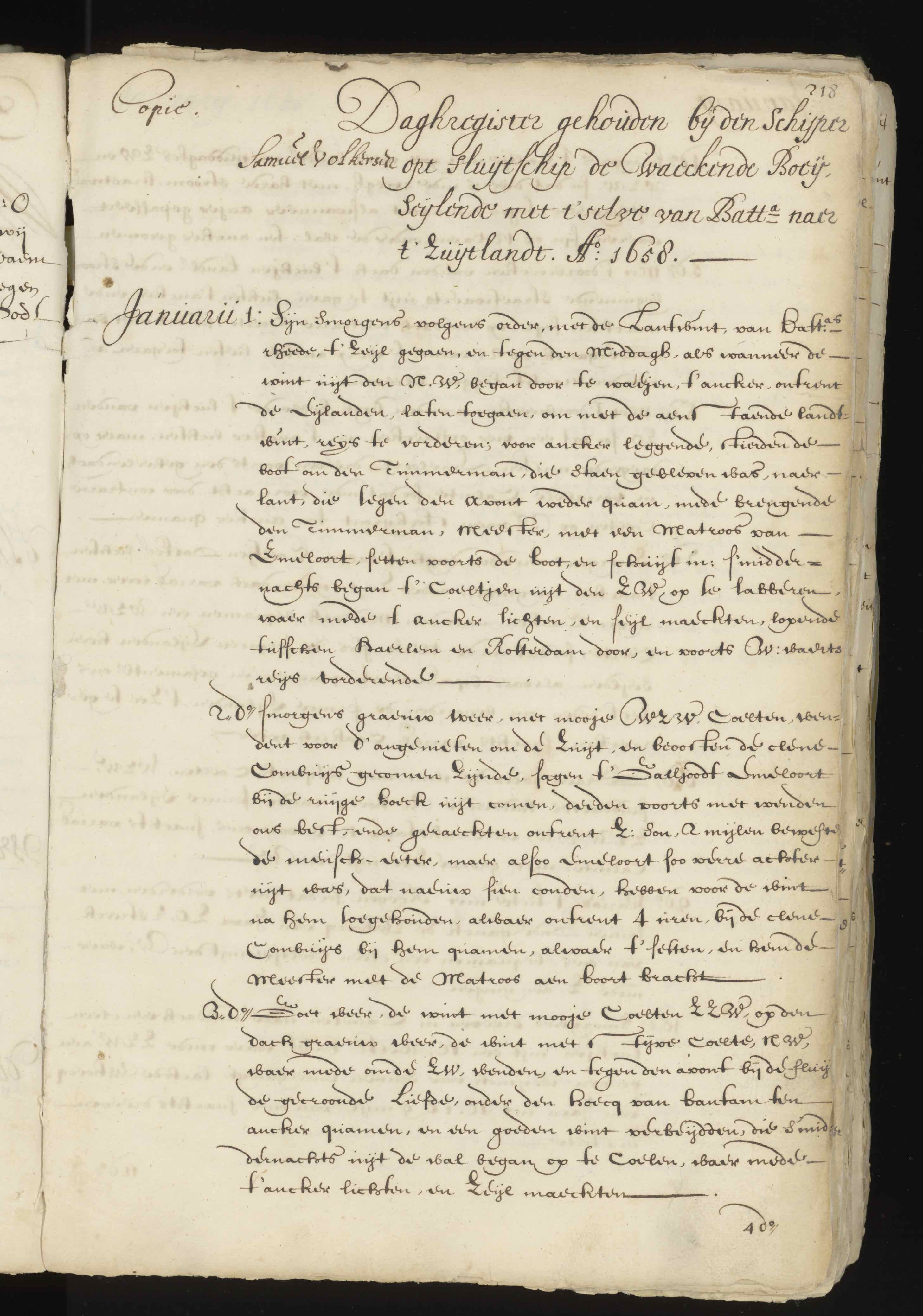
Daily journal by Samuel Volkersen, skipper of Wakende Boei, during the expedition to the south-land with Emmeloord to find any survivors of the wreck Vergulde Draeck, 1 January –10 April 1658.
Credit: Nationaal Archief, the Netherlands (NL-HaNA_1.04.02_1225_0465-488; NL-HaNA_4.VEL_506-508).
Follow this link to view the daily journal by the skipper of Wakende Boei, accompanied by Adriaan de Jong’s transcription and translation.
On 24 February Volkersen’s uppersteersman Abraham Leeman went ashore on the mainland and reported finding remains of the Vergulde Draeck. This was the first of several visits to the mainland, many proving very dangerous due to strong winds. They found some wreckage but no sign of survivors.
On 22 March Leeman was sent ashore and found more wreckage, he returned to the ship due to imminent poor weather but was ordered ashore a second time. When the weather hit Volkersen had to stand out to sea and only six days later did he manage to get back to the same place. Not seeing the boat, his presumed it was destroyed. Although he spotted a fire that night and thought it may have been ‘people of the Draeck or Hoop’ the ship could not find safe anchorage amongst the coral, nor did it have a boat, and so when the wind carried the ship north they chose to continue on to Java.
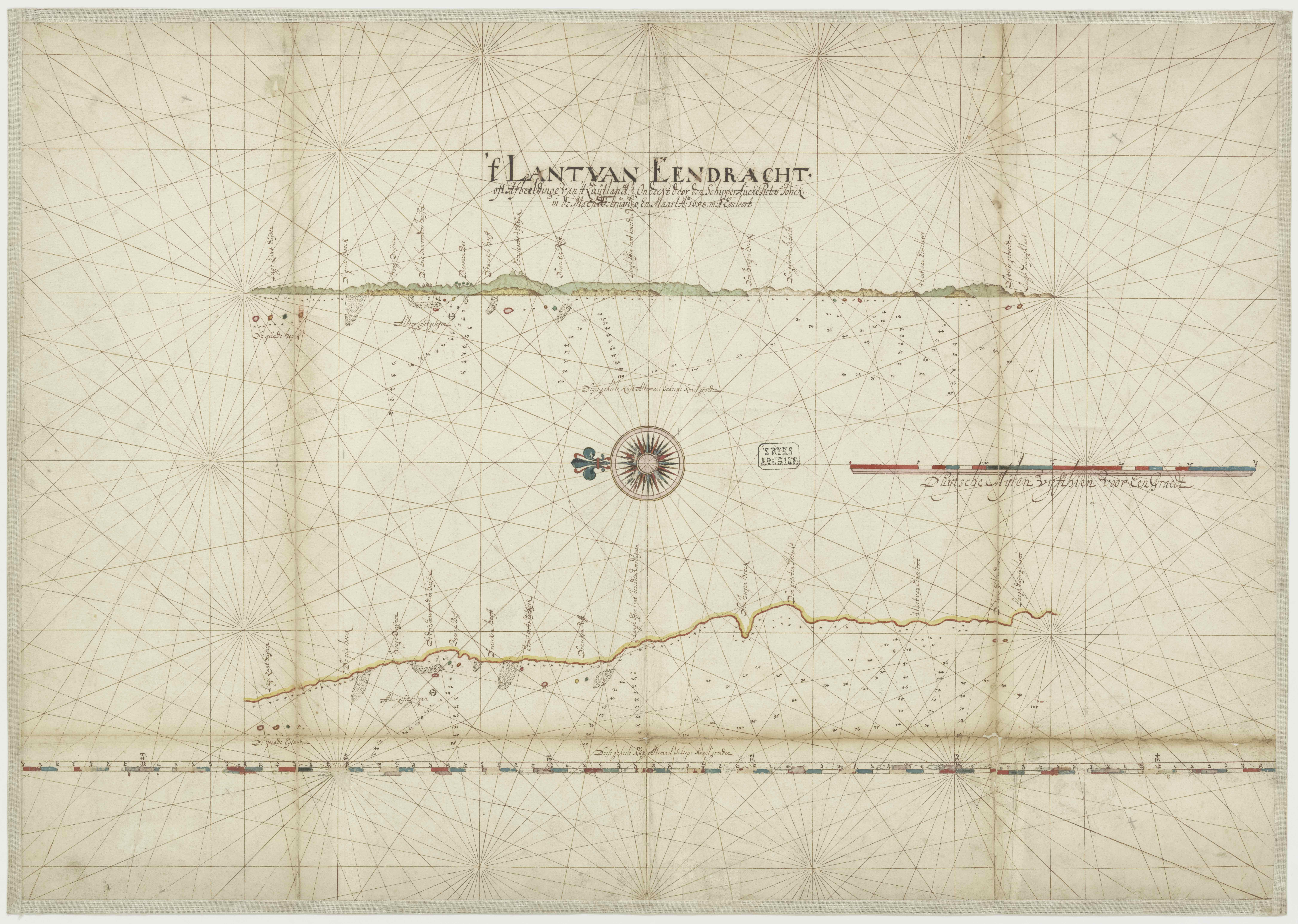
Daily journal by Aucke Pieters Jonck, skipper of Emmeloord, during the expedition to the south-land with Wakende Boei to find any survivors of the wreck Vergulde Draeck, 1 January – 19 April 1658.
Credit: Nationaal Archief, the Netherlands (NL-HaNA_1.04.02_1225_0437-464, NL-HaNA_4.VEL_503-505).
Follow this link to view the daily journal by the skipper of Emmeloord, accompanied by Adriaan de Jong’s transcription and translation.
On 25 February Emmeloord sighted the Southland in 32° 50′ S. On 10 March a boat was sent ashore to investigate smoke spotted the day before, hoping it was set by survivors. They noted both cultivated and uncultivated land. The journal describes encounters with first nations people. Jonck seems to have only sent a boat ashore twice.
Both Volkersen and Jonck produced detailed charts of the coastline, although Jonck missed an island that Volkersen sighted on 23 February but declined to name, it is now known as Rottnest Island. Three charts from the expedition are included with Volkersen’s journal. One large chart runs from about 22° S to 34° S, with sketches showing coastal features and details from Dirk Hartog Island in the north and Rottnest Island in the south. A larger scale chart runs from 29° S to 32° S and shows Turtledove Shoal in the north and Rottnest Island in the south. The Coastal annotations are identical in the two charts.
Jonck’s coastal profiles, whilst detailed are not a chart, and his daily log lacks coordinates. He seems to have been a lesser sailor than Volkersen. His linear coastal landscape, included with the journal, is notable for the illustration of three huts in about 30° 15' S (Jurien Bay area) annotated as
de drie Inwoonders huisen [the three inhabitants’ houses].
This is the first known illustration of Aboriginal people’s buildings by Europeans. The coastal landscape runs from 29° 40' S to 33° 40' S with annotations of the land features. This chart starts at Cape Naturalist, but it does not show Rottnest.
The separated ships reunited on 14 April and arrived together in Batavia on 19 April, where the Governor General and Councillors resolved that the skippers would be questioned by the Advocaat Fiscaal for disobeying orders to stay together. They left on the coastline Abraham Leeman with thirteen other men.
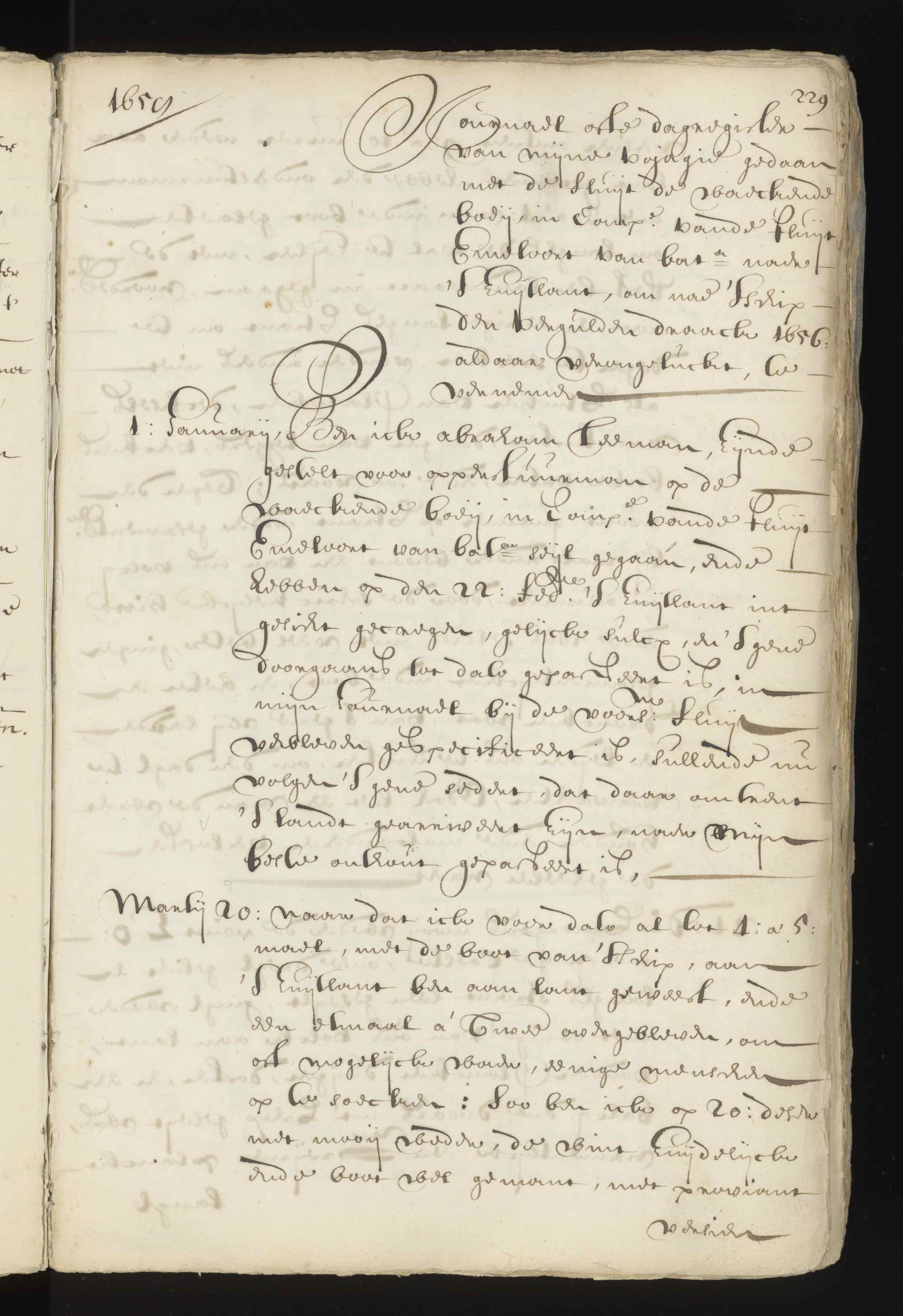
Follow this link to view the daily journal by Abraham Leeman, accompanied by Adriaan de Jong’s translation and transcription.
Abraham Leeman, who accompanied the expedition to the Southland to find the wreck Vergulde Draeck aboard the Waekende Boei was forced to make an epic journey back to Java. His account spans 20 March – 23 September 1628 and was written after he had returned to Batavia and recovered from his ordeal.
Recognising that Volkersen had abandoned them, Leeman and his crew repaired their boat and set sail. Three died on the way, and Leeman lost another seven who went in search of water when the boat arrived on Java’s south coast on 29 April. The next day, Leeman lost his boat, forcing the four men to walk along the coast and through the jungle until they reached the Company lodge in Japara on 23 September.
Last effort
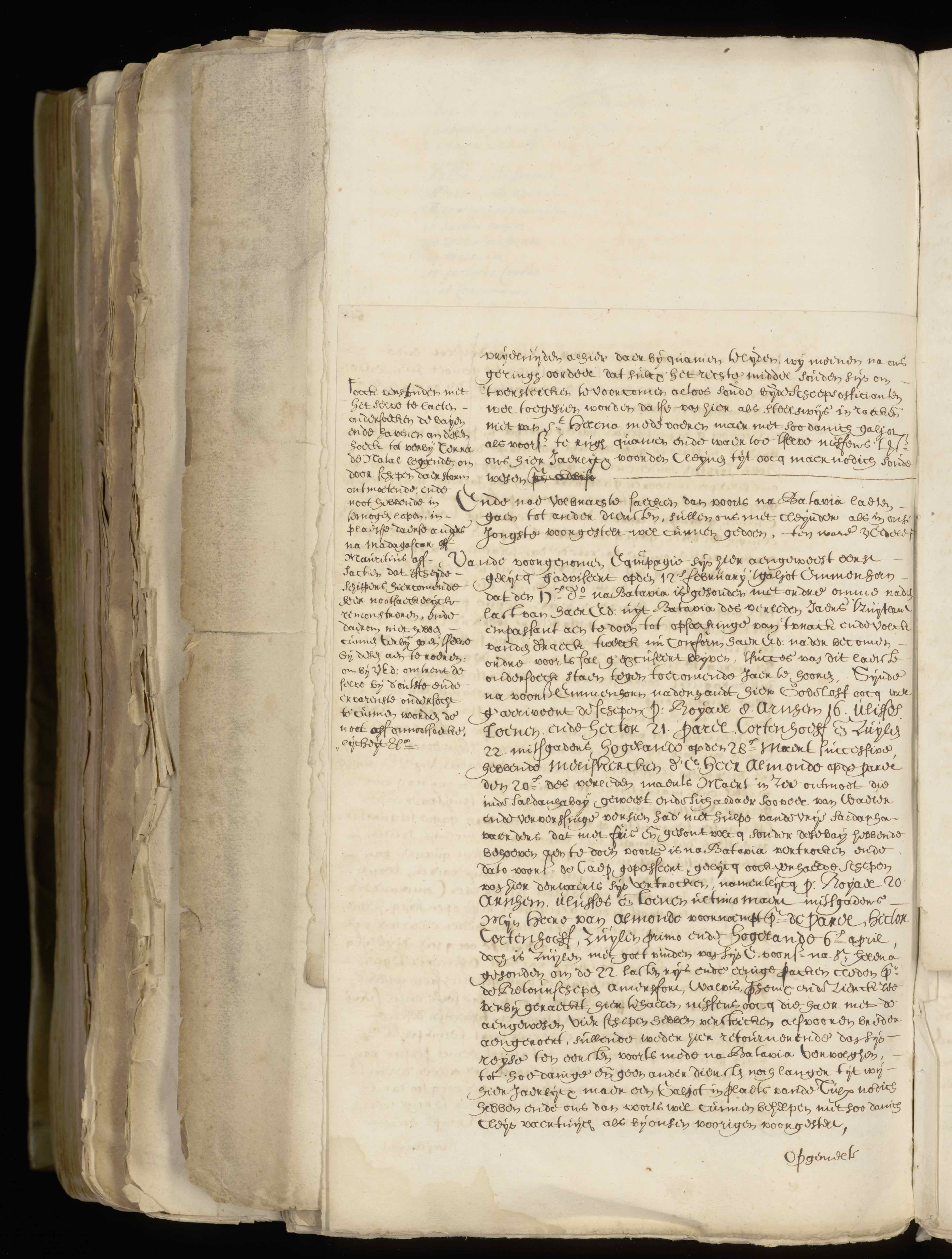
Part of a general missive from General Van Riebeeck to the Heeren XVII dated 26 April 1659, noting the departure of the Immenhorn to Batavia on 17 February.
Credit: Nationaal Archief, the Netherlands (NL-HaNA_1.04.02_3993_1474).
Follow this link to view the note regarding the voyage of Immenhorn, accompanied by Adriaan de Jong’s translation and transcription.
In early 1659 Van Riebeeck dispatched the galjoot Immenhorn (also Emmenhorn) to search the Southland for survivors. Six days after this vessel had left the Cape, a fleet arrived from Batavia instructing Van Riebeeck to abandon further searches. This was the last effort to look for the people and the wreck of Vergulde Draeck. On 21 August 1660, the Heeren XVII wrote to the Governor General and Councillors:
…Now that all missions have been fruitless, we will have to give up, to our distress, the people of the Draeck
Resources
Nationaal Archief, the Netherlands: Series 1.04.02, Inventaris van het archief van de Verenigde Oost-Indische Compagnie (VOC);
—— No. 677: Kopie-resoluties van gouverneur-generaal en raden. 1654 January 20 – 1657 December 28; [Copy resolution of the Governor General and Council of the Indies for Wednesday 7 June 1656]. NL-HaNA_1.04.02_677_0559-561.
—— No. 1225, fols 204-217 [Daily journal by Aucke Pieters Jonck, skipper of Emmeloord, during the expedition to the Southland]. NL-HaNA_1.04.02_1225_0437-464.
—— No. 1225, fols 218-227 [Daily journal by Samuel Volckersen, skipper of Wakende Boei, during the expedition to the Southland]. NL-HaNA_1.04.02_1225_0465-488.
—— No. 1225, fols 229-252 [Daily journal of Abraham Leeman who was stranded with 13 men on the coast of the Southland and returned to Java in a ship’s boat]. NL-HaNA_1.04.02_1225_0489-533.
—— No. 3991, fol. 397 [Letter of instruction to the officers on board the fluyt Vink from the Commander Jan van Riebeeck at the Cape of Good Hope, dated 26 April 1657]. NL-HaNA_1.04.02_3991_0847-848
—— No. 3993, fol. 647 [Part of a general missive from General Van Riebeeck to the Heeren XVII dated 26 April 1659, noting the departure of the Immenhorn to Batavia on 17 February]. NL-HaNA_1.04.02_3993_1474.
Nationaal Archief, the Netherlands: Series 4.VEL Inventaris van de verzameling buitenlandse kaarten Leupe, 1584-1813 (1865);
—— No. 503. Kaart van 't Lant van Eendracht, off afbeeldinge van 't Zuyt-landt, ontdect door den schipper Aucke Pietersz. Jonck in de maendt February en Maert, A. 1658, met Emeloort. NL-HaNA_4.VEL_503.
—— No. 504. Kaart van 't Lant van Eendracht, off afbeeldinge van 't Zuyt-landt, ontdect door den schipper Aucke Pietersz. Jonck in de maendt February en Maert, A. 1658, met Emeloort. NL-HaNA_4.VEL_504.
—— No. 505. Kaart van 't Lant van Eendracht, off afbeeldinge van 't Zuyt-landt, ontdeckt door den schipper Aucke Pietersz. Jonck in de maendt February en Maert, A. 1658, met Emeloort. 1658. NL-HaNA_4.VEL_505.
—— No. 506. Kaart van 't Lant van Eendracht, off afbeeldinge van 't Zuytlandt. Ontdeckt door den schipper Samuel Volckertz, in de maendt Februarie en Maart, A' 1658, met de Wakende Boey. NL-HaNA_4.VEL_506.
—— No. 507. Kaart van 't Lant van Eendracht, off afbeeldinge van 't Zuytlandt. Ontdeckt door den schipper Samuel Volckertz, in de maendt Februarie en Maart, A' 1658, met de Wakende Boey. NL-HaNA_4.VEL_507.
—— No. 508. Kaart van 't Lant van Eendracht, off afbeeldinge van 't Zuytlandt. Ontbreckt door den schipper Samuel Volckertz, in de maendt Februarie en Maart, A' 1658, met de Wakende Boey. NL-HaNA_4.VEL_508
Western Cape Archives; Archives of the Council of Policy. C 1/1/277 [old vol. no. 409, part 2]. Letters Received. 1656 Apr 12 – 1657 Jul 15. No. 126, pp. 57 – 58. (old p.n. 734) [A copy missive of the letters signed 7 May 1656 entreating on behalf of the survivors of the wrecking of Vergulde Draeck for aid to be sent, entrusted to a crew of seven men sent in the ship's schuijt to Batavia]. VOC_C 1/1/277, no. 126:57-58.
Additional reading
Edwards H (1970) The wreck on the Half-Moon Reef, Rigby, Adelaide.
Gerritsen R (2011) Selected Transcriptions, Translations, and Collation of Information for a Textual Analysis Relating to Material Evidence from the Vergulde Draeck and the 68 Missing Crew and Passengers from that Vessel, Reportedly Found on the Coast of Western Australia in the Period 1656 – 1658, Batavia Online Publishing, Canberra.
Green JN (1977) The loss of the Verenigde oostindische compagnie Jacht Vergulde Draeck, Western Australia 1656, BAR Supplementary Series No. 36, British Archaeological Reports, Oxford.
Green JN (1981) ‘The Vergulde Draeck excavation 1981,’ Bulletin of the Australian Institute for Maritime Archaeology 5:46-47.
Green JN (1983) ‘The Vergulde Draeck excavation 1981 and 1983,’ Bulletin of the Australian Institute for Maritime Archaeology 7(2):1-8.
Green JN and Patterson A (2020) Shipwrecks of the Roaring Forties Researching some of Australia’s earliest shipwrecks, UWA Press, Crawley.
De Heer C (1963) ‘My Shield and My Faith’, Westerly 8(1):33–46.
Henderson JA (1985) Marooned: the wreck of the Vergulde Draeck and the abandonment and escape from the southland of Abraham Leeman in 1658, St George Books, Perth.
Jarvis L (31 March 2015) ‘Chasing the Dragon’, North Coast Times, accessed 9 January 2025.
Van Riebeeck J (1954) Journal of Jan van Riebeeck Volume II 1656–1658, Van Riebeeck Society, AA Balkema, Cape Town and Amsterdam.
Sigmond JP and Zuiderbaan LH (1979) Dutch discoveries of Australia: shipwrecks, treasures and early voyages off the west coast, Rigby, Adelaide.
Western Australian Museum (n.d.) ‘Vergulde Draeck (Gilt Dragon), 1656’, Western Australian Museum. Accessed 28 November 2025.