Zeewijk was a VOC retourschip (return-ship) that departed from Middelburg for Batavia on 7 November 1726 with a crew of 208. The skipper was Jan Steijns and the understeersman was Adriaan Van Der Graaf (also Adriaen van der Graeff). The vessel stopped for 24 days at the Cape of Good Hope and departed for Batavia on 19 April 1727 with a crew of 153. On 9 June 1727, the vessel was wrecked on Half Moon Reef in the Pelsaert Group of the Houtman Abrolhos.
At the time of the wreck, there were 137 people on the ship; 82 ultimately survived, arriving at Batavia on 30 April 1728. The ship remained largely intact after striking the reef, to the point that survivors were able to access supplies and some continued to reside in the wreck during their ordeal. Survivors also made their way to a nearby island, now known as Gun Island, where they were able to forage for supplemental food, water, and building materials.
A month after the wreck, in July 1727, the survivors dispatched the ship’s boat in the hope of obtaining help from Batavia. The boat and its crew of 12 were never sighted again. In October 1727, more than four months after the wreck, with the growing realisation that the rescue attempt had failed, the survivors commenced building a new vessel from the wreckage of Zeewijk. The vessel was a type of sloop, the first European vessel built in Australia. They successfully loaded it with salvaged coins, cargo, and supplies and sailed it to Batavia.
Details of the wreck of Zeewijk and the steps survivors took to return to Batavia are recorded in four contemporary journals and five extant maps. The journals include one recorded by the skipper Jan Steijns (from 19 April 1727 at the Cape of Good Hope to 24 August 1729 at Batavia), one original by Adriaan Van Der Graaff and another falsified (for the period 7 November 1726 to 24 August 1729) and a so-called ‘Anonymous Journal’ (for the period 9 June 1727 to 24 August 1729).
On the sloop’s eventual arrival at Batavia, the journals and charts of Steijns and Van Der Graaff were examined as evidence in an inquiry into the loss of the vessel. This examination recognised that Steijns had falsified one of the journals. Steijns was convicted of gross negligence in the loss of the ship and was sent home in 1729.
The fourth ‘Anonymous Journal’, which included a map, was found in the 19th century in the Bibliothèque Royale de Belgique, Brussels. It was part of a collection of manuscripts most probably gathered or written by the VOC Skipper Wouter Thomasz Van Dijk, in the period between 1704 and 1734. It would seem that the author must have obtained access to the Zeewijk journals as the journal closely follows the accounts of both Steijns and Graeff. The author also had a notably different handwriting style from the VOC secretaries’ transcription, which is evident in the other journals held in the Nationaal Archief, the Netherlands.
The Maritime Journals Archives Project, undertaken by Jeremy Green and Adriaan de Jong, includes several of these journals that refer to the events surrounding the wreck of Zeewijk (1727). Here you will find an introduction to what each of these documents are, and links to access and read the material for yourself.
Jan Steijns Journal
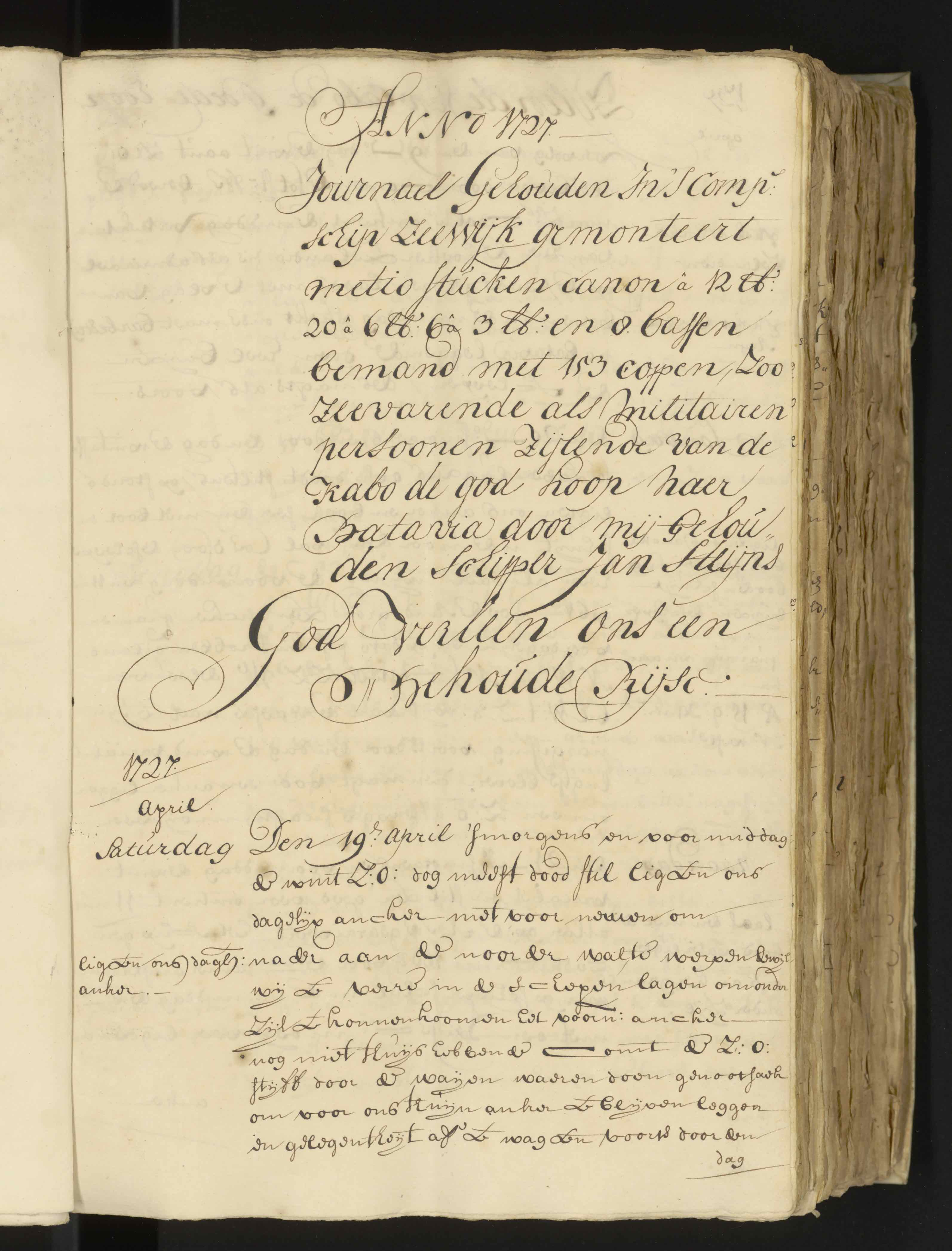
Follow this link to view Jan Steijns journal 19 April 1727 – 30 April 1728, accompanied by Adriaan de Jong’s transcription and translation.
The journal of the skipper Jan Steijns is held in two separate sections in the Nationaal Archief, the Netherlands. The first section (NL-HaNA_1.04.02_9353_0587-628) covers the journey from the Cape of Good Hope to the Western Australian coast (19 April – 9 June 1727), and the voyage in the Sloop from Gun Island to Batavia (26 March – 30 April 1728). The second section (NL-HaNA_1.04.02_9353_0667-741) covers the event of the wreck, and time on the reef and islands of the Houtman Abrolhos (10 June 1727 – 26 March 1728). This document was presented as evidence during the 1728-29 trial where he was prosecuted for the loss of Zeewijk and the falsification of records.
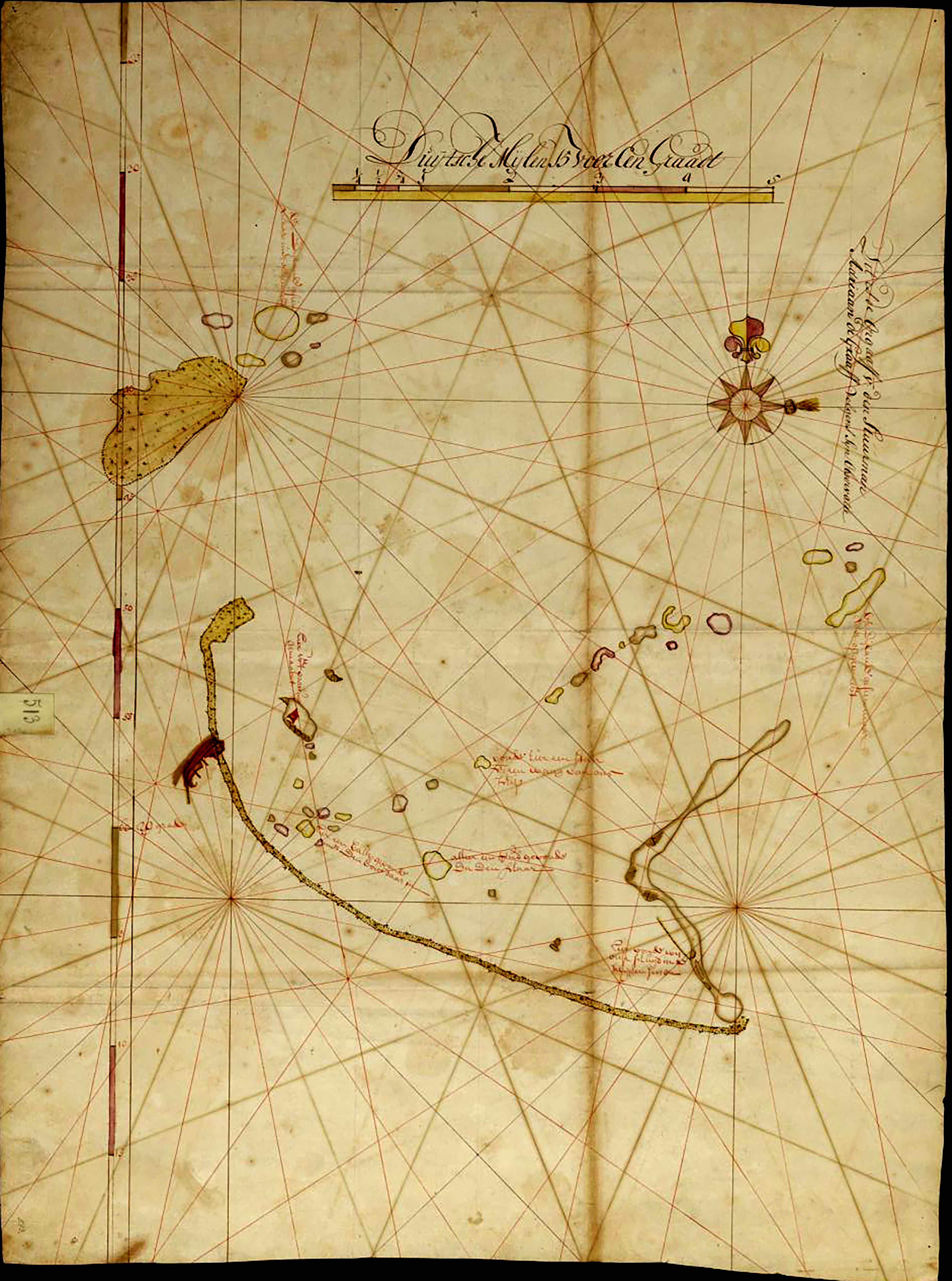
Included at the end of Jan Steijns journal in the Archive Project is two versions of a map produced of the southern group of the Houtman Abrolhos where Zeewijk was wrecked, as observed by Jan Steijns (NL-HaNA_4. VEL.512, 512A).
Adriaan Van Der Graaf’s Journal
Follow this link to view the Journal of Adriaan Van Der Graaf, accompanied by Adriaan de Jong’s transcription and translation.
A copy of the day journal kept on the ship Zeewijk by under-steersman Adriaan Van Der Graaff, copied and signed 9 September 1729. This journal is separated into five parts:
- ‘Sailing from Patria to the Cape of Good Hope’, 7 November 1726 – 26 March 1727 (NL-HaNA_1.04.02_11417_0008-88)
- ‘Lying at the Roads of the Cape of Good Hope’, 26 March – 21 April 1727 (NL-HaNA_1.04.02_11417_0088-95)
- ‘Sailing from the Cape of Good Hope to Batavia’, 21 April – 9 June 1727 (NL-HaNA_1.04.02_11417_0095–128)
- ‘On the wreck and island’, 10 June 1727 – 26 March 1728 (NL-HaNA_1.04.02_11417_0128–297)
- ‘In the yacht’, 27 March – 28 April 1728 (NL-HaNA_1.04.02_11417_0298–330).
The falsified Van Der Graaff journal is an exact copy of this, the original journal, except for minor changes Steijns made to the ship’s position. Consequently, it is not included in the Maritime Journals Archive Project.
Included at the end of Adriaan Van Der Graaf’s journal in the Archive Project is two versions of a map produced of the southern group of the Houtman Abrolhos where Zeewijk was wrecked, recorded by Adriaan Van Der Graaf (NL-HaNA_4. VEL.513, 513A).
The ‘Anonymous Journal’
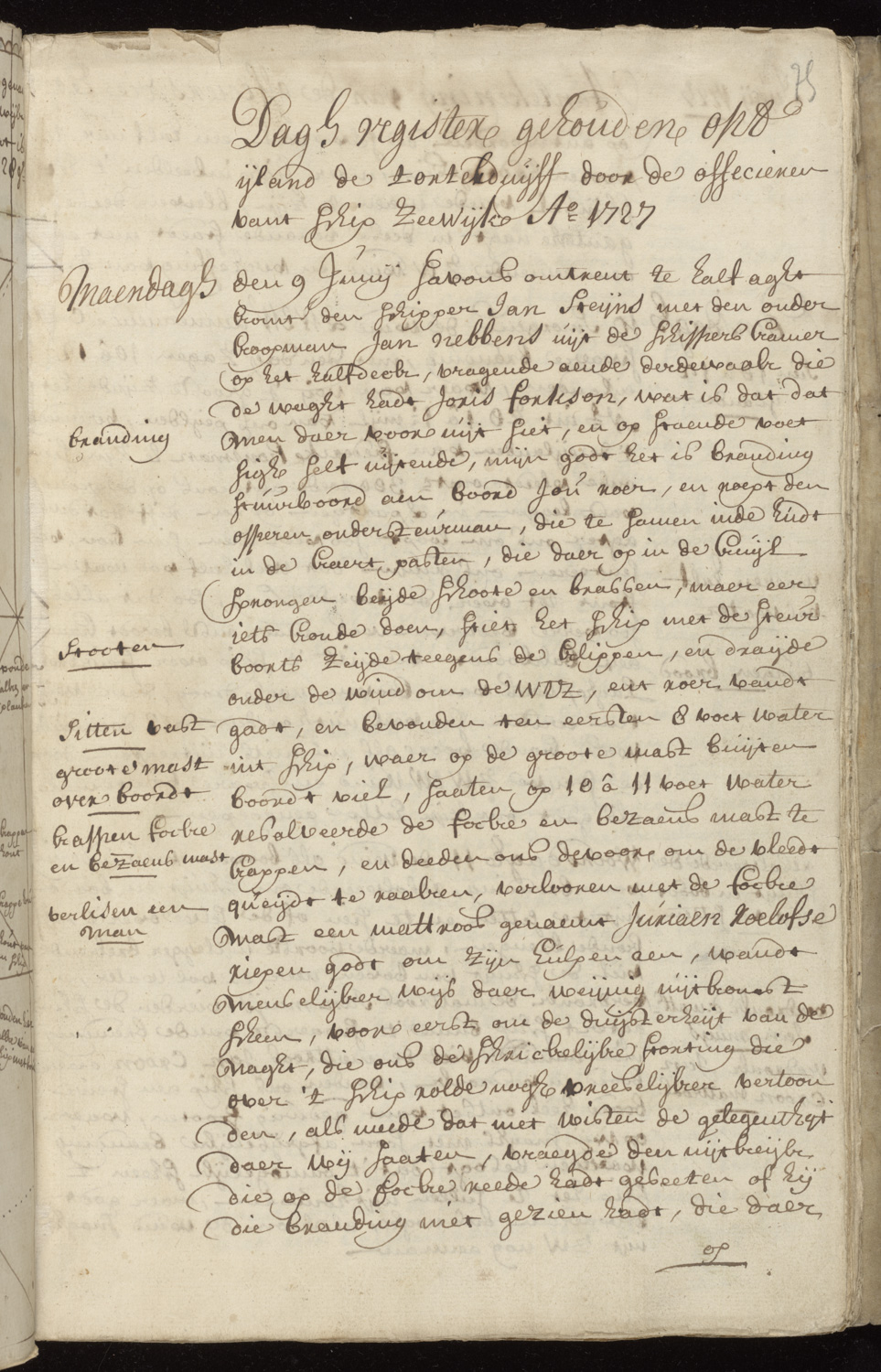
Follow this link to view the ‘Anonymous Journal’, accompanied by Adriaan de Jong’s transcription and translation.
The ‘Anonymous Journal’ was found in the 19th century in the Bibliothèque Royale de Belgique, Brussels (now known as the KBR) and runs for 42 pages.
The journal is part of a collection of manuscripts probably gathered or written by the VOC Skipper Wouter Thomasz Van Dijk, in the period between 1704 and 1734. It also includes a map on the first page. It was probably made separately from the three other journals found in the Nationaal Archief that were involved in the court cases relating to the prosecution of Jan Steijns (Parthesius and CIE 2014:20).
Editor’s note
Both Steijns’s and Van Der Graaff’s journals contain a number of symbols in the marginalia (annotations in the margins) that cannot be properly represented in the transcriptions and translations provided in the Maritime Journals Archives Project interface. We have used text symbols to indicate the written symbols, as follows.
Death symbols


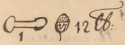
These marginalia symbols represent the death of a person. In the Maritime Journals Archives Project transcriptions and translations, these symbols are represented by a cross: ‘†’.
In Van Der Graaff the death symbol contains a number, which conveys the total number of people who had died on the voyage up to that point. Further information was sometimes provided by the inclusion of other annotations or symbols. In the case of the 27th person to have died (pictured above), a symbol and annotation representing one bar shot of 12 lb was included. This may indicate the weight used in the body bag so that it sank quickly.
Monograms

The monogram MP denotes the observed position where the sun rose at the horizon. In the Maritime Journals Archives Project transcriptions and translations, this is indicated by ‘MP’.

The monogram AP followed by degrees and a compass direction denotes the observed position where the sun set at the horizon. In the Maritime Journals Archives Project transcriptions and translations, this is indicated by ‘AP’.
Resources
Bibliotheque Royale de Belgique (KBR): Beschrijvingh van d'Indische Zee: Ms. II, 2586. Fols 74-96. Dagh register gehouden opt ijland de tortelduijff door de officieren vant schip Zeewijk A°: 1727.
Nationaal Archief, the Netherlands: Series 1.04.02, Inventaris van het archief van de Verenigde Oost-Indische Compagnie (VOC);
—— No. 9353, [547-584] [The falsified journal of the understeersman Adriaan Van Der Graaf, of Zeewijk, presented as evidence during the 1728-29 trial of skipper Jan Steijns]. NL-HaNA_1.04.02_9353_0547-0584.
—— No. 9353, [587-628] [A signed certified copy of the Zeewijk day journal of Jan Steijns for the period up until the point of wrecking (9 June 1727), and the return journey to Batavia (starting 26 March 1728)]. NL-HaNA_1.04.02_9353_0587-628.
—— No. 9353, [667-741] [A signed certified copy of the Zeewijk day journal of Jan Steijns for the period from the point of wrecking (9 June 1727) to their departure from the Houtman Abrolhos (until 25 March 1728)]. NL-HaNA_1.04.02_9353_0667-741.
—— No. 11417. Kopie-journaal gehouden op het schip Zeewijk tijdens de reis van de Republiek naar Batavia, met het relaas van de schipbreuk bij het onbekende Zuidland 1726 nov. 7–1728 apr. 28. NL-HaNA_1.04.02_11417.
Nationaal Archief, the Netherlands: Series 4.VEL Inventaris van de verzameling buitenlandse kaarten Leupe, 1584-1813 (1865);
—— No. 512, 512A, Kaart van de droogtens en Eylanden all waar het schip Zeewyk opgebleven is. A. 1727. (Dit is den Opgaaft can de Schipper Jan Stijns volgens Sijn Observatie). NL-HaNA_4.VEL.512, 512A.
—— No. 513, 513A, Kaart van de droogtens en Eylanden all waar het schip Zeewyk opgebleven is. 1727. (Dit is d'Opgaaft van de Stuurman Adriaan d' Graaff volgend Sijn Observatie). NL-HaNA_4.VEL.513, 513A.
Additional reading
Ariese C (1993) Databases of the people aboard the VOC ships Batavia (1629) & Zeewijk (1727): an analysis of the potential for finding the Dutch castaways’ human remains in Australia. Australian National Centre of Excellence for Maritime Archaeology, Special Publication No. 16, Western Australian Museum, Fremantle.
Parthesius R and CIE (Centrum voor Internationale Erfgoedactiviteiten) (2014) Inventory and analyses of archival sources in the Dutch East India Company (VOC) archives in the Netherlands in order to contribute to possible locations and identification of VOC shipwrecks off the Western Australian Coast, Report No. 310, Department of Maritime Archaeology, Western Australian Museum, Perth, with CIE-Centre for International Heritage Activities, Leiden.
Eginton CA-E (2014) Health and Disease on the Dutch High Seas: an analysis of medical supplies from Batavia, Vergulde Draak and Zeewijk, Report No. 109, Department of Maritime Archaeology, Western Australian Museum, Perth.
Green JN (2018) The mystery of the missing VOC shipwreck in the Houtman Abrolhos Islands, Western Australia, Australian National Centre of Excellence for Maritime Archaeology, Special Publication No. 16, Western Australian Museum, Fremantle.
Green JN (2020) ‘The Zeewijk story and the missing second wreck,’ Journal of Maritime Archaeology 15:333–364.
Van Huystee M (1993) Dutch references to the Batavia, Vergulde Draak, Zuiddorp, Zeewijk and other vessels. Report No. 77, Department of Maritime Archaeology, Western Australian Museum, Perth.
Ingelman-Sundberg C (1976) The VOC ship Zeewijk: report on the 1976 survey of the site, Report No. 5, Department of Maritime Archaeology, Western Australian Museum, Perth.
Ingelman-Sundberg C (1977) The VOC Ship Zeewijk Lost in 1727: A Preliminary Report on the 1977 Survey of the Site. Report No. 6, Department of Maritime Archaeology, Western Australian Museum, Perth.
Western Australian Museum (n.d.) ‘Zeewijk’, Roaring 40s, Western Australian Museum. Accessed 28 November 2025.
Western Australian Museum (n.d.) ‘Zeewijk, 1727’, Western Australian Museum. Accessed 28 November 2025.