On 25 May 1622 the English East India Trading Company Ship Trial was wrecked off the coast of Western Australia. This wasn’t known until Captain John Brookes arrived at Batavia in the ship’s skiff on 5 July, followed by the Company factor (Merchant Officer) Bright and 36 other men in the ship’s boat on the 8 July.
The English East India Company headquarters in London kept records of their deliberations in Court Books. These provide the only extant contemporary references to Trial prior to her loss. These include: a note on 10 August 1621 of Brookes’ request for and receipt of an allowance of 13 pounds for his planned travel to Plymouth; a 4 September entry confirming that the ship was seaworthy before it departed for Plymouth; and a note from 7 September recoding the arrival of a letter from Mr Bagg the younger at Plymouth complaining ‘of the fienderies of the men of the Triall [sic]’ who exacted two months’ pay from the reluctant company before quieting down and planning to set off with fair winds (Court Book 580).
The letters from Captain John Brookes and English East India Company factor Thomas Bright provide a much fuller story of the voyage and disaster. These documents are reproduced with transcription and translation as part of the Maritime Journals Archive Project.
The President and Council of the English East India Company (EEIC) in the Indies wrote a (likely misdated) note to the Company of their fear that the ships Trial and Whale may have been lost on the backside (south coast) of Java (the date provided was 11 January 1622 but the ship only left the Cape for Batavia in mid-March).
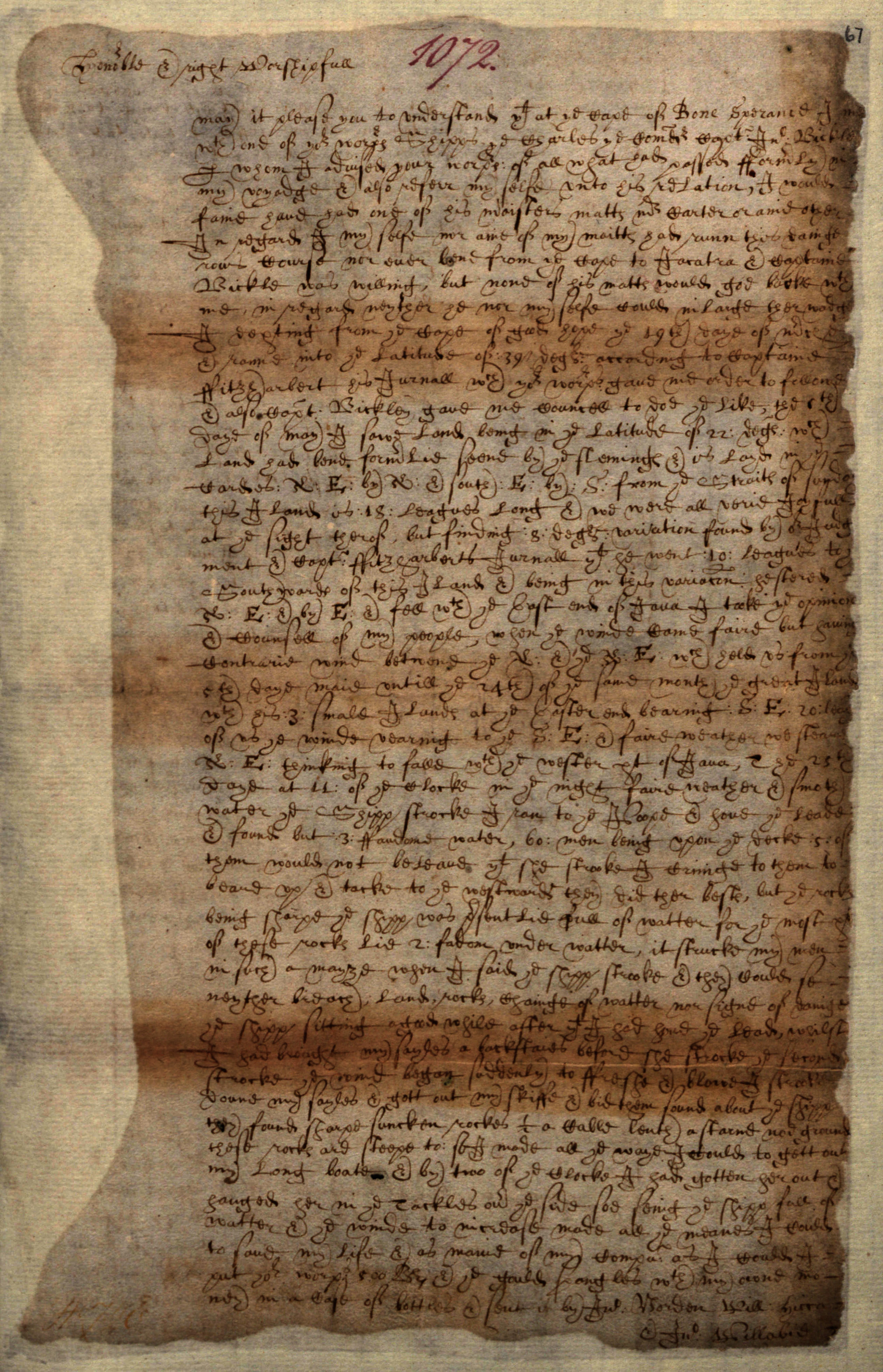
Follow this link to view the two letters that tell Brookes’ account, accompanied by a transcription and translation by Susan Broomhall and Jeremy Green.
Captain John Brookes arrived at Batavia (modern day Jakarta) in a skiff with 9 others to announce the loss of Trial off the Great Southland. Brookes’ own records—using the Julian calendar—dated this arrival 25 June 1622, whereas the Dutch records—using the Gregorian calendar—recorded his arrival as 5 July. From Brookes’ letters we learn that Trial arrived safely at the Cape of Good Hope where they encountered the returning East Indiaman Charles, under the command of Captain Bickle. Brookes asked Captain Bickle’s master mate Mr Carter and others if they would accompany him to the Indies as neither he nor any of his mates had sailed previously from the Cape to Jakarta. Captain Bickle was willing to let any of his mates go, but none volunteered.
Brookes departed from the Cape on 19 March and followed Humfry Fitzherbert’s 1620 Journal (the first English East India Company captain to sail the Brouwer Route). He sailed south to latitude 39° S and then east on that parallel. On 1 May, land was sighted in latitude 22° S which he stated had formerly been sighted by the Dutch.
From 5 May, Trial experienced north easterly winds that prevented Brookes from heading onward to Java. On 24 May he sighted land, but on the next day at 11 o’clock at night, Trial struck a reef off the Montebello Islands. In the debacle that followed, Brookes climbed down a rope out of the poop into the skiff at 3am, an hour later the boat got off the reef but by 4.30am the fore-part of the ship had broken up. Of a total of 139 people, ten, including Brookes, evacuated in the skiff, and 36 in the long boat. (It appears four had already died on the way out since the ship had departed with 143 men. Variables created by births and deaths during voyages can make numbers difficult to determine with certainty. The VOC records state that there were 141 on board.) Brookes indicated that he visited the nearby islands. There are several references to Brookes’ charts being sent home but, unfortunately, they appear to have been lost.
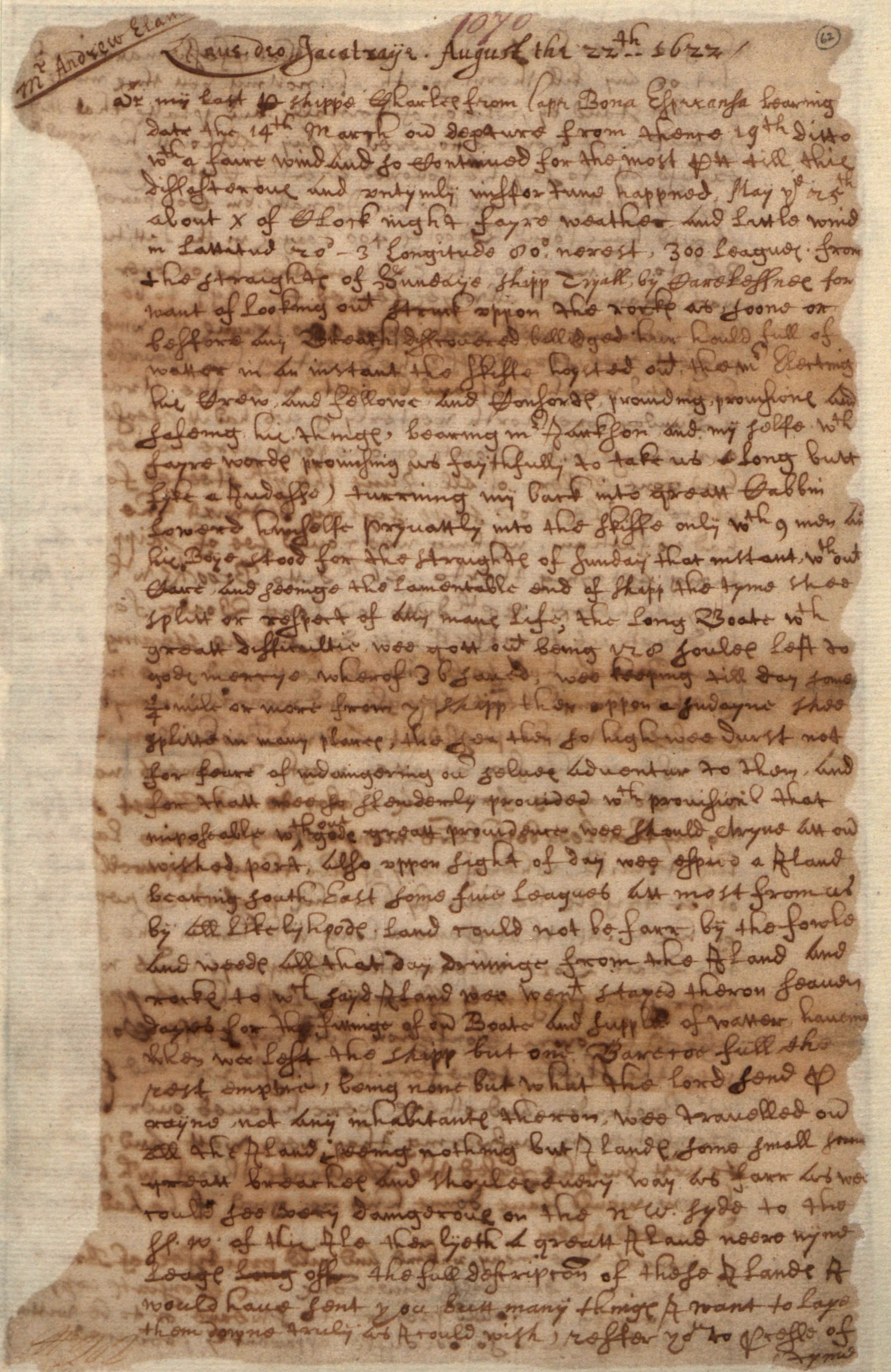
Follow this link to view Bright’s account, accompanied by a transcription and translation by Susan Broomhall and Jeremy Green.
A witness to the events, Trial’s factor Thomas Bright, believed Brookes was guilty of negligence, and held him responsible for the catastrophe. In a letter to Andrew Ellam, Bright gave his account of the loss of Trial, stating it was due to Brookes’ carelessness, for want of looking out and he accused Brookes of leaving him with the ship’s boat to rescue the remaining crew. Bright also visited the nearby Montebello Islands. They spent some time there because on 11 June he returned to the wreck site but no evidence of the ship remained. Bright also accused Brookes of falsifying his account of the voyage stating he (Brookes):
…would excuse itt [the loss] to say he followed directly captin Humphrie Fitze Harbotte Jornall, had our Jornalls bin compared wth. his he should have found Broocks 400 leagues in the Lattitude of 38° to 34° more to the Eastward then he or ever shippe was againe, wee allwayes feared the shipp to be beyound his recknoing well-nigh uppon 450 leagues.
It was obvious that some form of falsification occurred because Bright states that Brookes claimed he sailed NE and NE by E for the Sunda Strait but were in fact, according to Bright, NW. This was the beginning of the problem of finding Trial Rocks (the location where the ship wrecked) because Brooke claimed the site was to the west of the Sunda Strait. In Bright’s meandering letter, he also claimed Brookes either stole or lost the Companies’ money and spangles destined for the King of Siam (modern day Thailand).
Resources
The British Library; IOR/E/3/9, India Office Records, East India Company Original Correspondence;
—— ff 62-63, [Thomas Bright?] at Jakatra to Andrew Ellam in London, 22 August 1622.
—— ff 67-68, John Brook at Jakatra to the East India Company in London, 25 August 1622.
—— ff 181-182, John Brook at Jakatra to the East India Company in London, 8 February 1623.
Additional reading
Green JN (1977) Australia’s Oldest Wreck: the historical background and archaeological analysis of the wreck of the English East India Company’s ship Trial, lost off the coast of Western Australia in 1622, BAR Supplementary Series No. 27, British Archaeological Reports, Oxford.
Western Australian Museum (n.d.) ‘Trial, 1622’, Western Australian Museum. Accessed 28 November 2025.
Western Australian Museum (n.d.) ‘Trial’, Roaring 40s, Western Australian Museum. Accessed 28 November 2025.