In 1696 the VOC commissioned an expedition of exploration under the command of Willem de Vlamingh, who sailed in the Geelvink, with Gerrit Colaert skipper of the hooker Nijptangh, and Laurens Teunisz Zeeman (later Cornelis De Vlamingh) skipper of the galliot Wezeltje. The three ships departed Texel 3 May 1696 and arrived Batavia 20 March 1697. De Vlamingh was instructed to investigate the largely unknown ‘Land of Eendracht’ (Australia) and to investigate the fate of Ridderschap van Holland that had disappeared after leaving the Cape of Good Hope in 1694.
The Maritime Journals Archives Project includes journals associated with each of the ships involved in the expedition, as well as the pewter plate erected at Cape Inscription by De Vlamingh on 3 February 1697. Here you will find an introduction to each of these documents.
The Geelvink Journal
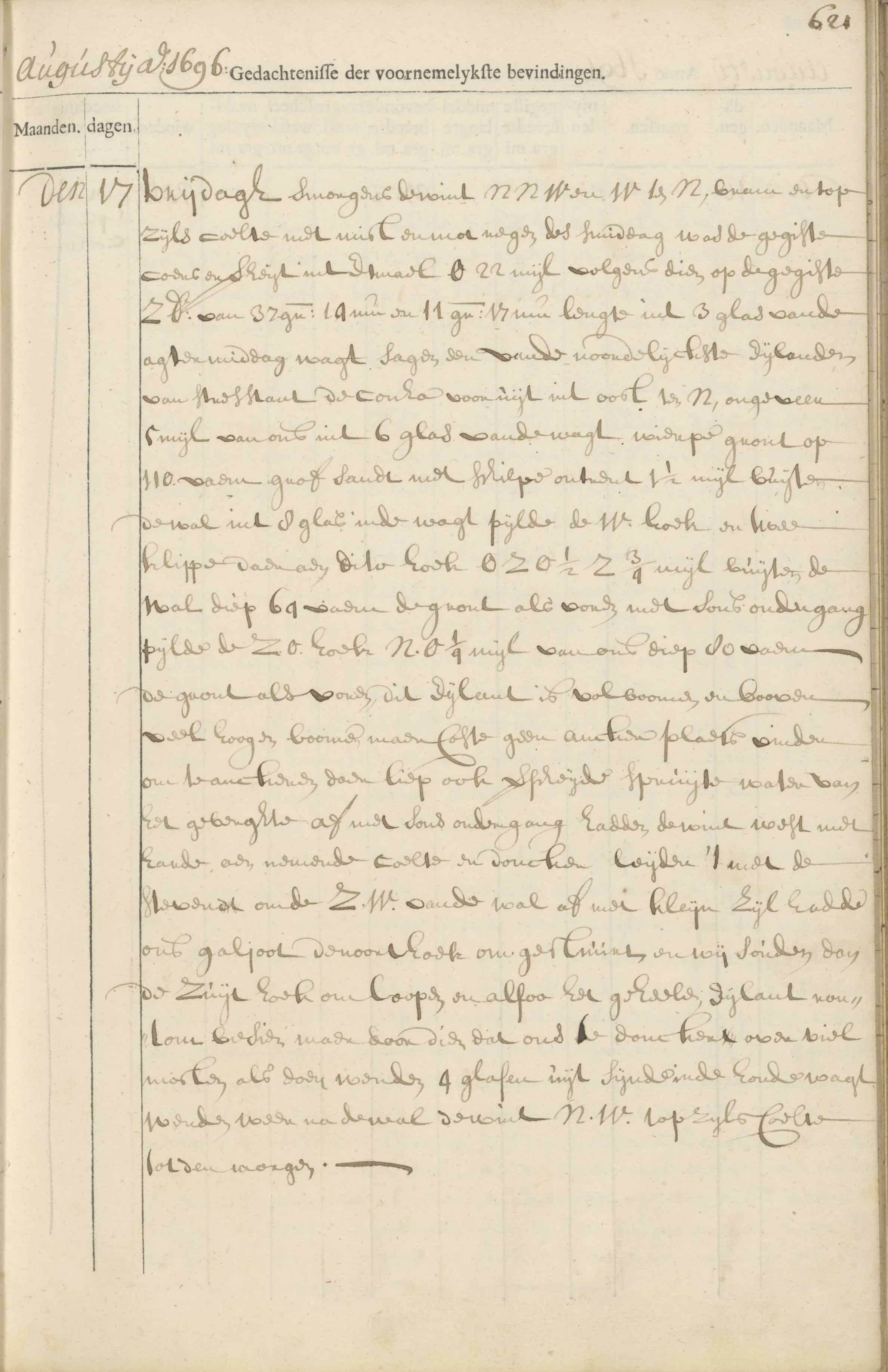
Follow this link to view the journal of Willem De Vlamingh on board Geelvink, 3 May 1696 – 20 March 1697, accompanied by Günter Schilder’s (1985) transcription and translation.
There are two versions of Willem De Vlamingh’s Geelvink journal. The one reproduced here covers the journey starting in Texel 3 May 1696 and ending in Batavia 20 March 1697 (NL-HaNA_1.04.02_1587_0645–0712). It consists of a double-page pre-printed log where the entries for date, course, milen (progress in Dutch miles), latitude, wind and nature of the weather are entered on the left-hand page, and the more detailed notes of his experiences are written on the right-hand side. The pages reproduced in the Maritime Journals Archives Project enter the voyage from 17 August at Tristan da Cunha, a group of islands in the South Atlantic Ocean, and only the right-hand pages are included.
Another version (yet to be incorporated in the Project) is a hand-written journal starting at Texel and ending 7 September 1696 at the Cape of Good Hope (NL-HaNA_1.04.02_5060).
The Nijptang journals
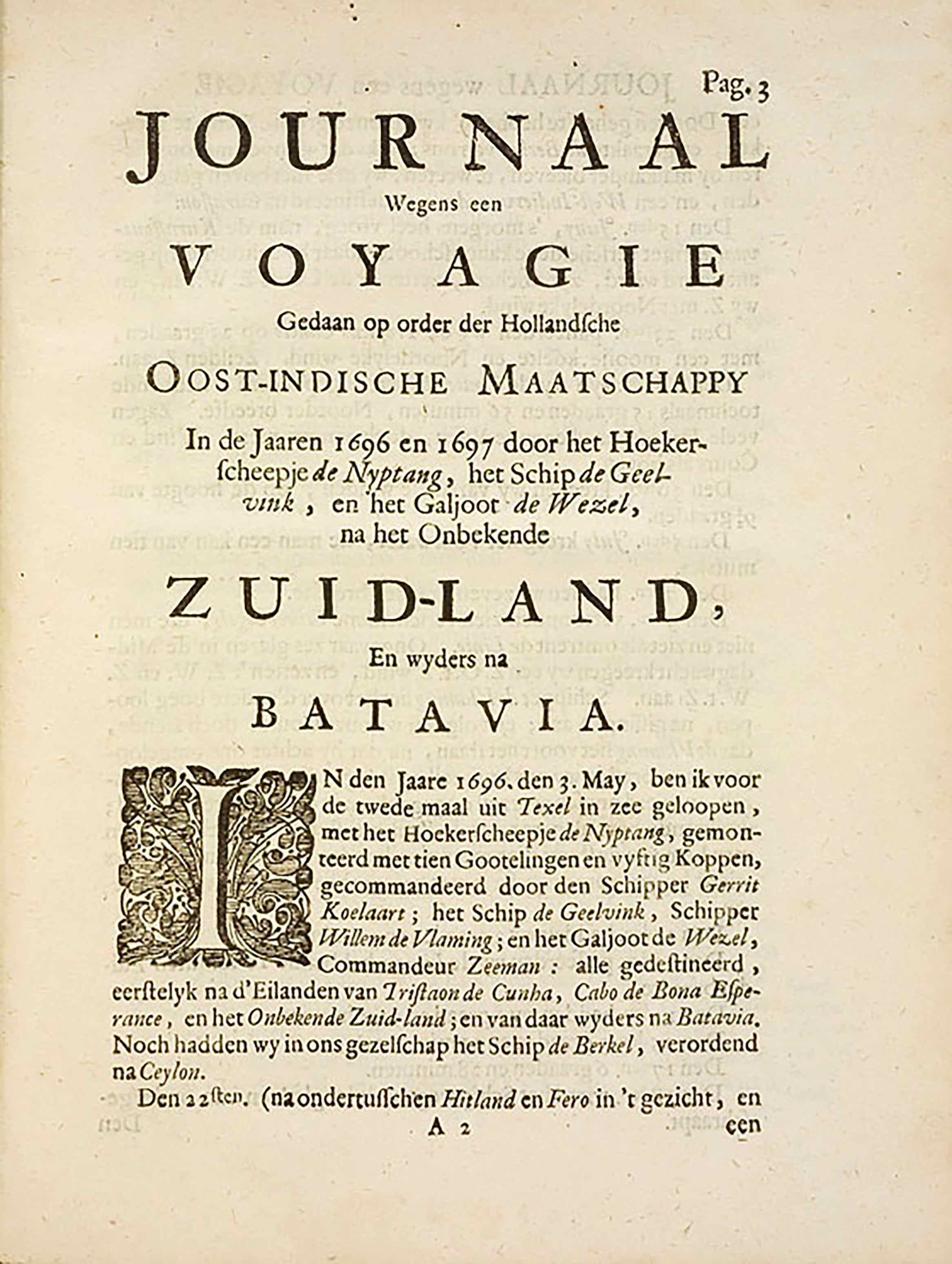
Credit: Journaal wegens een voyagie, gedaan op order der Hollandsche Oost-Indische Maatschappy in de jaaren 1696 en 1697 door het hoekerscheepje de Nyptang, ... (1701). State Library of Western Australia (SLWA_O04981).
Follow this link to view the published account attributed to Nijptang’s upper-surgeon Mandrop Torst, accompanied by Jeremy Green’s transcription and translation.
There are two different journals relating to the voyage of Nijptang. The fullest is not from the archives, but is a printed publication attributed to the upper-surgeon Mandrop Torst (Journaal wegens een voyagie… 1701). The journal starts on departure from Texel on 3 May 1696, where he refers to putting to sea for the second time, and finishes in Batavia on 17 March 1697. Nijptang ran aground on the Pampus, a sandbar just outside Amsterdam, which had delayed the fleet’s departure.
The other journal is by the skipper of Nijptangh, Gerrit Collaert, whose hand-written journal only runs from their departure from Texel on 20 April 1696 to their arrival at the Cape of Good Hope, 14 August (NL-HaNA_1.04.02_5062). The transcription and translation of this journal has not yet been completed.
The Wezeltje (Weesseltjee) Journal
There are two Wezeltje journals; unfortunately neither refer to De Vlamingh’s exploration of the Western Australian coast. The first has the same basic layout as the printed Geelvink journal (above). It runs from 3 May when the ship departed Texel to 7 September 1696 when it arrived at the Cape of Good Hope (NL-HaNA_1.04.02_5064 – not currently added to Maritime Journals Archive Project).
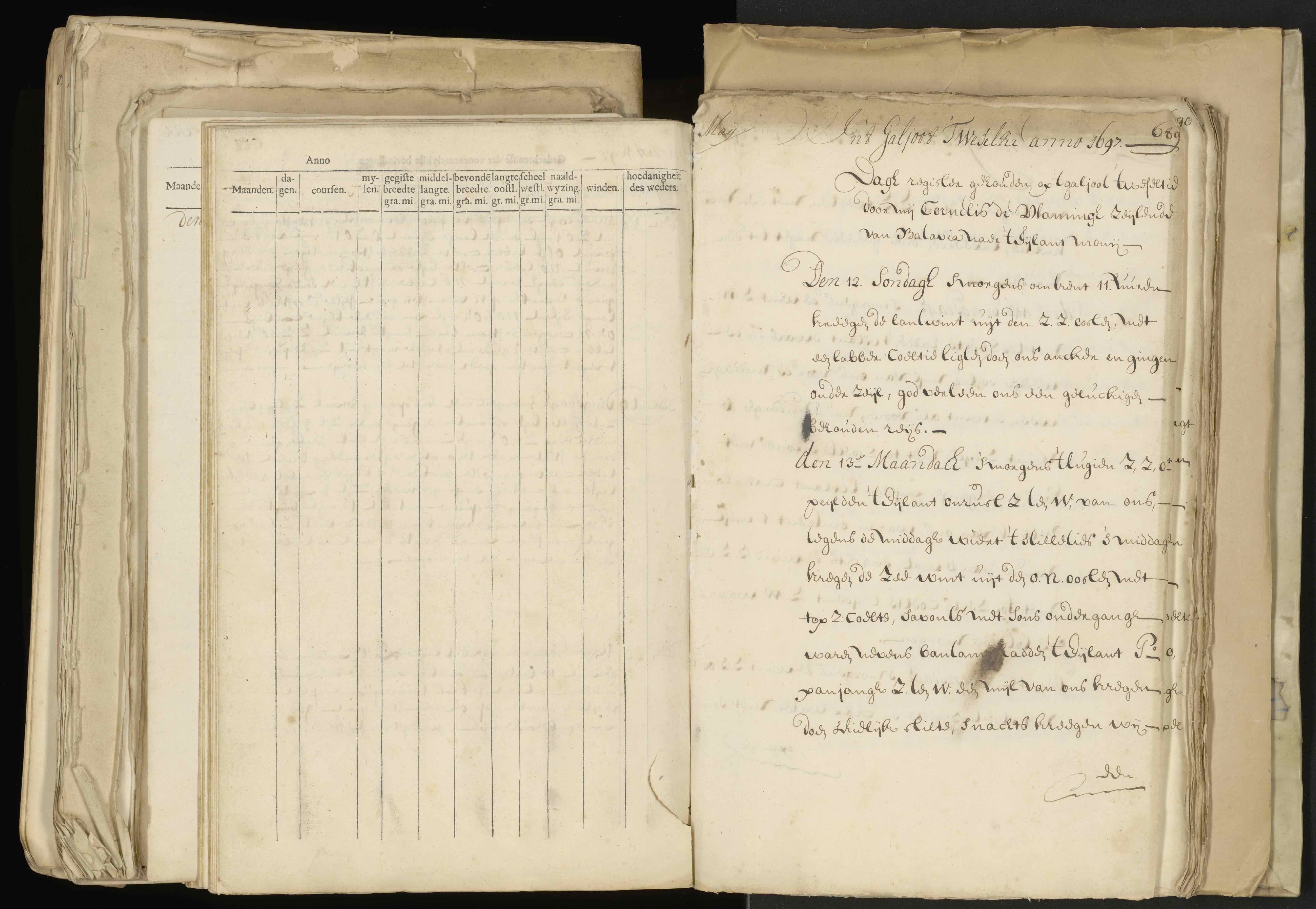
‘1697 Wezeltje C. De Vlamingh’
Follow this link to view the Wezeltje journal by Cornelis De Vlamingh, 12 May – 17 June 1697 (transcription and translation not yet available).
The other is a journal by Cornelis De Vlamingh, starting 12 May 1697 and concludes 17 June (NL-HaNA_1.04.02_1587_0713–728). It recounts the expedition’s arrival at Batavia, and a subsequent voyage for the purpose of mapping the Island Monij (today known as Christmas Island).
The Vlamingh Plate
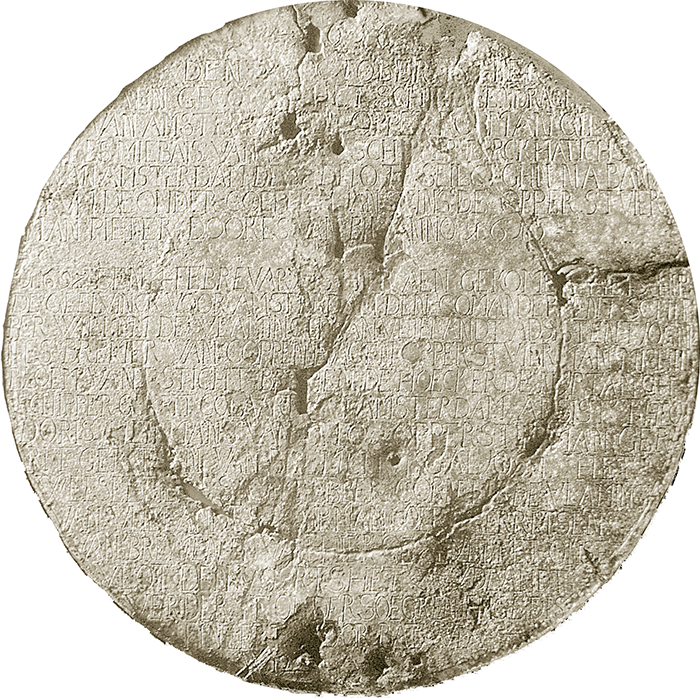
Follow this link to view the De Vlamingh Plate, with transcription and translation.
The story of the De Vlamingh Plate is of great interest. De Vlamingh’s journal describes, on 3 February 1698, finding the plate left by Dirk Hartog on an earlier expedition. De Vlamingh had Hartog’s original text copied to a new plate alongside the expedition’s own text. De Vlamingh then erected this in place of the Hartog plate, which he took to Batavia. Hartog’s plate was eventually taken to the Netherlands and is now held by the Rijksmuseum.
One curious point is the #12 at the bottom of the plate. The relevance of this only became apparent when historian Günter Schilder located the 13 pages of Victor Victorsz’s coastal watercolour paintings made during the voyage (held by the Maritiem Museum Rotterdam, K268). Each coastal view was numbered, and number 12 shows:
Dirck Hartoogs reede geseegn op d: SB van 25 gr 24 min d’veshoonde t’ lands aldus, als vanuedr men op des schips reede eeanckert lagen op d’diepte van 18: a 19 vaam Zandt gront ½ mijlvan d’ wal hebbende de West Lorck Letter A int WZW½W d: Oost Loeck letter B: ZOtOt van ons
Dirk Hartog’s roadstead lying S latitude of 25 deg. 24 min. the land shows thus, when you are anchored at the roadstead of same at the depth of 18 to 19 fathoms sandy bottom ½ mijl from the shore, having the west point letter A to WSW½W and the east point letter B, SE by E of us.
Just left of letter A is the text: hier d:tinne schotel gevonden [Here we found the pewter plate] (Schilder 1985:89; Schilder and Kok 2010:138-39).
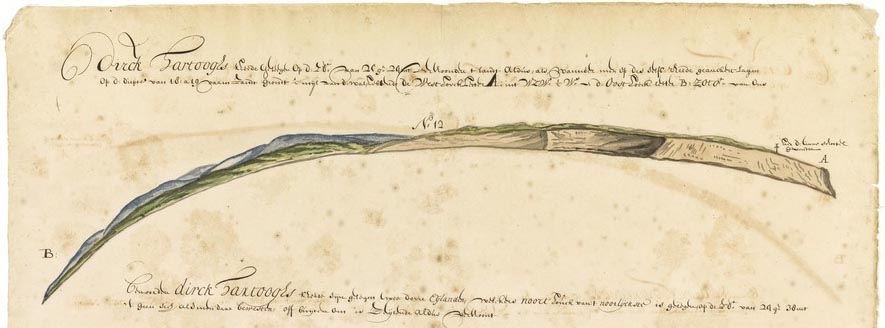
Victor Victorsz’s coastal profile at Dirk Hartog’s roadstead. Note the number ‘12’ (middle), and the annotation recording the location of the pewter plate (just left of the letter ‘A’ on the right).
Credit: Maritiem Museum Rotterdam, Kustprofielen van de Westkust van Australië [Coastal profile of the west coast of Australia] (K268-5).
Resources
Nationaal Archief, the Netherlands: Series 1.04.02, Inventaris van het archief van de Verenigde Oost-Indische Compagnie (VOC);
—— No. 1587, fols 593-688 [A copy of the journal of Willem de Vlamingh on board Geelvink, 3 May 1696 – 20 March 1697]. NL-HaNA_1.04.02_1587_0616-0712.
—— No. 1587, fols 689-707 [Day journal of Cornelis De Vlamingh on board Wezeltje, 12 May – 17 June 1697]. NL-HaNA_1.04.02_1587_0713–728
—— No. 5060, Journaal gehouden op het schip Geelvink door Willem de Vlaminck tijdens de ontdekkingsreis naar het Zuidland, met aantekeningen van opperchirurgijn Gerard Hardenbergh over de ziekte- en sterfgevallen aan boord en de toegediende medicijnen 1696. NL-HaNA_1.04.02_5060.
—— No. 5062, Journaal gehouden op het schip Nijptang door schipper Gerrit Kolaert tijdens de ontdekkingsreis naar het Zuidland, met aantekeningen van opperchirurgijn Th. Heirmans over de ziekte- en sterfgevallen aan boord en de toegediende medicijnen. NL-HaNA_1.04.02_5062
—— No. 5064, Journaal gehouden op het schip Wezeltje door schipper Laurens Zeeman. NL-HaNA_1.04.02_5064.
[Torst M] (1701) Journaal wegens een voyagie, gedaan op order der Hollandsche Oost-Indische Maatschappy in de jaaren 1696 en 1697 door het hoekerscheepje de Nyptang, het schip de Geelvink, en het galjoot de Wezel, na het onbekende Zuid- land, en wyders na Batavia, Willem de Coup, Willem Lamsvelt, Philip Verbeek, en Jan Lamsvelt, Amsterdam. Accessed State Library of Western Australia, SLWA_O04981.
Additional reading
Heeres JE (1899) Het aandeel der Nederlanders in de ontdekking van Australië, 1606-1765 = The Part Borne by the Dutch in the Discovery of Australia, 1606-1765, Luzac, Amsterdam.
Schilder G (1985) Voyage to the Great Southland Willem de Vlamingh 1696-1697, Royal Australian Historical Society, Sydney.
Schilder G and Kok H (2010) Sailing for the East: History and Catalogue of Manuscript Charts on Vellum of the Dutch East India Company (VOC), 1602–1799. Utrecht Studies of the History of Cartography Vol. 10, Hes & De Graaf, Houten.
Western Australian Museum (n.d.) ‘Dirk Hartog’s Pewter Dish: A Maritime Relic’, 1616 Dirk Hartog, accessed 26 November 2025.
Western Australian Museum (n.d.) ‘de Vlamingh Plate’, Western Australian Museum, accessed 26 November 2025.
Western Australian Museum (n.d.) ‘Willem de Vlamingh’, Voyages of Grand Discovery, accessed 26 November 2025.