- references to death, dying, and/or grief.
- references to drug use, alcohol consumption, and/or substance abuse.
- descriptions of physical violence and cruelty.
The Maritime Journals Archives Project, undertaken by Jeremy Green and Adriaan de Jong, includes several documents that refer to the events surrounding the wreck of Batavia (1629), including the journal that Pelsaert kept following the wreck of the ship. Here you will find an introduction to what each of these documents are, as well as an overview of the events leading up to and after the wrecking of Batavia.
Francisco Pelsaert’s journal
Francisco Pelsaert, commander of the Batavia, kept a journal of his voyage from the Netherlands but it was reported to have been thrown overboard by the drunken crew at the time of the shipwreck. From then onwards he kept a new journal, a copy of which has survived. The journal details the wreckage, Palsaert’s journey to Batavia in the ship’s boat, his return to the Houtman Abrolhos in Sardam to discover the aftermath of a deadly mutiny, his consequent trial of ringleaders and the voyage back to Batavia. The manuscript is held in the Nationaal Archief (State archives) in the Netherlands: it is not Pelsaert’s own handwritten journal, but a copy made by the VOC clerks in Batavia.
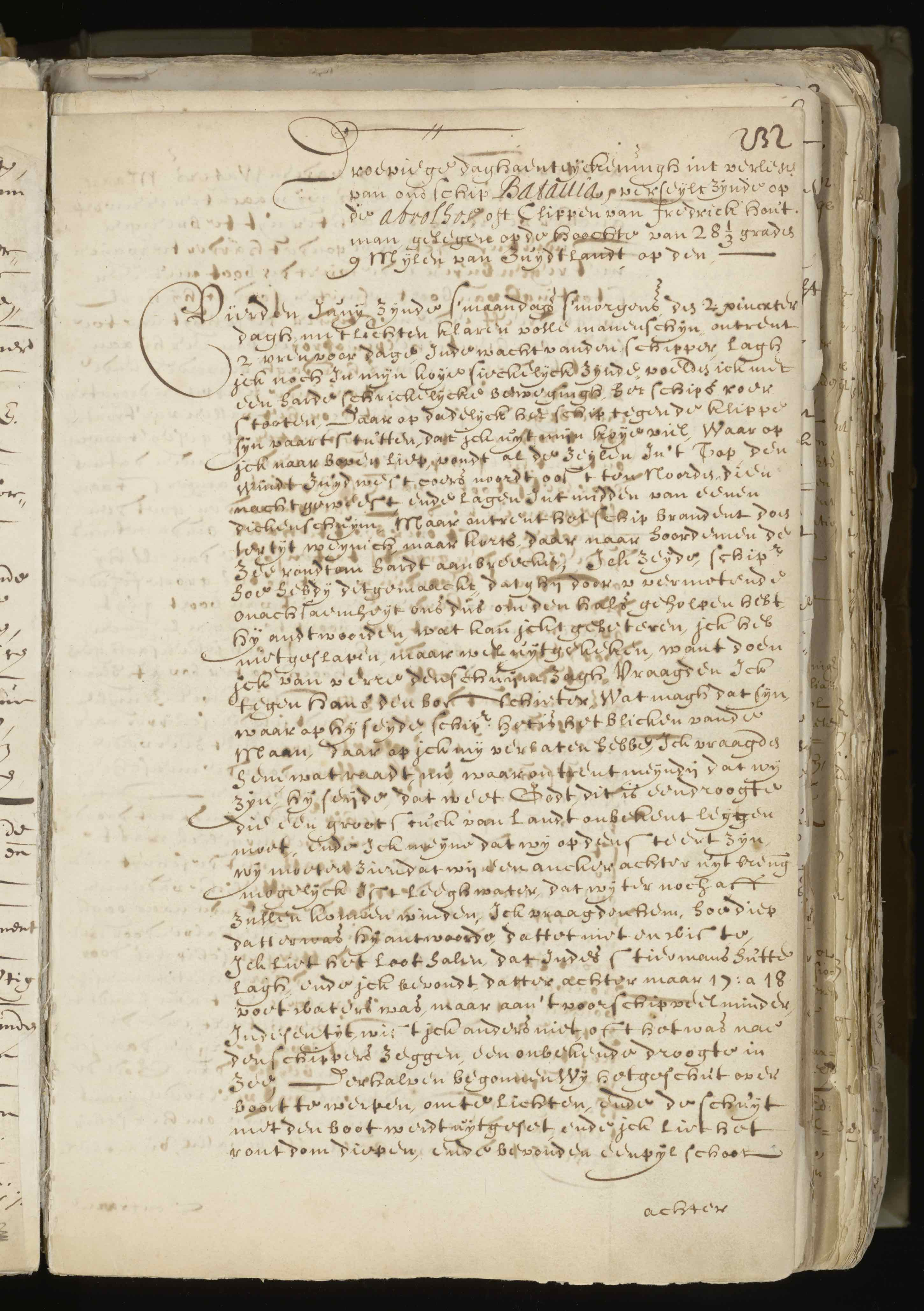
Follow this link to view Francisco Pelsaert’s journal 4 June - 5 December 1629, accompanied by Adriaan de Jong’s transcription and translation.
Francisco Pelsaert’s letters
Pelsaert wrote two letters after his return to Batavia: one outlining to the Governor General and Council of the VOC the events that took place, and another answering the questions of the Advocate Fiscal (akin to a prosecutor) in Batavia.
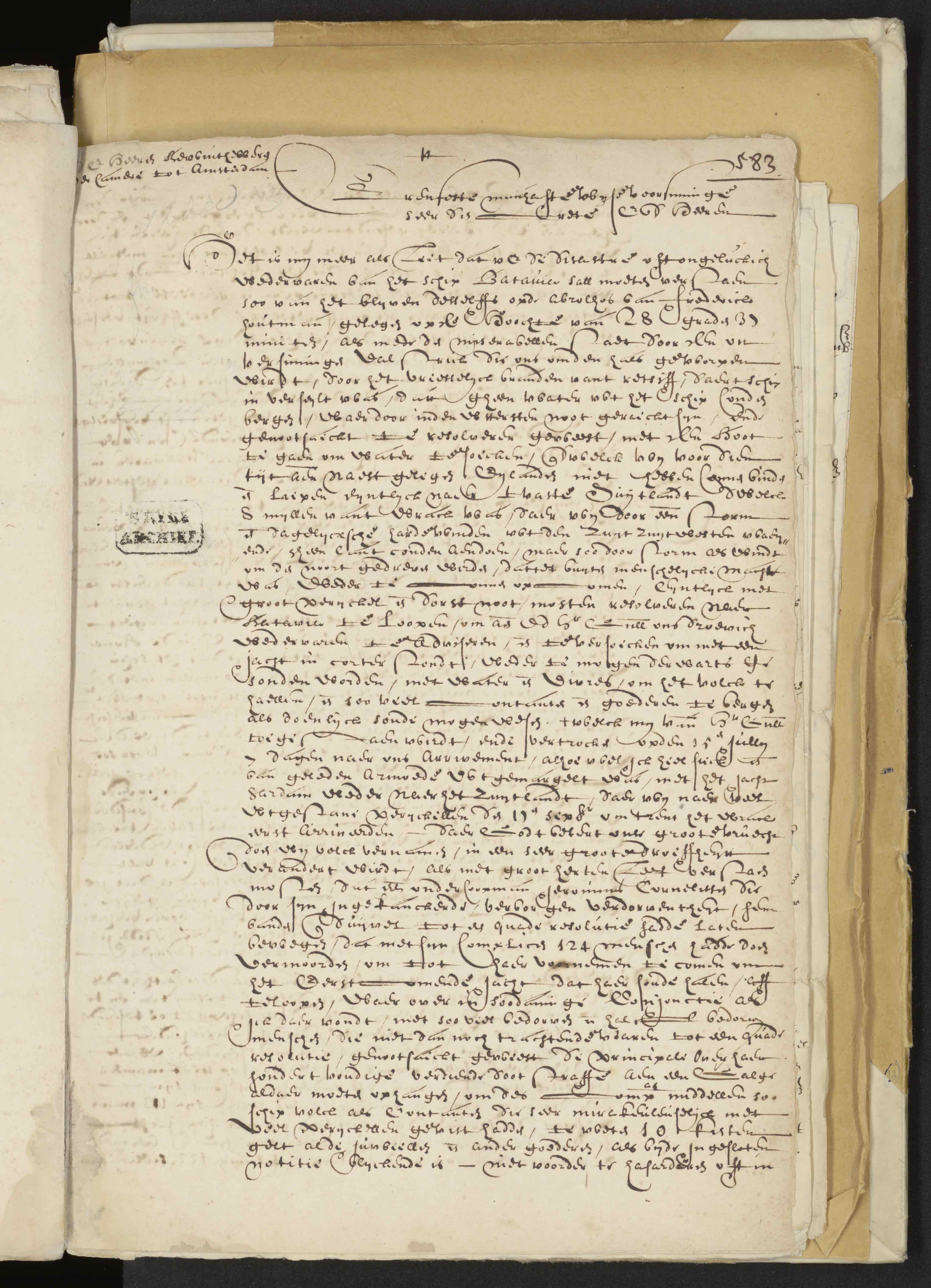
‘1629 Batavia Pelsaert Letter’
Follow this link to view the letter by Pelsaert to the VOC Chamber of Amsterdam, 12 December 1629, accompanied by Adriaan de Jong’s transcription and translation.
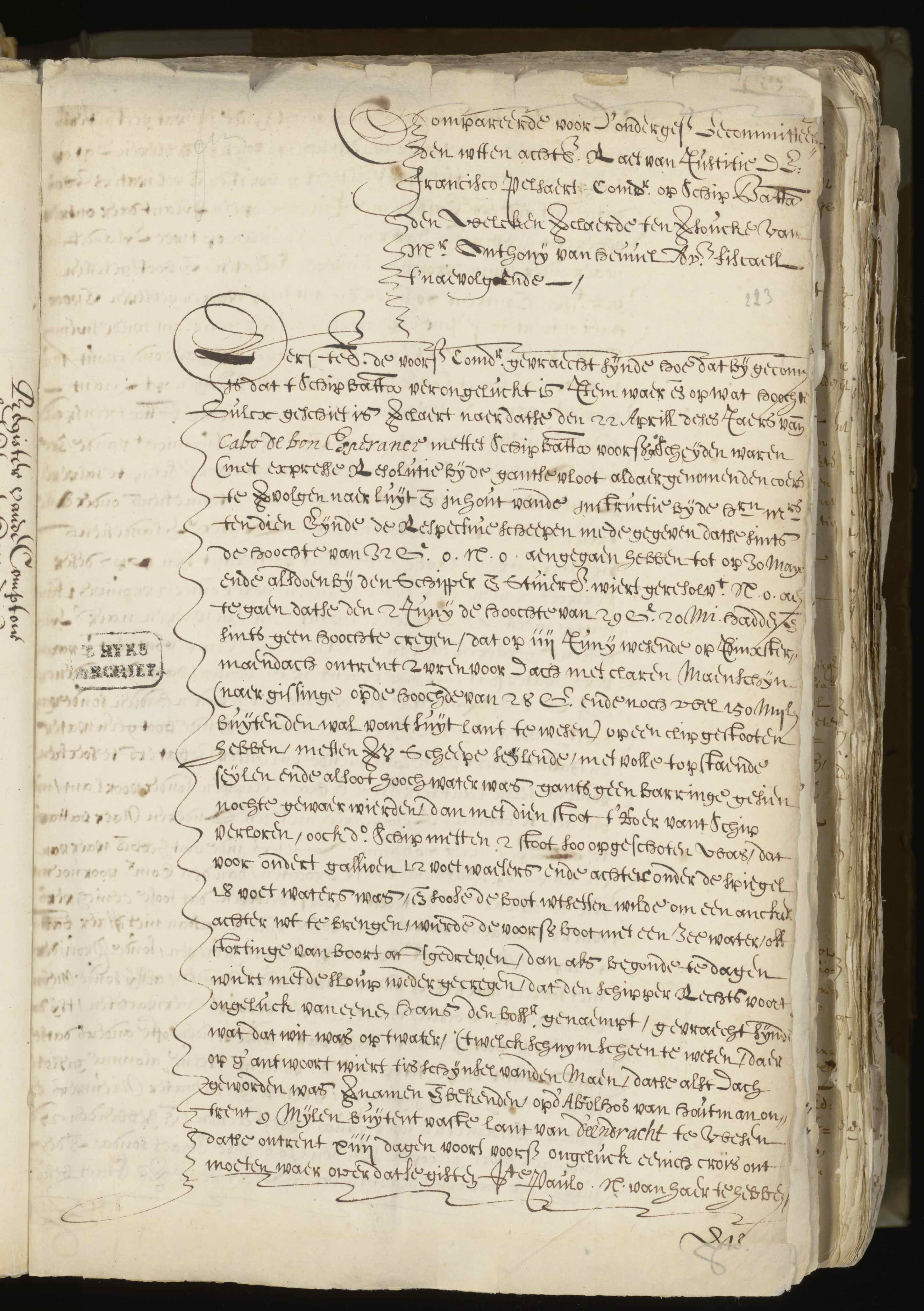
‘1629 Batavia Pelsaert Fiscal Letter’
Follow this link to view Pelsaert’s account to the Advocaat Fiscael of the Raet van Justie in Batavia, 6 November 1629, accompanied by Adriaan de Jong’s transcription and translation.
The Predicant’s account
The Predicant that was one of the passengers on the ship, Gysbers Bastiensz, also wrote a long letter to his family and religious friends in the Netherlands outlining the events that occurred. This account was published in one of the later editions of the book Ongeluckige Voyagie van’t Schip Batavia (1649), known as the ‘Utrecht edition’, published by Lucas de Vries.
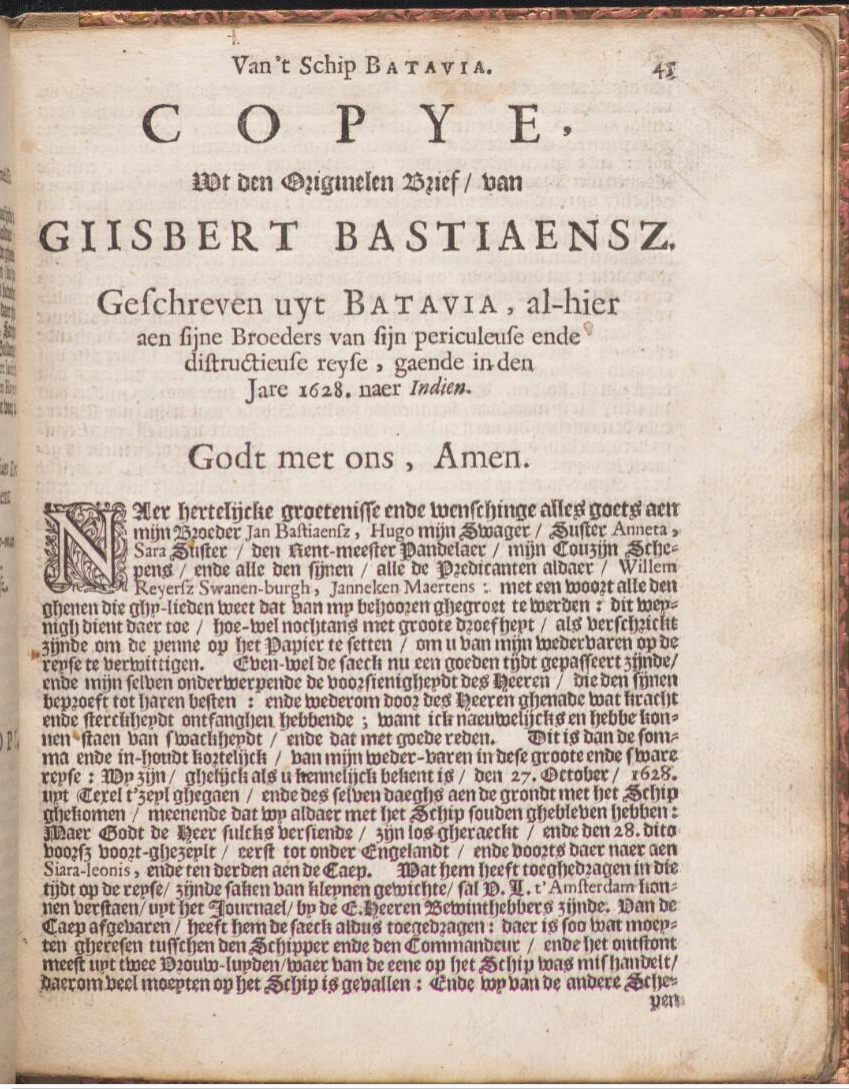
‘1629 Batavia Bastiantz Letter’
Follow this link to view the published account of Gijsbert Bastiansz, the predikant, accompanied by Jeremy Green’s transcription and translation.
Account of the loss by Antonio Van Diemen to Pieter De Carpentier
Antonio Van Diemen wrote to Pieter De Carpenter in Amsterdam describing the arrival of
…the Commandeur Francisco Pelsaert, the skipper of ditto ship [Batavia], Capn. Hans Jacobsz, the uppersteersman and more other officers in total 48 and amongst them two women and a child of 3 months…
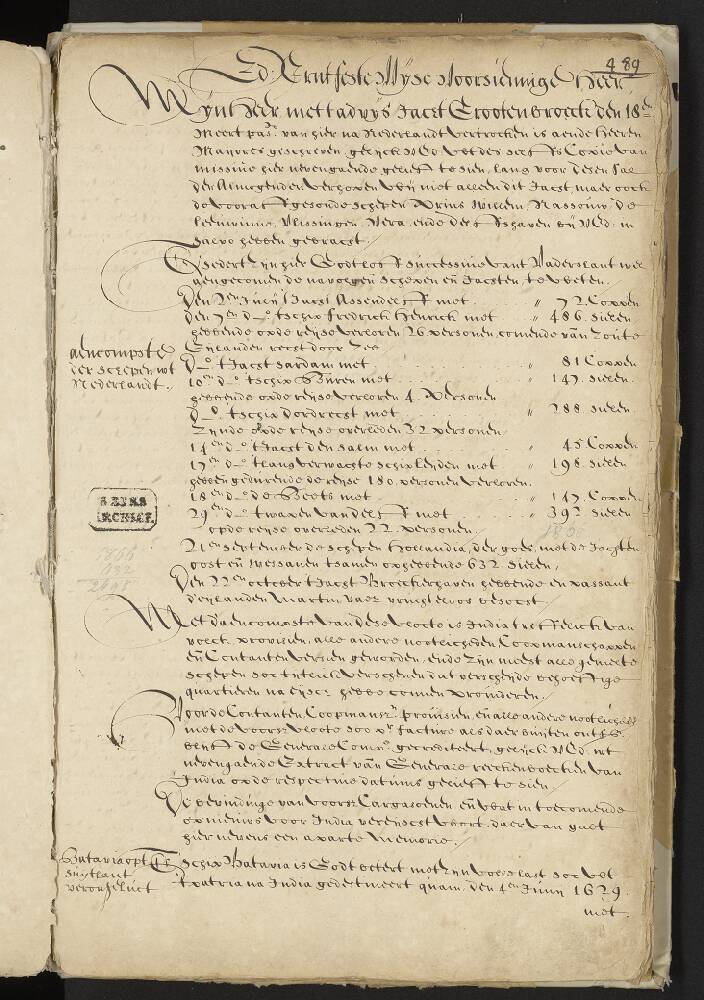
Follow the link to view the account of the loss of Batavia by Antonio Van Diemen, accompanied by Adriaan de Jong’s transcription and translation.
Additional documents
Contained in the archives is also a list of the people who died at various points in the journey and the goods salvaged from the wreck by Pelsaert.
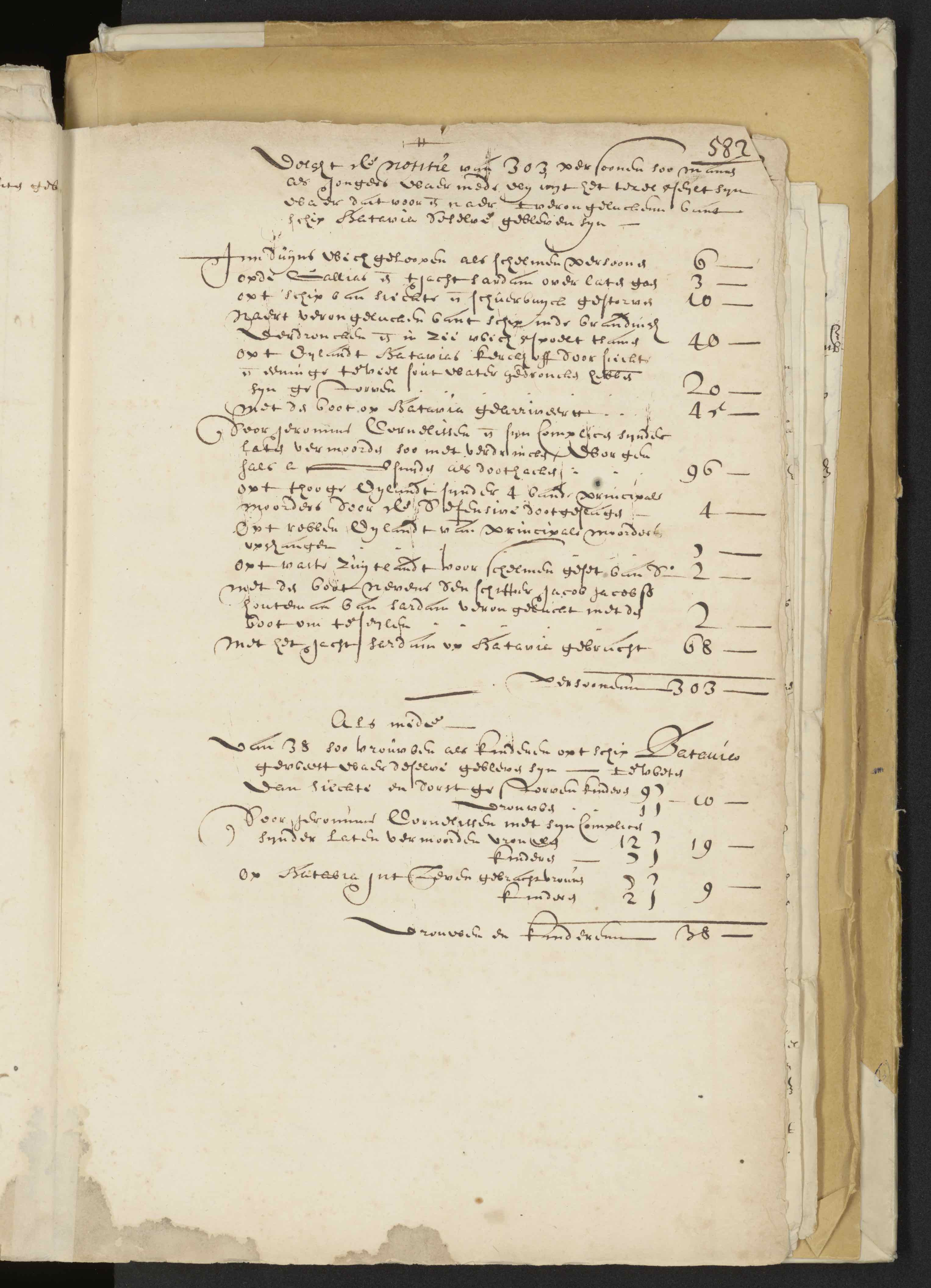
‘1629 Batavia deaths and goods’
Follow the link to view the Accounts by VOC in Batavia of deaths and goods recovered, accompanied by Adriaan de Jong’s transcription and translation.
The story of the disaster was subsequently published in 1647 as the Ongeluckige Voyagie van ‘t Schip Batavia nae Oost-Indien, and republished nine times in largely pirated versions until 1664. There were also subsequent versions in French and English. Nevertheless, by the end of the seventeenth century the story had largely been forgotten.
Background to the loss
The retourship (return-ship) Batavia set out with 341 people from Texel in the Netherlands on 29 October 1628 in a fleet of seven ships (Asseldelft, Buren, Kleine David, Dordrecht, ’s-Gravenhage and Sardam), under the command of Francisco Pelsaert. The fleet was bound for Batavia – modern day Jakarta, Indonesia. After a relatively uneventful trip, Batavia arrived at the Cape of Good Hope on 14 April 1629 with the rest of the fleet and departed 22 April. On the morning of 4 June 1629, Batavia was wrecked on the Houtman Abrolhos, off the coast of Western Australia. The shipwreck was a prelude to an extraordinary tragedy.
There was years-long animosity between Pelsaert and the skipper of the Batavia, Adriaan Jacobsz (see Moreland and Geyl 1925). In 1629, Pelsaert reprimanded Jacobsz after the skipper went on a drunken spree, visiting other vessels of the fleet, whilst at the Cape. After the fleet set sail, Batavia separated from the rest of the fleet. During this part of the voyage one of the senior women passengers was assaulted as an attempt to antagonise Pelsaert and use his response as a springboard to stage a mutiny. This came to naught, because Pelsaert was sick and unable to deal with the matter. With dissension brewing, the ship sailed on until, on the morning of 4 June 1629, it ran onto a reef off the coast of West Australia, now known as Morning Reef, Houtman Abrolhos.
Events after the wreck
At the time of the shipwreck there were 322 people aboard the ship. After conveying about 252 people off the ship, most to Beacon Island, the sea conditions deteriorated, making it impossible to reach the ship. Pelsaert then decided to go in search for water, accompanied by all the senior officers, some crew and passengers (48 in all, including two women and a child). This effectively deserted 204 people on two waterless islands and 70 people on board the ship, with no senior officers left to manage the situation. The only remaining senior person was Jeronimus Cornelisz, an undermerchant who was still on board the ship when Pelsaert departed. After 10 unsuccessful days, Paelsart abandoned the search and changed course for Batavia, to obtain help. It took 33 days to get there.
Events on arrival in Batavia
On arrival at Batavia, the high boatswain was executed on Pelsaert's indictment, for outrageous behaviour onboard before the loss of the ship. The skipper, Adrien Jacobsz was arrested, again on Pelsaert's word, for negligence. Governor General Coen dispatched Pelsaert seven days later in the jacht Sardam to rescue the survivors and to salvage as much cargo as possible from the wreck. Blighted by extraordinary bad luck, the voyage took another 63 days.
Events on the islands
After Pelsaert departed on the ship’s boat, the remaining people on the wrecked ship attempted to swim to the nearby islands; many drowned. Once Jeronimus Cornelisz arrived ashore he revived the plan to mutiny, plotting to capture the ship Pelsaert would return with and take up pirating. To do this Cornelisz needed to get rid of the people who would oppose their actions; this included individuals deemed useless and a group of loyal Company soldiers. These soldiers under command of Wiebbe Hayes were sent to the ‘High Island’ (East Wallabi Island) to search for water, with the hope they would fail and die there. Once they were gone Cornelisz’s accomplices started to murder men, women, and children. In all 125 people were brutally killed. Meanwhile the soldiers sent up a smoke signal indicating they had found water, but it was ignored; the soldiers remained on East Wallabi Island. Some survivors escaped Cornelisz and his compatriots and made their way to the soldiers so, when Cornelisz turned his attention to them they had been forewarned. When Cornelisz and his cronies attempted to attack and overcome the soldiers armed with muskets they failed. Cornelisz was captured and at this moment, as in some Hollywood movie, Pelsaert in Sardam finally arrived. There was then a race between the mutineers, in one boat, and Wiebbe Hayes, in another, to reach the ship. Hayes was able to warn Pelsaert and the mutineers were arrested.
After the arrival of Sardam
On discovering that a mutiny and a terrible massacre had taken place, led by Cornelisz and a small group of mutineers, Pelsaert arrested the ringleaders and set up a court on the islands. The mutineers were tried and those found guilty, executed. Whilst the lengthy interrogations and trials were underway, Pelsaert set about recovering the chests of specie (silver bullion in coin) and other valuable items from the wreck, using divers from Gujarat and the Netherlands.
When the Sardam finally departed, two ship’s boys implicated in the events of the mutiny were punished by exile on the Australian mainland, and the lesser offenders were flogged, keelhauled and dropped from the yard arm as punishment during the voyage to Batavia. On arrival, they were summarily executed.
At the conclusion of the calamitous voyage, of the 322 people aboard at the time of the wreck, only 116 reached Batavia.
Events leading to the discovery of the wreck site
It was not until the 1830s, when the British Commander Wickham and Lieutenant Lort Stokes undertook the first hydrographic surveys of the coast of the new colony of Western Australia, that the story of the Batavia re-emerged. In their survey of the Houtman Abrolhos in HMS Beagle (the ship previously used by Charles Darwin), they named the three main groups of the Abrolhos: from north to south, the Wallabi Group (after the resident Tammar Wallabies, Macropus eugenii), Easter Group, and Pelsaert Group. The latter, including Pelsaert Island, Batavia Roads, and Wreck Point, were named under the misapprehension that wreckage found there was Batavia. They identified the wreck site of the VOC ship Zeewijk (1727) in the same group. This indicates that the Beagle carried accounts of both Batavia and Zeewijk, but evidently not Pelsaert’s original journal which described wallabies (the first description of an Australian marsupial) and would have associated Batavia with the northern group.
It was not until the 1960s that a study by H. Drake-Brockman (1963), using the copy of Pelsaert’s journal held in the archives, determined that the wreck site was in the Wallabi Group. The key to this realisation was the original journal’s mention of catten, referring to wallabies that are only found in the northern Abrolhos Islands.
In 1963 a local fisherman reported a large anchor on Morning Reef and, subsequently, a group of divers from Geraldton confirmed the site was that of Batavia.
More information about the Batavia story and the modern discovery and excavation can be found on the Western Australian Museum website.
Resources
Nationaal Archief, the Netherlands: Series 1.04.02, Inventaris van het archief van de Verenigde Oost-Indische Compagnie (VOC);
—— No. 1097, fols 489-490 [Account of the loss of Batavia by Antonio van Diemen], NL-HaNA_1.04.02_1097_1071–73.
—— No. 1098, fols 232-316 [Francisco Pelsaert’s journal 4 June - 5 December 1629], NL-HaNA_1.04.02_1098_0539–0710.
—— No. 1098, fols 583-584 [letter by Pelsaert to the VOC Chamber of Amsterdam, 12 December 1629], NL-HaNA_1.04.02_1098_1345–47.
—— No. 1098, fols 223-224 [Pelsaert’s account to the Advocaat Fiscael of the Raet van Justie in Batavia, 6 November 1629], NL-HaNA_1.04.02_1098_0527–29.
—— No. 1098, fols 529, 581-582 [Accounts by VOC in Batavia of deaths and goods recovered], NL-HaNA_1.04.02_1098_1209-1210, 1341–43.
Ongeluckige Voyagie, Van’t Schip Batavia ... (1649), Lucas de Vries, Utrecht. Accessed State Library of New South Wales, 25 November 2025.
Additional reading
Ariese C (2012) Comparisons between the different versions of the Ongeluckige Voyagie, Report No. 331, Department of Maritime Archaeology, Western Australian Museum.
Bigourdan N (2014) Translation into English of a section of the first edition of Relations de Divers Voyages Curieux published in 1663 by Melchisédech Thévenot. Report No. 304, Department of Maritime Archaeology, Western Australian Museum.
Drake-Brockman H (1963) Voyage to Disaster The life of Francisco Pelsaert, Angus and Robertson, Australia.
Edwards H 1966 Islands of Angry Ghosts, Hodder and Stoughton, Sydney.
Green JN (1975) ‘The VOC ship Batavia wrecked in 1629 on the Houtman Abrolhos, Western Australia,’ International Journal of Nautical Archaeology 4(1):43–63.
—— (1989) The loss of the Verenigde Oostindische Compagnie retourschip Batavia, Western Australia 1629: an excavation report and catalogue of artefacts, BAR International Series 489, British Archaeological Reports, Oxford.
Green JN and Patterson A (2020) Shipwrecks of the Roaring Forties: Researching some of Australia’s earliest shipwrecks, UWA Publishing, Crawley.
Moreland WH and Geyl P (1925) Jahangir’s India the Remonstrantie of Francisco Pelsaert, W. Heffer and sons, Cambridge.
Ongeluckige Voyagie, Van’t Schip Batavia, Nae de Oost-Indien. Gebleven op de Abrolhos van Frederick Houtman, op de hooghte van 28 1/3 graet by-Zuyden de Linie Æquinoctiael. Uytgevaren onder den E. Francoys Pelsert (1647), Jan Jansz, Amsterdam. Accessed Trove, National Library of Australia, 25 November 2025.
Roeper VD (1993) De Schipbreuk van de Batavia, 1629, Walvurg Press, Zutphen.