- references to death, dying, and/or grief.
- descriptions of physical violence and cruelty.
- images or descriptions of human remains.
Shortly after the Dutch East India Company (VOC) ship Batavia wrecked on the Houtman Abrolhos Islands in early June of 1629, its commander Francisco Pelsaert and a group of forty or so survivors set off in a smaller vessel for Batavia, the fortified outpost on the Indonesian island of Java that served as the VOC headquarters in the East Indies. The commander returned to the Abrolhos islands three months later to rescue the people he had abandoned there, along with ‘all the cash and the goods that can possibly be fished up,’ bringing a team of Gujurati divers with him to salvage the wreck (Pelsaert 1994:8). Once there, Pelsaert was shocked to discover that a large group of VOC merchants, soldiers, and sailors had brutally murdered at least 125 of their fellow castaways, with women and children among their victims.
Pelsaert quickly launched an investigation into the castaways’ crimes on the Islands. As was customary in Dutch criminal proceedings in this era, he interrogated the accused under torture and ultimately sentenced seven murderers to death. Pelsaert ordered his men to build gallows from salvaged wood—perhaps from recovered pieces of the broken ship Batavia—to hang these convicts until dead. To intensify their suffering, he also instructed that they were to have one or both of their hands chopped off before they were strung up. It is likely that the murderers’ corpses were left on the gallows to rot in the open air, with the denial of a respectful Christian burial a further punishment (Pelsaert 1994). Both torture and execution scenes were depicted in the 17th century account of the Batavia disaster, Ongeluckige voyagie, van 't schip Batavia (‘Unlucky Voyage of the Batavia Ship’).
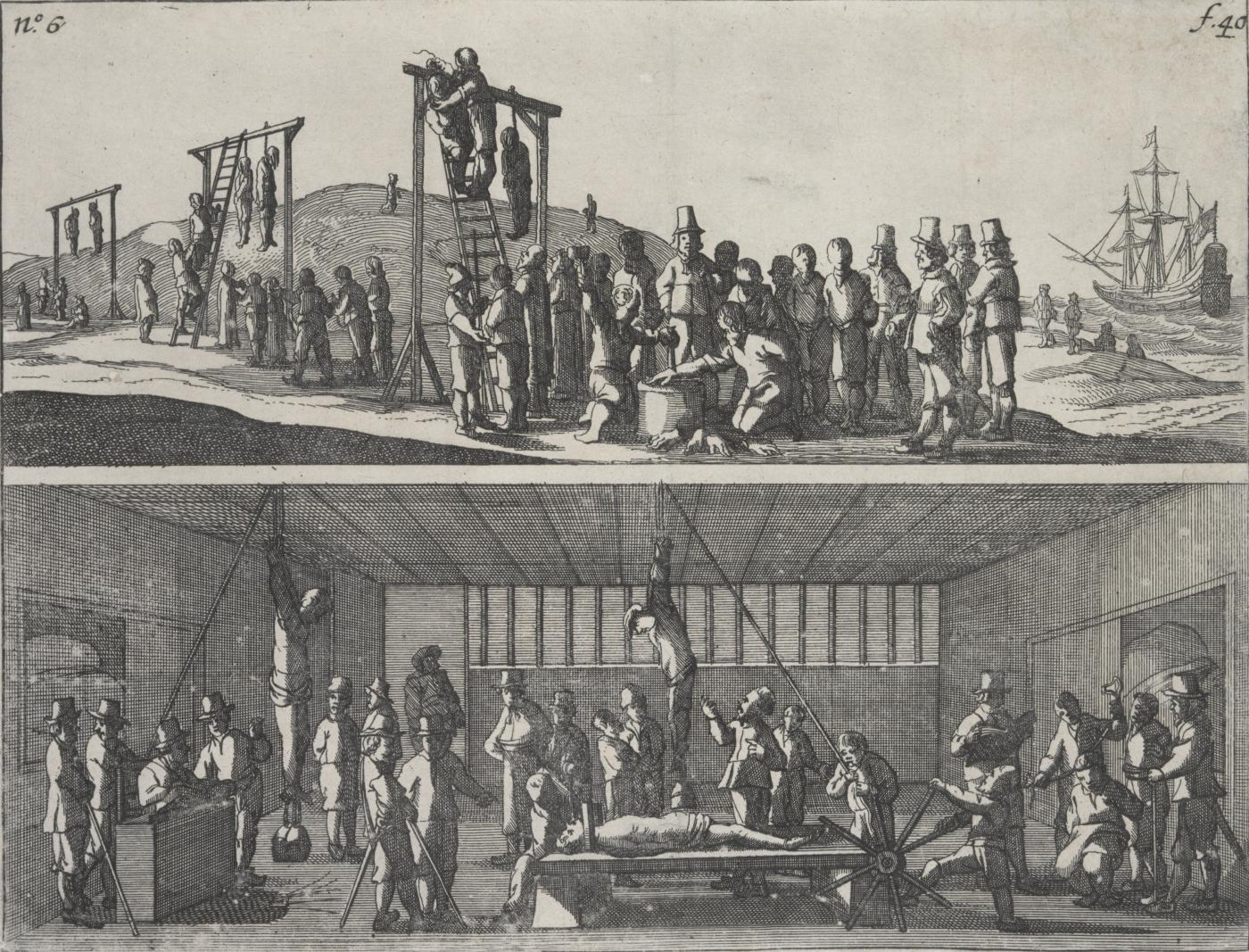
Credit: State Library of New South Wales.
During archaeological surveys on Long Island a concentration of corroded ferrous metal fastenings was detected and excavated from the coral surface of the island. The research team hypothesised that these were the remains of gallows, which were located at an area directly west of Beacon Island, which is also known as Batavia’s Graveyard.
The Western Australian Museum holds these metal artefacts. Over time the gallows’ wooden components decomposed, leaving only the small piles of metal fastenings including ‘spikes, nails, and rivets’ that archaeologists recovered. Tucked away in a cardboard box on a museum storage shelf, this material holds the status of one of the very first structures that Europeans built in Australia (Paterson et al. 2023:45).
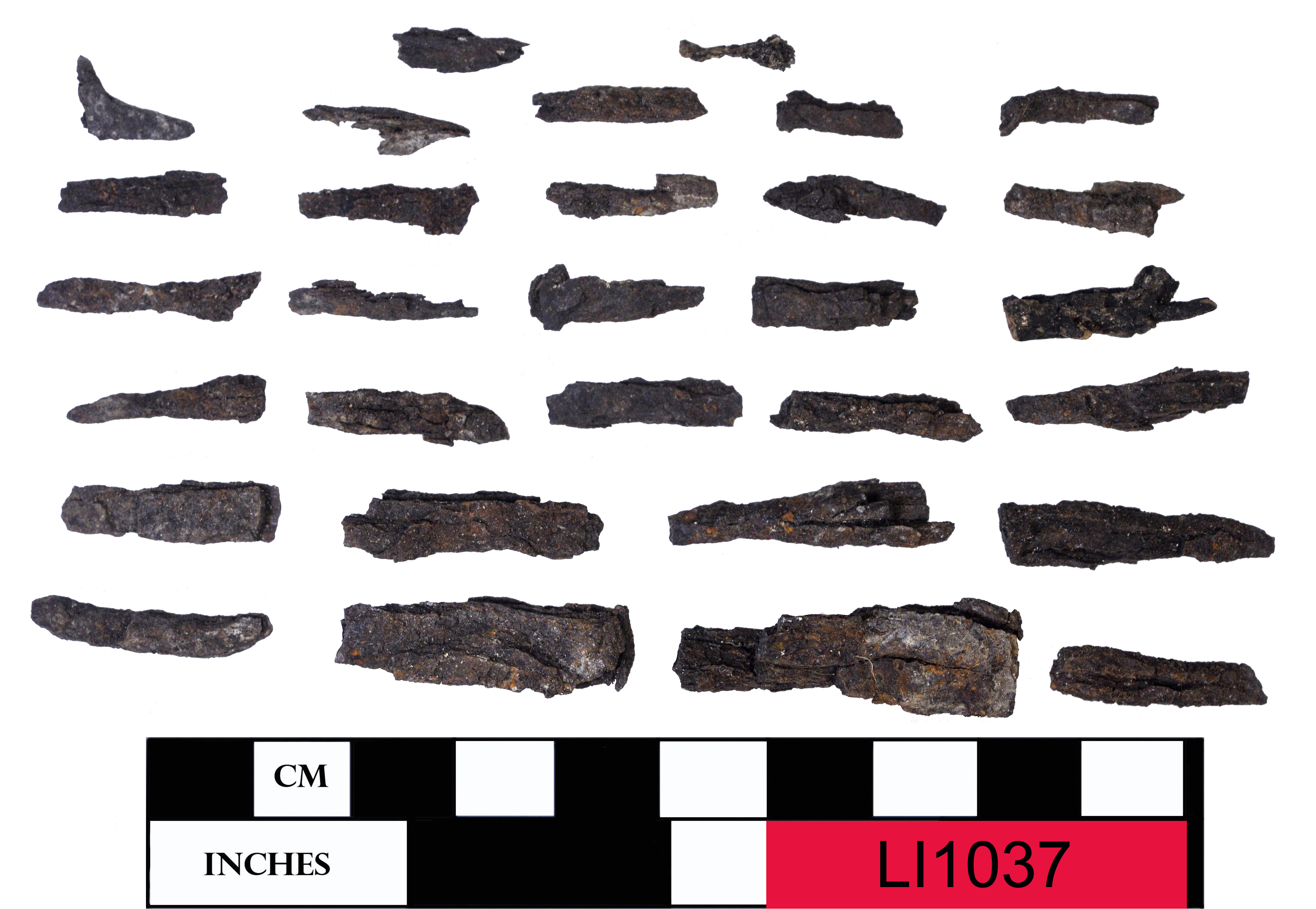
Credit: Western Australian Museum, Department of Maritime Heritage.
On the return voyage to Java, Pelsaert continued to punish the castaways’ crimes, marooning two young men on the Australian mainland. Once in Batavia, in January 1630, thirteen more castaways were sentenced to severe punishments that included limbs amputated, gruesome executions, bodies whipped and branded, and years of hard labour in chains. For example, Jacob Pietersz Cousijn, a stonemason, was executed by being put on the wheel (NL-HaNA_1.04.02_1099_0141-2). This agonizing death involved the convict’s limbs being tied to the frame of a wheel before the executioner smashed them between the joints. Dislocated limbs would then be ‘woven’ through the spokes of the wheel, which was left on display, the convict’s body typically left to rot in public view (McIlvenna 2022:37-38).
Back in the 17th century and today, there seems to be a consensus that the Batavia ship convicts got what they deserved. But was Dutch colonial justice always fair? Could knowing more about law and order in the VOC world make us more critical of Dutch colonial justice?
The VOC punished many other criminals in Batavia in 1630. Salomon Coenraets and Fredrick Jansz were hanged for deserting to the enemy or running away (NL-HaNA_1.04.02_1099_0163). For committing the crime of sodomy, the boatswain Frans Fransz of Leeuwarden was burned alive (NL-HaNA_1.04.02_1099_0278). Two Chinese men who were both known as Joctuan were sentenced to be tied to a stake, whipped, branded, their faces scorched with fire, and if they survived this abuse, be banished from Batavia (NL-HaNA_1.04.02_1099_0278). Their crime was circulating counterfeit coins. Two Dutch women convicted of adultery were branded with hot metal rods and briefly imprisoned in the city hall, the doors of their cell left open so the public could visit, mock, and ‘humiliate’ them (NL-HaNA_1.04.02_1099_0278). The range of violent punishments were intended to send a strong message to the VOC’s subjects in the East Indies that the Company would not tolerate violations of its laws (note also Jaśniewicz-Downes 2024).
Many of us would be shocked that murderers, men and women who committed ‘white collar crimes’ like fraud, and those who had engaged in consensual sex that did not align with Dutch Protestant values, all faced punishments that maximized physical suffering, grotesquely disfigured their bodies, and in some cases, resulted in their deaths. In Batavia the line between legitimate and illegitimate Dutch violence blurred as state-sanctioned violence mirrored the horrific crimes committed by the Batavia castaways.
References
Jaśniewicz-Downes (2024) ‘Amok and Its Punishment in 17th Century Dutch Batavia through the Eyes of Johann Gottfried Dreyer from Gdańsk,’ Studia Historica Gedanensia 15(2):224-256.
McIlvenna U (2022) Singing the News of Death: Execution Ballads in Europe 1500-1900, Oxford University Press, New York.
Nationaal Archief: Series 1.04.02 Inventaris van het archief van de Verenigde Oost-Indische Compagnie (VOC), 1602-1795 (1811). No. 1099 (NL-HaNA_1.04.02_1099).
Paterson A et al. (2023) ‘The Unlucky Voyage: Batavia’s (1629) Landscape of Survival on the Houtman Abrolhos Islands in Western Australia,’ Historical Archaeology 57(1):32-49.
Pelsaert F (1994) The Batavia Journal of François Pelsaert (ARA Document 1630: 1098 QQ II, fol. 232-316) (M Van Huystee trans), Report No. 136, Department of Maritime Archaeology, Western Australian Museum, Perth.
Pelsaert F (1647) Ongeluckige Voyagie, Van 'T Schip Batavia, Nae de Oost-Indien, Voor Jan Jans, Amsterdam.