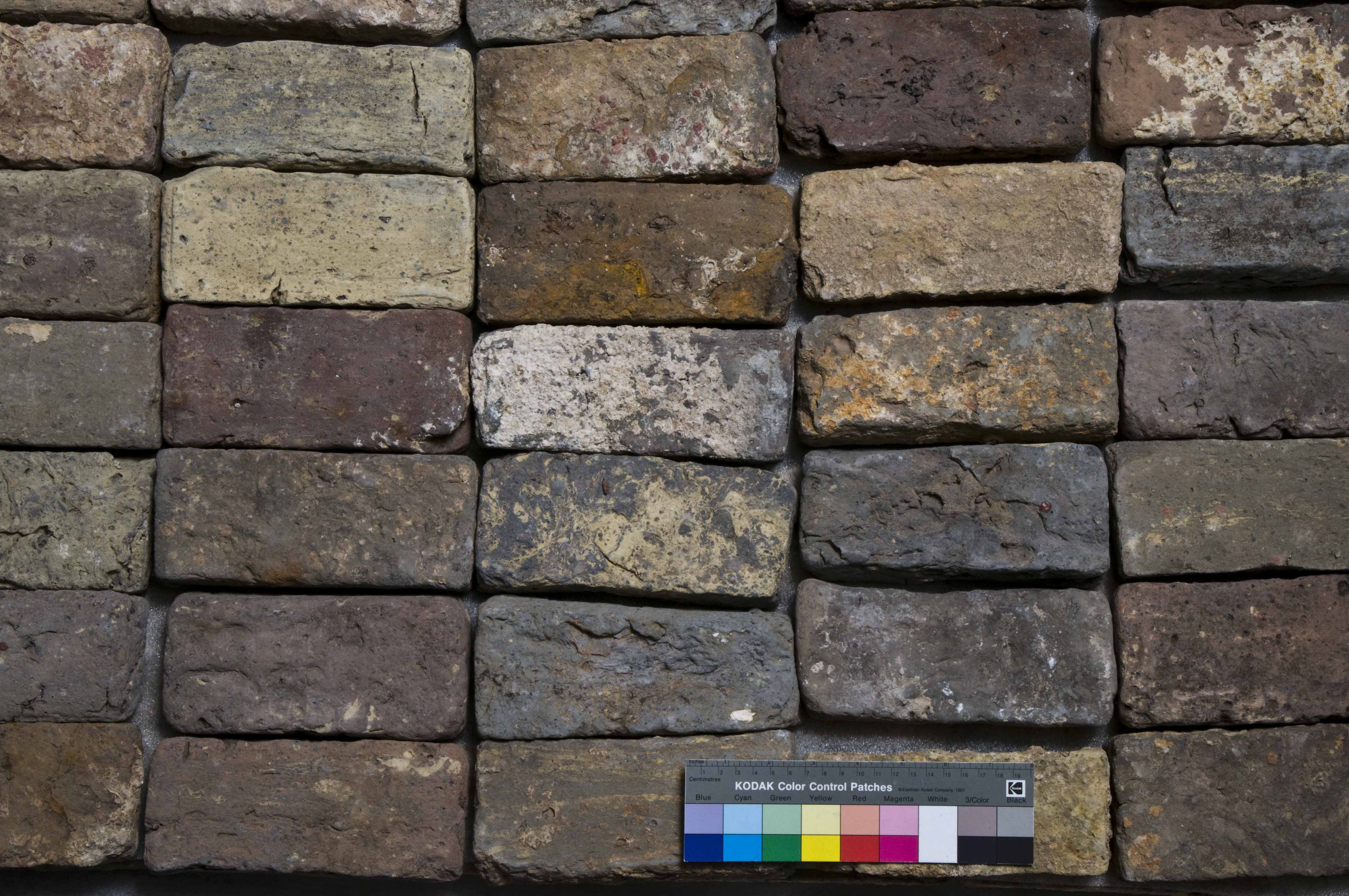
Credit: Western Australian Museum, Department of Maritime Heritage.
About 12,000 bricks were recovered from the Batavia shipwreck (Green 1989:190)—a tiny fraction of the bricks that the Dutch Republic exported overseas. There would have been more bricks on board of the Batavia itself, as well as on the other ships that left Texel on 28 October 1628 as part of a fleet of eight. While no comprehensive estimate exists for total Dutch brick exports, the scale was extraordinary: in 1653 alone, 400,000 bricks weighing a combined 330 tons were sent to Batavia (Green 1977:379, table 6-19).
The recovered Batavia bricks reveal much about 17th century Dutch brick production. They varied in colour, ranging across three basic types: pale yellow, pink-brown, and grey. Within these groups there was considerable variation in colour range, and in some cases the body of individual bricks displayed a mixture of all three colours, suggesting the clay had not been properly mixed. The bricks averaged 182 ± 5 mm long by 84 ± 3 mm wide by 37 ± 1 mm thick (Green 1989:190). These measurements are slightly larger than bricks recovered from the Vergulde Draeck wreck site, where the same dimensions were 176 mm by 76 mm by 34 mm (Green 1977:462, note 1). This size difference between bricks from 1628 and 1656 confirms the pattern of progressively smaller brick production over the 17th century.
Brick defined Dutch architecture. With limited access to natural stone, the Dutch Republic built its cities from clay. Although small quantities of stone appeared in construction or building decoration, brick determined the visual character of Dutch urban life. It formed not only most buildings but also pavements, creating the distinctive streetscapes captured in works like Pieter de Hooch’s Courtyard of a House in Delft (National Gallery, London) or Johannes Vermeer's The Little Street.
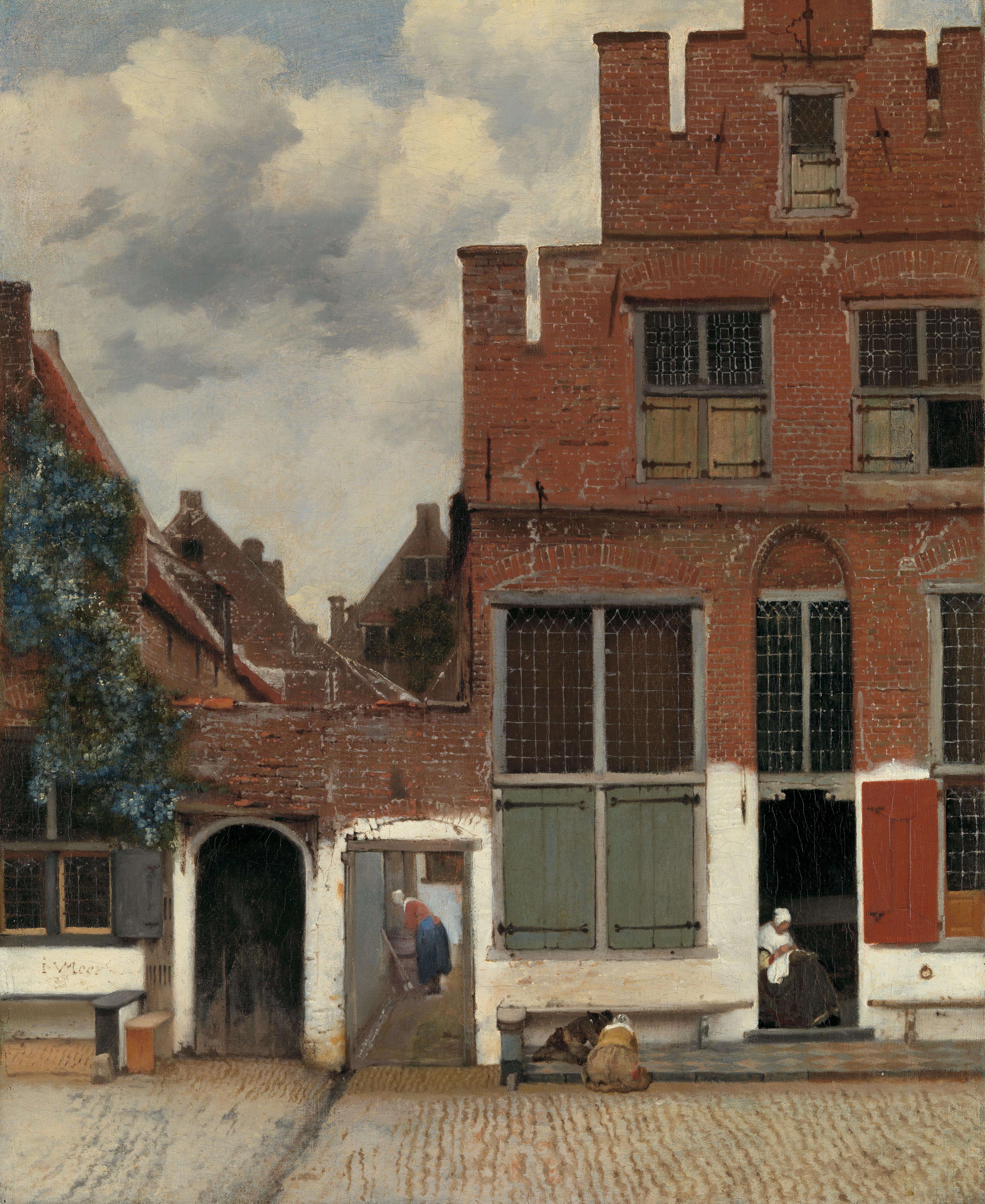
Credit: Rijksmuseum, Amsterdam.
Material and production
The distinctive character of 17th century Dutch bricks emerged directly from the physical properties of the Republic's clay-rich deltaic landscape. Brickmakers sourced their raw material from tidal river mud, particularly along the Hollandse IJssel near Gouda or from lakebeds, where continual deposition of fine, wet clay ensured renewable supply. This high moisture content and plasticity imposed clear technical constraints: larger bricks would slump during drying, which explains why Dutch bricks became progressively smaller over the 16th and 17th centuries (Van der Hoeve 2012:22-23).
The production process was labour-intensive, highly seasonal, and starkly hierarchical. Brick manufacturing depended on workers from the lowest social classes, whose gruelling labour prompted the printmakers Jan and Caspar Luyken to compare the work to slavery. Men mixed clay to a workable consistency, then pressed it into water-dipped, sand-coated moulds whose granular lining facilitated release. Women and children unmoulded the bricks, laid them out in long rows for open-air drying, and regularly turned them to promote even hardening. This slow drying process, undertaken from April to late autumn, produced characteristic irregularities—slight tapering, oblongness, and surface deformation—resulting from differential shrinkage and manual handling (Smith 2001).
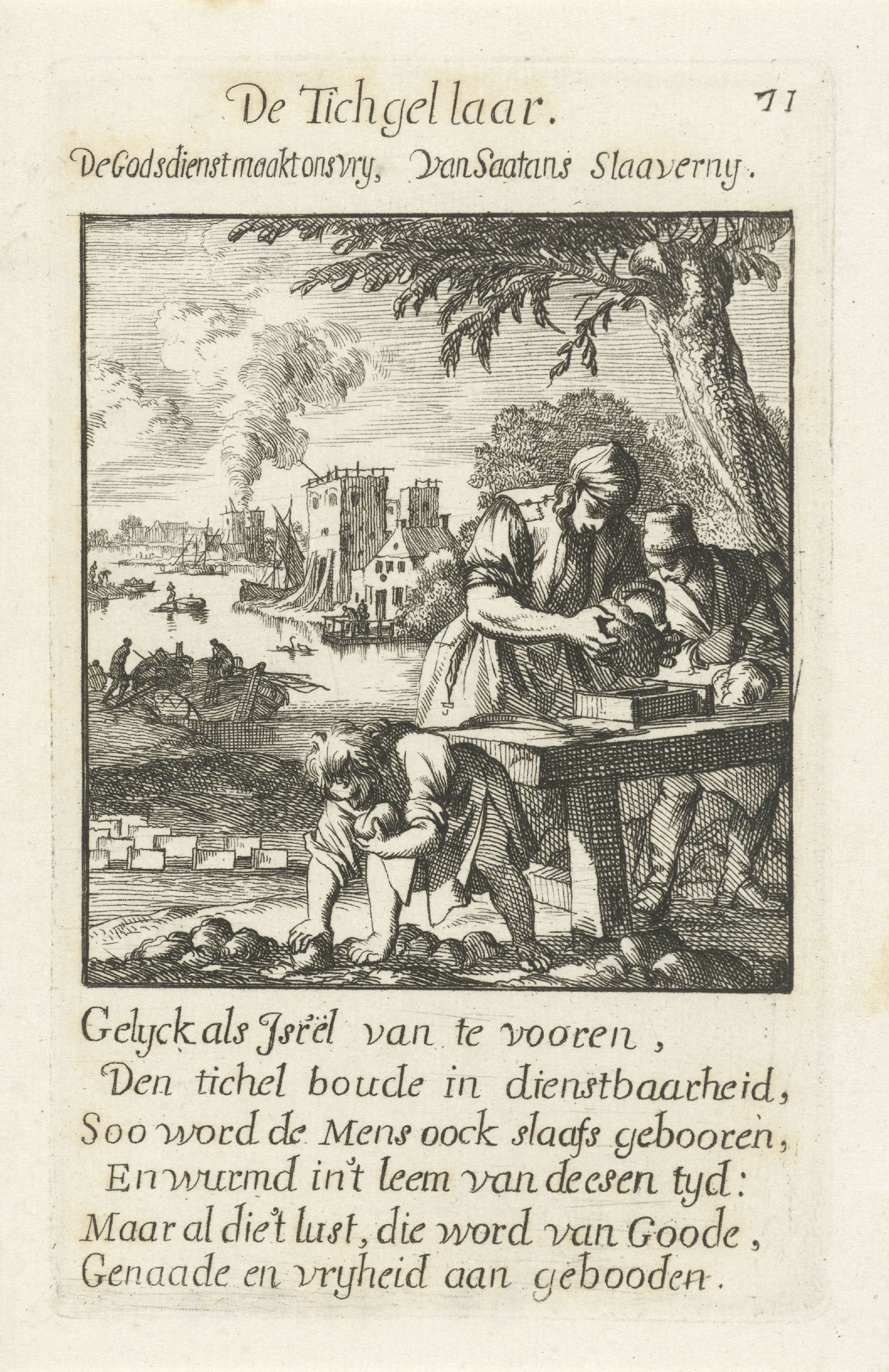
Credit: Rijksmuseum, Amsterdam.
Firing took place in large clamps capable of containing 100,000 bricks or more, where prolonged exposure, often a minimum of four weeks, to temperatures between approximately 900 and 1,250 degrees Celsius determined hardness, density, and colour. Mineral composition played a decisive role in the colouration valued in regional markets: iron-rich clays from the Oude Rijn river yielded deep reds, while chalk and lime-rich clays from the river IJssel produced the yellow tones associated with high-quality paving bricks such as those from Gouda. Variations in firing conditions and position within the clamp further modulated hue and texture, allowing sorters to grade bricks by quality for pricing. Even the thoroughness of clay mixing affected the final product, as evidenced by the colour variations within individual Batavia bricks. The resulting material was compact, modular, and highly durable, lending itself to a wide range of structural and decorative applications. Production estimates suggest some 200 million bricks and tiles were manufactured across the 17th century (Arntz 1947:64), underscoring brick's centrality within the built environment of the Dutch Republic.
Bricks and empire
Bricks were likely the most exported product of the Dutch Republic in the 17th and 18th centuries. These bricks served multiple functions: as ballast, they steadied the large and heavy Oostindiëvaarders (‘East Indiamen’—the name bestowed on the large ships trading in the ‘East Indies’), which on their return journey would be overladen with spices, textiles and other commodities. Yet, their use as ballast, though important, was secondary to their role in constructing the Dutch colonial empire overseas.
Bricks made from Dutch clay, and transported on Dutch ships, transformed architecture abroad. The Verenigde Oostindische Compagnie's colonial empire was literally constructed with bricks. The Dutch used them to build fortifications and moats, to pave streets, to facilitate water infrastructure (Lin 2023), and to construct warehouses and other buildings, not only in the East Indies (Indonesia) but also across Asia: in Formosa (Taiwan), Ceylon (Sri Lanka), Malacca (Malaysia) and several trading posts in Mughal India (Surat, Malabar, and Coromandel). The Dutch needed so many bricks that supply from the Dutch Republic fell short. From early on, they required additional supply from China and soon established local kilns, often supervised by Dutch specialists, to provide for their massive building programme (Arntz 1947:103ff; Chou and Theodossopoulos 2014).
Architecture and identity in Batavia
In 1628 it was decided that the city of Batavia should be built, where possible, with bricks (Arntz 1947:103). This decision reflected a broader colonial strategy: constructing a distinctively Dutch urban landscape would help maintain cultural cohesion among the Republic’s expatriate population. Batavia's population was extraordinarily diverse—some visitors reported over 40 nationalities, with Europeans forming only a minority. In this context, where Dutch residents lived and worked among a predominantly non-European population, architectural familiarity became a tool for reinforcing colonial identity. Buildings that echoed the streetscapes of Amsterdam or Delft served to anchor settlers' sense of themselves as Dutch in an environment that constantly challenged that identity (Kehoe 2015).
The architectural style of these buildings represented the tropical equivalent of 17th century Dutch architecture: high sash windows with split shutters and gable roofs typical of Dutch design. The structures were solidly built with relatively enclosed forms, not particularly well suited to the tropical climate. Unlike in the Dutch Republic, brick in Batavia was usually covered with plaster or white paint as a protective measure against the heat. Yet this protective cover would wear off over time, sometimes within decades, revealing the brick construction underneath, as shown in Johan Nieuhof's depiction of the Tygersgracht.
![Tygersgracht (detail), Johan Nieuhof, 1682 (KW 1049 B 10 [-13]).](https://collections.museum.wa.gov.au/sites/default/files/user/5/2025-11/Nieuhof%2C_Tygersgracht.jpeg)
Credit: National Library of the Netherlands.
Today, the dilapidated remains of 17th century VOC warehouses in Jakarta (the Oostzijdsche Pakhuizen, now known as the Graanpakhuizen), located east of the Ciliwung River and south of the former castle of Batavia, have lost much of their plaster façade and reveal their brick core after centuries of wear.
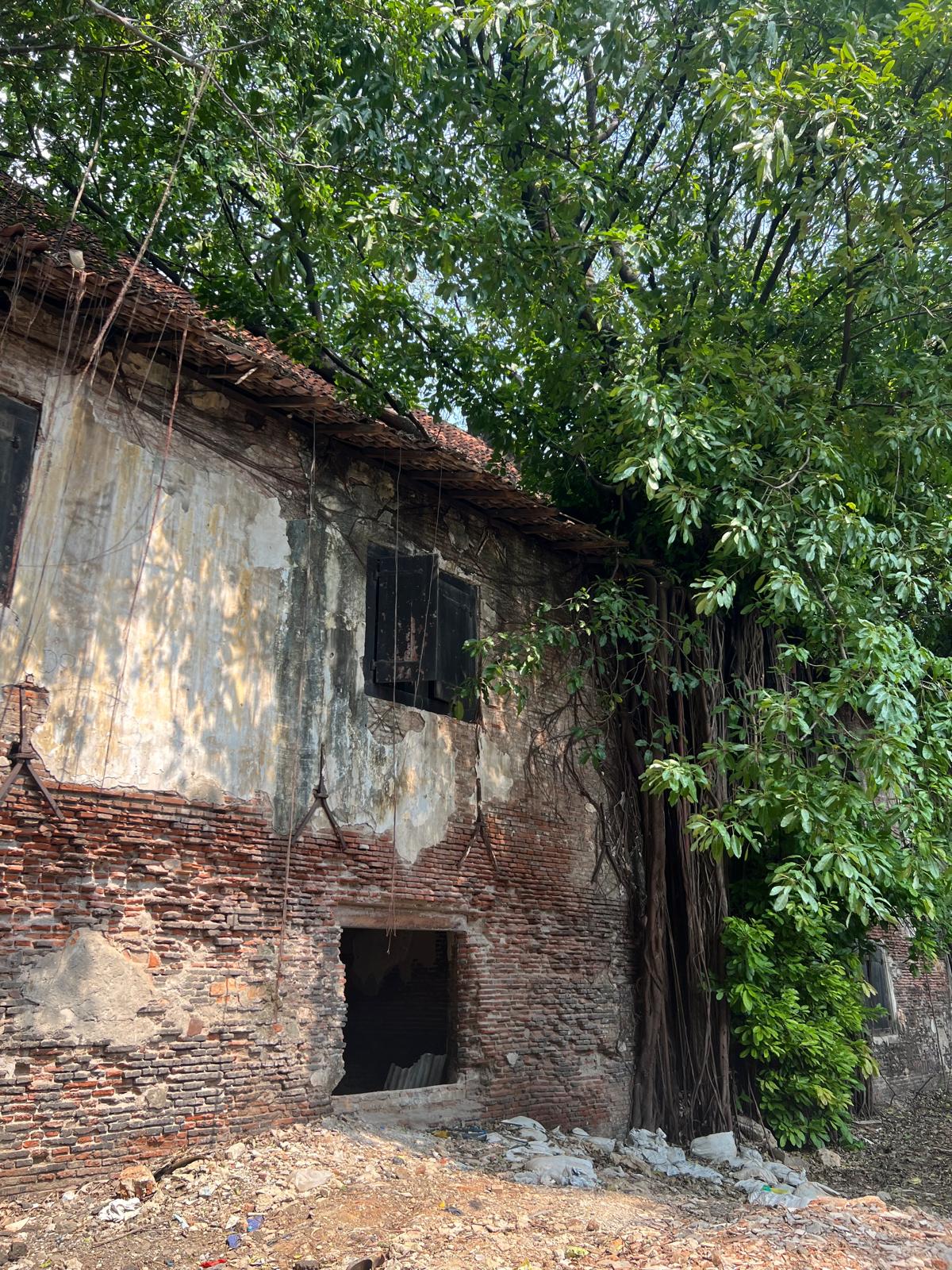
Credit: Diyan Achjadi.
These solid brick buildings also served as visible markers of Dutch imposed hierarchy, creating a clear distinction between the colonial core and the suburbs outside the city walls, or kampungs, with buildings constructed from less durable materials like wood, woven bamboo and leaf roofs—structures actually better suited to the tropical climate. This material difference contributed to the stark segregation between the Dutch and the many other races and nationalities that populated Batavia.
An Australian footnote
Dutch bricks made their way to Germany, the Baltic and Russia, to Scandinavia, and to European colonies in the Americas, Africa, and Asia (Arntz 1947). In a somewhat ironic turn, Australia is the only inhabited continent where the Dutch did not deliberately transport any bricks. The thousands of 17th and 18th century Dutch bricks currently stored at the Western Australian Museum were destined for Asia but shipwrecked off the Australian coast. The only known architectural feature left by the Dutch in Australia during their early encounters is the small, improvised fort built by Wiebbe Hayes and his men on West Wallabi Island, which was constructed from locally sourced limestone.
References
Arntz WJA (1947) ‘Export van Nederlandsche baksteen in vroegere eeuwen,’ Economisch-historisch Jaarboek: Bijdragen tot de Economische Geschiedenis van Nederland 23:57-133.
Chou Y-S and Theodossopoulos D (2014) ‘Building Material Migration: Imported Brick and Localization in Taiwan in 17th Century,’ in JWP Campbell et al (eds), Proceedings of the First Conference of the Construction History Society, Queen’s College, Cambridge, 11-12 April 2014, Cambridge: 71-81.
Green J (1977) The Loss of the Verenigde Oostindische Compagnie Jacht Vergulde Draeck, Western Australia 1656. An historical background and excavation report with an appendix on similar loss of the fluit Lastdrager, BAR Supplementary Series 36, British Archaeological Reports, Oxford.
Green J (1989) The loss of the Verenigde Oostindische Compagnie retourschip Batavia, Western Australia 1629. An excavation report and catalogue of artefacts, BAR International Series 489, British Archaeological Reports, Oxford.
Kehoe ML (2015) ‘Dutch Batavia: Exposing the Hierarchy of the Dutch Colonial City,’ Journal of Historians of Netherlandish Art 7(1): DOI:10.5092/jhna.2015.7.1.3.
Lin Q (2023) ‘(Re)visiting and (Re)valuing the Vanishing Water Heritage in VOC Asia: Dutch Malacca and Ceylon,’ Blue Papers 2(2):108-117.
Smith TP (2001) ‘On “small yellow bricks … from Holland”,’ Construction History 17:31-42.
Van der Hoeve J (2012) ‘Vroeg metselwerk in Nederland: Volop regionale verschillen,’ in M Van Hunen (ed), Historisch Metselwerk. Instandhouding, herstel en conservering, Zwolle:14-25.