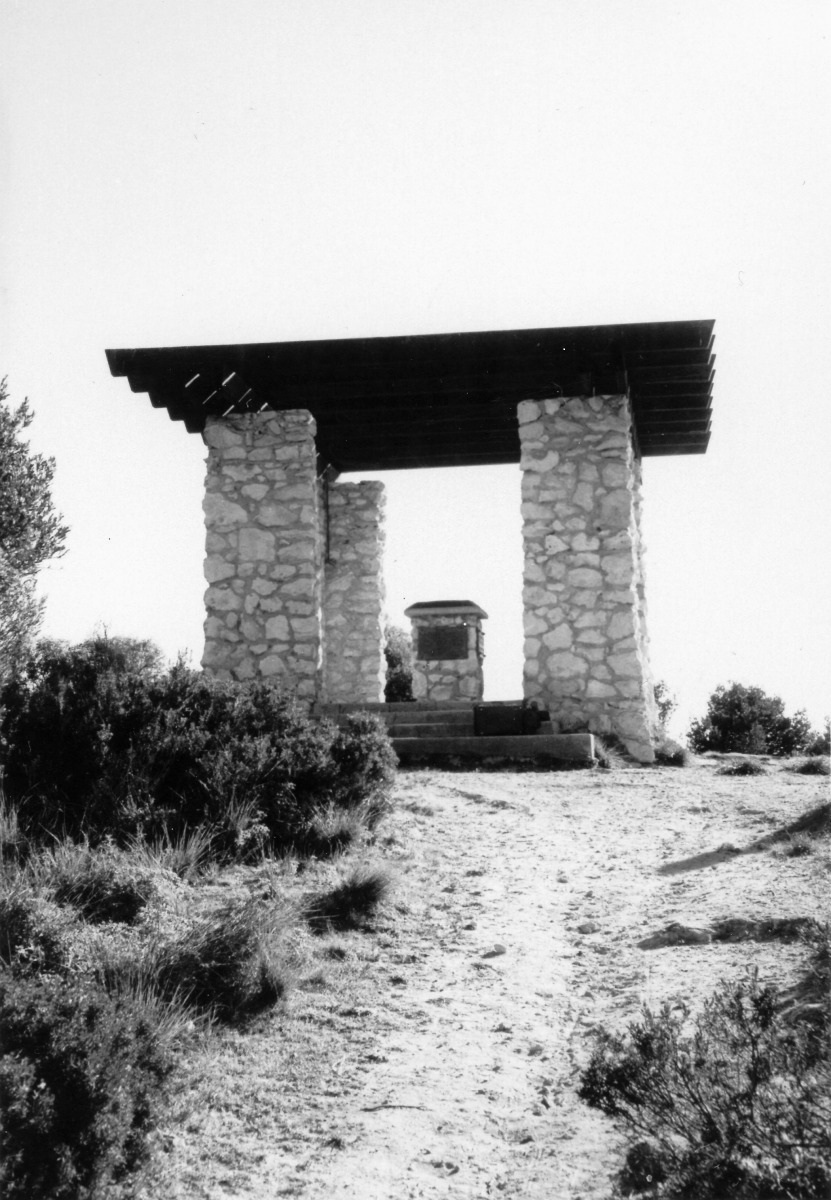
Vlamingh Memorial, Rottnest Island, 1935
Credit: State Library of Western Australia (b2035069 6), photograph by John Hooton, 1962
In December 1935 a memorial commemorating Willem De Vlamingh’s 1696-7 exploration of Western Australia was erected at Rottnest Island, also known as Wadjemup. De Vlamingh had been charged with leading a voyage of discovery to the Great South Land, and searching for survivors or signs of De Ridderschap van Holland which went missing in 1694. This expedition traced approximately 1,200 kilometres of the Western Australian coastline from Rottnest Island and the Swan River up to the North West Cape before heading towards Batavia. De Vlamingh is best remembered in Australia for having named Rottnest Island after its endemic quokkas, which the Dutch mistook for large rats (see Curthoys, Konishi and Ludewig 2023:ch. 1).
Located at View Hill, the memorial was designed by architect Edgar Le Blond Henderson and marked the anniversary of De Vlamingh’s original visit to the island on 30 December 1696 (‘Famous Dutch Navigator Commemorated’ 1935). The memorial comprises a ten-foot-tall rotunda supported by four pillars, housing a stone plinth inlaid with a bronze toposcope and plaques commemorating De Vlamingh. It is the oldest memorial in Australia dedicated to Dutch voyagers.
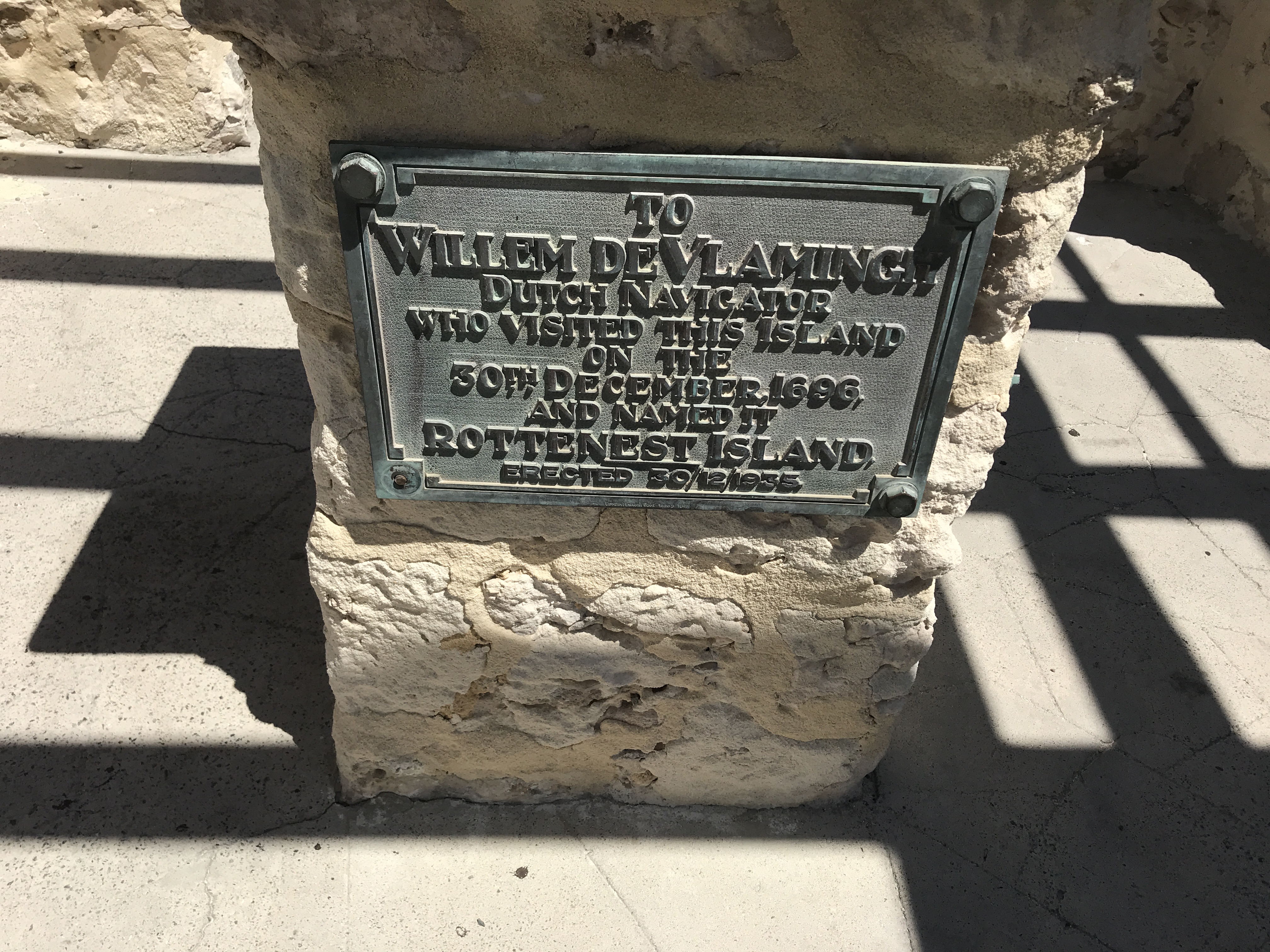
Bronze Tablet, Vlamingh Memorial, 1935
Credit: Shino Konishi, 2019
The memorial had been an initiative of the Rottnest Board of Control, supported by the Western Australian Historical Society and the state and commonwealth governments, and was intended to symbolize the ‘friendly relations between the Netherlands and Australia’ (‘Vlamingh Memorial’ 1935). The ceremonial unveiling was attended by dignitaries representing Australia, the Netherlands, and Britain, and was described, at the time, as the most prestigious event ever hosted on the island. In lieu of a hoped-for visit from a Dutch warship, the Netherlands was represented by E. Straatemeier, the managing director of the K.P.M. Steamship Line, and Dr Frans Rijndert Johan Verhoeven, assistant to the Director of National Archives (‘For Rottnest Ceremony: Dutch Visitors Arrive: Tablet Unveiling’ 1935).
On 30 December 1935, the event’s dignitaries sailed to Thomson Bay, passing a fleet of decorated boats forming ‘a long guard of honour’ (‘Vlamingh Honoured’ 1935). They were welcomed by the Young Australia League Band, playing the national anthem, and then made their way to View Hill for the unveiling ceremony and a series of speeches which were broadcast on national radio (‘Rottnest Island’, Sydney Morning Herald, 31 December 1935). Paul Hasluck from the Western Australian Historical Society traced the history of early Dutch exploration. Western Australian Member of Parliament William Kitson unveiled the memorial plinth, proclaiming the ceremony marked ‘the first occasion on which official recognition has been given to one of the earliest known discoverers of this island and our state’ (‘Vlamingh Honoured’ 1935).
The Dutch dignitaries commented that while De Vlamingh was not well known at home, he represented the historical relationship between Australia and its neighbour, the Netherlands Indies (‘Vlamingh’s Lookout’ 1935). Straatemeier observed that the local dunes reminded him of ‘those along our shores of the North Sea’ and exclaimed ‘we can now understand why [De Vlamingh] called the land New Holland’ (‘Vlamingh Honoured’ 1935). He also hoped for the forging of closer trade ties, explaining that it was ‘the sea and the journeys of exploration for commercial possibilities in the past which brought us to Australia; it is now, and shall be, the sea and commerce which will bind us still closer in friendly relationship’ (‘Vlamingh Honoured’ 1935). The Dutch then presented one of the memorial’s bronze tablets marked with the words ‘Hier Landde 30 XII 1696 Willem de Vlaming’.
This memorial commemorating De Vlamingh was not the last. In 1974 an obelisk was erected to commemorate his supposed arrival at Cottesloe Beach. In 1997, the tercentenary of his landing in Western Australia saw a monument unveiled at Cape Inscription Lighthouse and a life-size statue of De Vlamingh erected at Burswood Park (Monuments Australia, Vlamingh’s Landing, n.d.; Monuments Australia, Tricentenary, n.d.). Finally in 2007 the Vlamingh Memorial Sundial was opened on the Swan River foreshore to commemorate his discovery of the Swan River and celebrate continuing links between the cities of Perth and Amsterdam (Monuments Australia, De Vlamingh Memorial Sundial, n.d.; Smith Sculptors 2013).
De Vlamingh’s voyage was considered a disappointment in 1697. It did not find the missing ship and its natural history discoveries seemed of little benefit to the VOC (Curthoys, Konishi and Ludewig 2023:28-30). However, the Vlaming Memorial and Lookout and other commemorative monuments reveal De Vlamingh’s enduring legacy as both a symbol of the early European exploration in Western Australia and the forging of diplomatic links between Australia and the Netherlands.
References
Curthoys A, Konishi S and Ludewig A (2023) Lives and Legacies of a Carceral Island: A Biographical History of Wadjemup/Rottnest Island, Routledge, Abingdon.
Monuments Australia (n.d.) Vlamingh’s Landing, Monuments Australia website, accessed 12 February 2018.
Monuments Australia (n.d.) De Vlamingh Memorial Sundial, Monuments Australia website, accessed 12 February 2018.
Monuments Australia (n.d.) Tricentenary of Vlamingh’s Visit to Dirk Hartog Island, Monuments Australia website, accessed 12 February 2018.
Smith Sculptors (2013) Willem De Vlamingh and the Black Swan, Smith Sculptors Website, accessed 12 February 2019.
Sunday Times (29 December 1935) ‘Vlamingh’s Lookout’, Sunday Times, accessed 7 November 2024.
Sydney Morning Herald (31 December 1935) ‘Rottnest Island’, Sydney Morning Herald, accessed 7 November 2024.
The West Australian (12 July 1935) ‘Vlaming Memorial: Rottnest Island Project. Dutch Co-operation Invited’, The West Australian, accessed 7 November 2024.
The West Australian (9 November 1935) ‘Famous Dutch Navigator Commemorated’, The West Australian, accessed 7 November 2024.
The Daily News (28 December 1935) ‘For Rottnest Ceremony: Dutch Visitors Arrive: Tablet Unveiling’, The Daily News, accessed 7 November 2024.
Western Mail (2 January 1936) ‘Vlamingh Honoured’, Western Mail, accessed 7 November 2024.