- references to death, dying, and/or grief.
- descriptions of physical violence and cruelty.
- references to sexual abuse.
Beatrice Glow’s Textures of Time (2025) takes us beneath the waterline on a haunting tour of imperial debris that littered the seafloor. Glow harnesses VR technology to imagine salvaged artefacts from shipwrecks that form part of the Western Australian Museum’s collections back in their watery graves, partly submerged in silt and sand. Weapons and ammunition are among the objects that scatter the seabed. They include a bag of lead musket balls (BAT7088) that were aboard the doomed Dutch East India Company (VOC) ship Batavia that wrecked off the Houtman Abrolhos Islands in 1629. Centuries of exposure to sea water and sea creatures transformed the lead shot into a concretion, an assemblage of metal and the remnants of marine organisms (Quigley 2023).
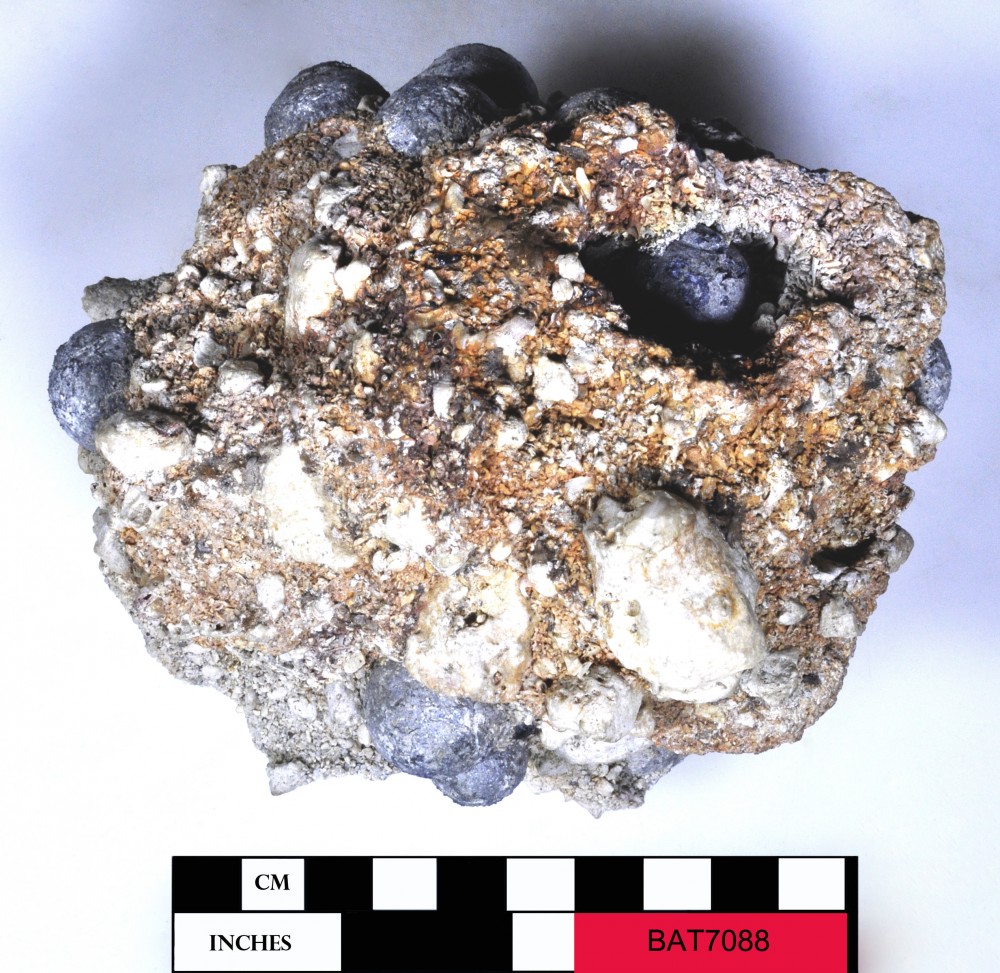
Musket balls from the VOC ship Batavia in concretion
Credit: Western Australian Museum, Department of Maritime Heritage
Museum displays centred on Dutch maps, nautical tools like astrolabes, and beautiful luxury trade goods might generate conversations about the Dutch as excellent cartographers, navigators, and merchants. In contrast, exhibiting the caches of weapons that the VOC transported around the world can prompt us to confront the violence that was integral to imperial expansion in the Indian Ocean world. Batavia, like other VOC ships, was heavily armed when it departed Texel bound for Java. Aboard were at least 30 cannon and over three thousand pieces of iron shot for big and small guns, in addition to a large quantity of langrel shot which comprised two balls or half-spheres of cast iron connected with an iron bar or chain (Duivenvoorde 2010; Green 1989:59, 71).
Weapons and ammunition were necessary to defend VOC ships against pirates and other enemies at sea. The Dutch and other European naval forces used cannon and langrel in naval battles, where the latter was particularly effective at destroying sails and rigging and clearing bodies from decks (Ní Chíobháin 2011:50; Green 1989:59). The VOC also used these military technologies to wage war against the populations that they wanted to subjugate. Across the East Indies, the VOC used cannons mounted on ships to bombard and weaken enemy forts and villages before sending soldiers in to fight (Dhont 2023:196-197).
Today Batavia is the most well known VOC wreck because of its macabre history. Stranded on the Houtman Abrolhos Islands for several months in 1629, one group of castaways set about raping and murdering their fellow shipwreck survivors, resulting in the brutal deaths of at least 125 men, women, and children. This violence is often framed as exceptional, distracting us from the killings that agents of the VOC carried out across the region.
The 1621 Banda genocide is a case in point. The seven small islands of the Banda archipelago lie two thousand kilometres northeast of Java. These islands were the only place on earth where nutmeg and mace were cultivated when the VOC was founded. In 1615, the Heeren XVII (Seventeen Gentlemen) who formed the board of the VOC in Amsterdam concluded that the ethnic cleansing of Banda was the only viable path to monopoly. They instructed the Governor of the Dutch East Indies to ‘conquer the Bandanese, exterminate and chase out their leaders, and to preferably repopulate the land with ‘heathens,’ a term they used to refer to non-Dutch settlers like the Chinese whom they perceived as being more compliant (Dhont 2023:195-96).
In 1621 the Governor of the Dutch East Indies, Jan Pietersz Coen, carried out this premeditated atrocity, leading a Dutch force of at least 1600 soldiers and twelve ships in an attack on the Banda Island of Lonthor. On May 8, his men massacred 44 Bandanese leaders. As survivors fled to the hills, the invaders weaponized starvation against them, blockading the island whose monoculture had made them dependent on imported food. Historians estimate that 6,000 Bandanese starved to death that year. The VOC forcibly migrated 789 Bandanese to Java, the majority trafficked into slavery. An estimated 1,700 refugees fled to the islands of Kei and Seram and other sites of safety, ensuring the survival of their language, culture, and enduring memories of genocide (McGregor and Dragojlovic 2024:602-4). What is striking is that this violence was uncontroversial for the Dutch. Leading jurists like Hugo Grotius regarded the massacres of Indigenous populations ‘as proportionate punishment’ for violating VOC contracts (Benton 2024:23-24).
Glow’s work offers a nuanced reflection on the patterns of violence that were so often entangled with the production of luxury and wealth in the early modern world. Her piece Explo'deur (2021) renders a Second World War-era ‘pineapple’ hand grenade in recognizably Delftware-style—the viral Dutch-made blue and white ceramics inspired by the Ming Chinese porcelains that the VOC imported into Europe. Contemporary cultural practitioners and the broader museum field continues to find resonance in how cultural production and trade goods that historically circulated intercontinentally between Asia, Europe, and the Americas continue to influence contemporary material and visual culture. Countering ‘historical amnesia,’ Explo'deur disrupts romanticised memories of the Dutch Golden Age, and prompts a confrontation with the mass death and dispossession that facilitated the global trade in opulent commodities across the world’s oceans—the paradox of luxury (Glow and Evangelista 2024).
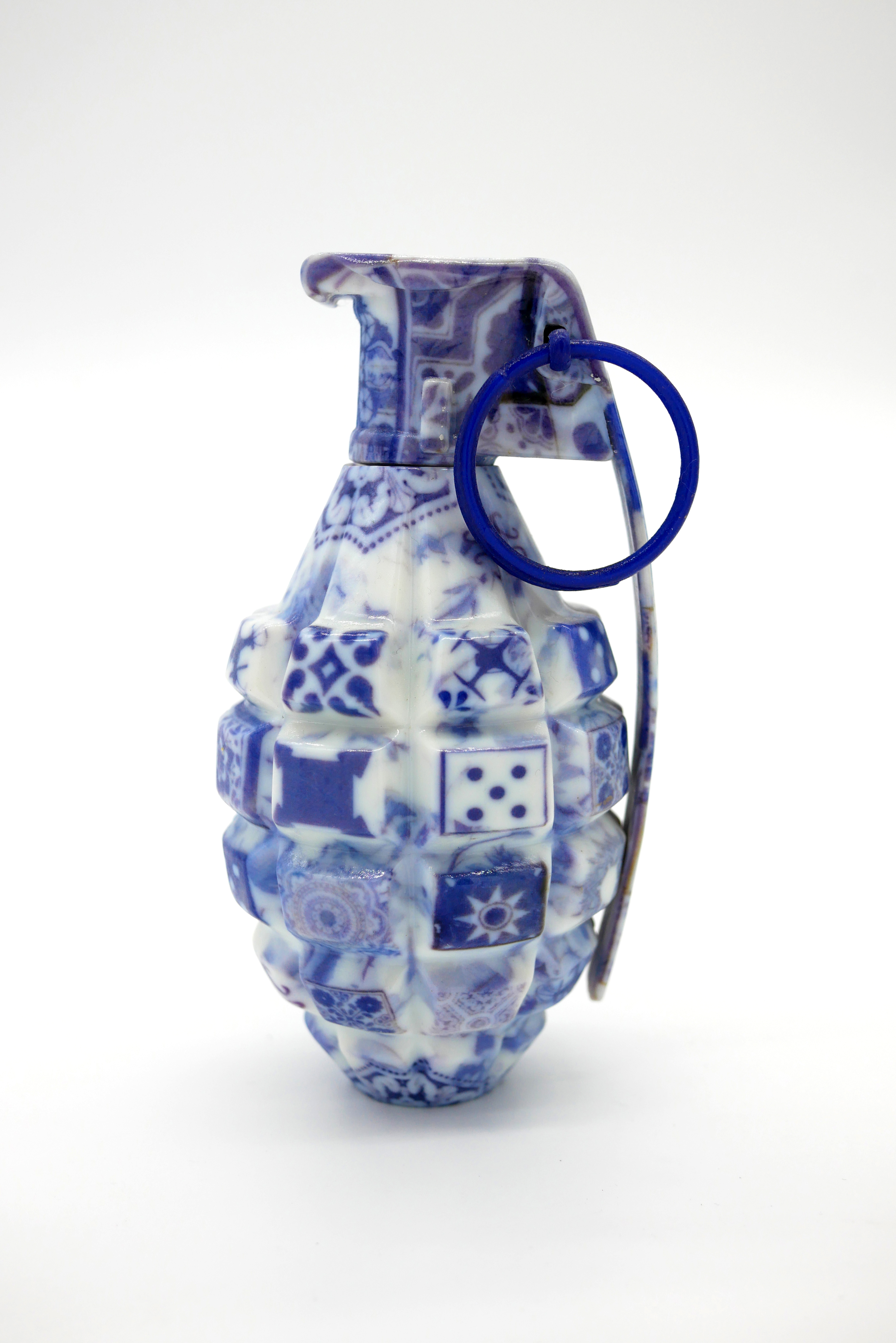
Beatrice Glow, Explo'deur — Delft, 2021, VR-sculpted 3D print, photopolymer resin, enamel coating, 6 x 3.75 x 3.25 in.
Credit: Beatrice Glow
References
Benton L (2024) They Called It Peace: Worlds of Imperial Violence, Princeton University Press, Princeton and Oxford.
Dhont F (2023) ‘Genocide in the Spice Islands: The Dutch East India Company and the Destruction of the Banda Archipelago Civilisation in 1621,’ in Blackhawk N, Kiernan B, Madley B and Taylor R (eds), The Cambridge World History of Genocide: 186-214. Cambridge University Press, Cambridge.
Games A (2020) Inventing the English Massacre: Amboyna in History and Memory. Oxford University Press, New York.
Glow B and Evangelista K (27 August 2024) ‘An Interview with Beatrice Glow,’ Art Summit, accessed 17 November 2025.
Green JN (1989) The Loss of the Verenigde Oostindische Compagnie Retourschip Batavia, Western Australia 1629, BAR International Series 489, British Archaeological Reports, Oxford.
McGregor K and Dragojlovic A (2024) ‘Songs from Another Land: Decolonizing Memories of Colonialism and the Nutmeg Trade,’ Memory Studies 17(3):599-612.
Ní Chíobháin D (2011) The Arming of Late 16th Century Merchantmen [Masters Thesis], Maritime Archaeology Programme, University of Southern Denmark.
Quigley K (2023) ‘Concretion: Submarine Growths and Imperial Wrecks,’ Critical Times 6:517–39.
Van Duivenvoorde W (2010) The Armament of Australia’s VOC Ships, Report No. 258, Department of Maritime Archaeology, Western Australian Museum, Perth.