In April 1656, the VOC ship Vergulde Draeck (Gilt Dragon) was wrecked on a reef off the Western Australian coast, near what is now Ledge Point. While understeersman Abraham Leeman and six other men survived a harrowing journey to Java to tell the tale, the fate of the other 68 survivors of the wreck remains unknown (Henderson 1982).
Less than twenty years later, the Anglo-French author Denis Varaisse (or Veiras) used this shipwreck as the starting-point for a utopian fantasy. In his story, the Gilt Dragon survivors, under Captain Siden (an anagram of Denis), send a search party into the interior, where they discover the advanced civilization of the Sevarambes—named after their founder Sevarias (an anagram of Varaisse). Varaisse (c. 1630-c. 1696) was a Huguenot exile who worked in London as a teacher and part-time spy. His utopia, perhaps predictably, advocates religious and social freedom.
The History of the Sevarambes was first published in five volumes between 1675 and 1679, and proved very popular. At least 22 editions in four different languages (English, French, Dutch, and German) appeared over the next hundred years. Its influence can be seen in Voltaire and Rousseau, as well as in Defoe and Swift—in Gulliver’s travels, Lilliput is probably located in the Tasman Sea and Houhynhnmland to the south of Australia (Spate 1987:28-29).
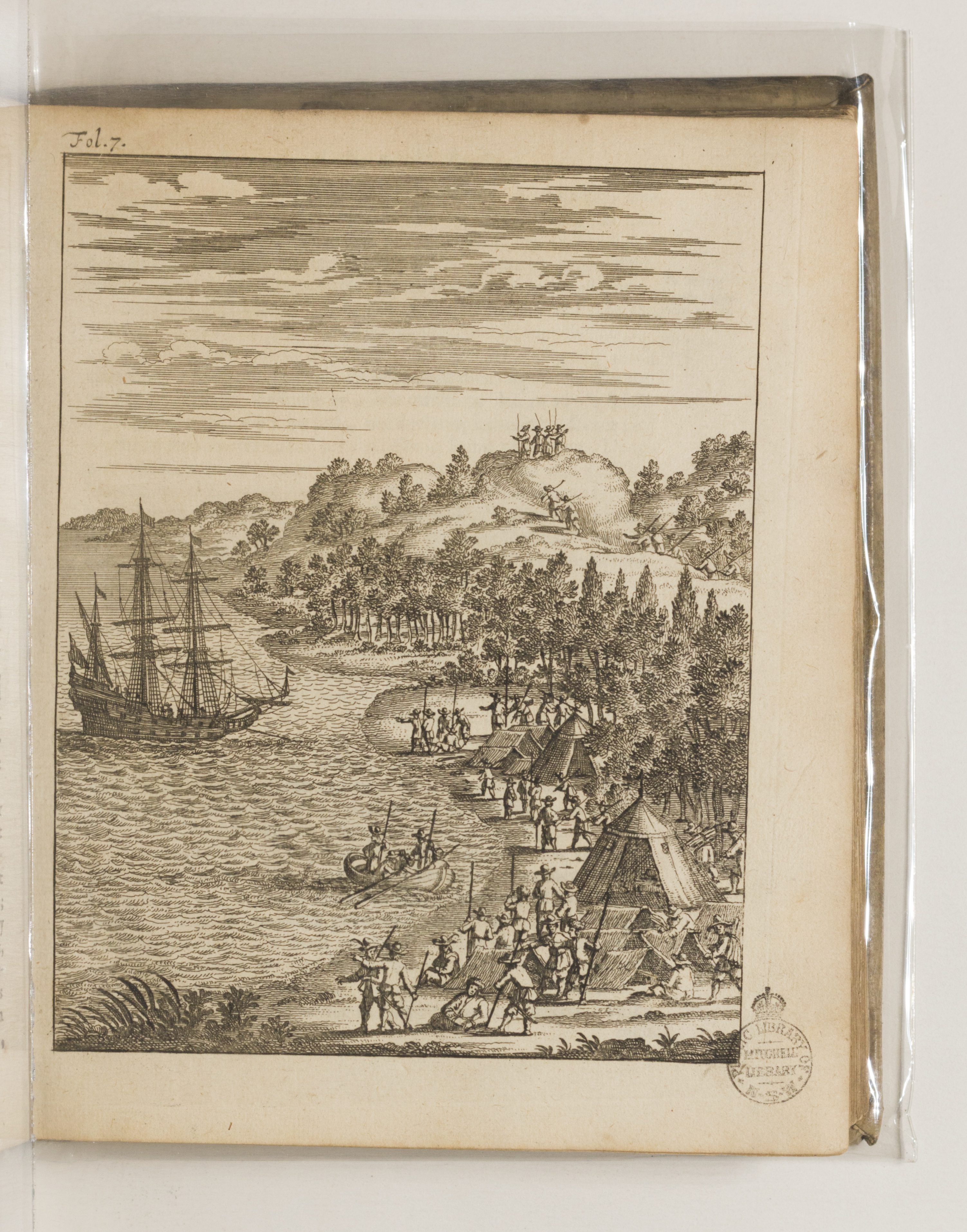
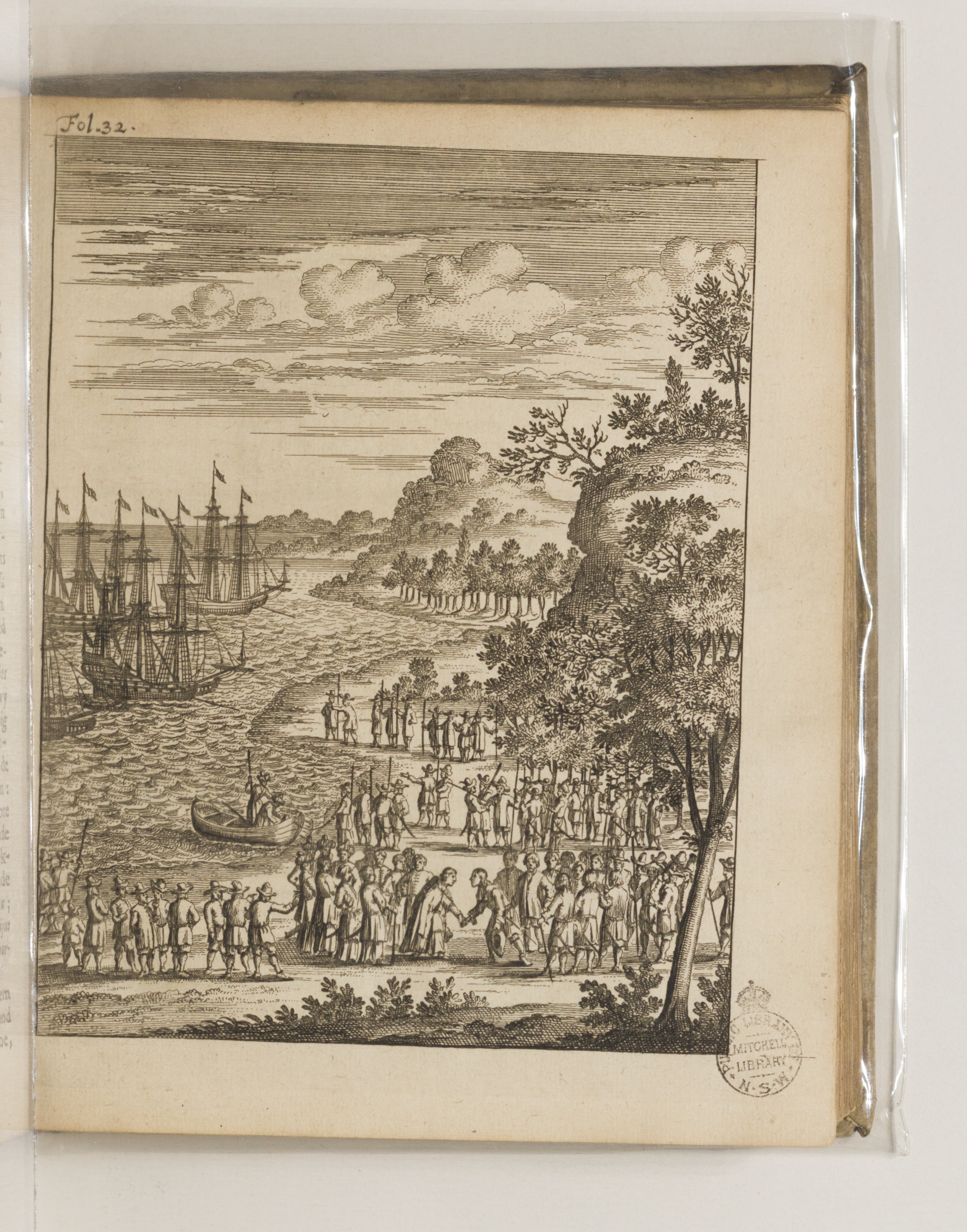
These two illustrations come from the 1682 Dutch edition held by the State Library of New South Wales (DSM/910.43/2F1), which included a full set of fourteen engravings. The two views of the coast, showing the local inhabitants and landscape, with Dutch ships offshore, are purely imaginary and bear no resemblance to the Australian continent.
The History of the Sevarambes was one of the earliest examples of fantastic fiction inspired by European voyages to the Great South Land and the Southern Ocean. Others included Gabriel de Foligny’s La terre australe connue (1676), Simon Tyssot de Patot’s Voyage et avantures de Jacques Massé (1710), and Nicolas Restif de Bretonne’s La découverte australe (1781). Even in the 19th and 20th centuries, fantastic fiction was still envisaging unknown civilizations in the centre of the Australian continent, or underneath it, particularly in connection with the idea of the vanished continent of Lemuria, popularized in G. Firth Scott's novel The last Lemurian: a Westralian romance (1898).
Vergulde Draeck has also been the subject of at least one realistic historical novel: The Gilt Dragon Incident, by James H. Turner (1963). But its place in Australian creative works has been overtaken by those that reference the dramatic events associated with the wreck of Batavia in 1629. In the last hundred years, the events following the wrecking of Batavia have inspired at least fourteen novels, a French graphic novel, eight plays, seventeen poems, and various artworks, as well as an opera by Richard Mills and Peter Goldsworthy.
As The History of the Sevarambes demonstrates, it did not take long for the VOC shipwrecks along the Western Australian coast to capture the imagination of Europeans, even though the initial manifestations of this interest bore no resemblance at all to reality. Varaisse’s utopian fiction remains a fascinating curiosity, which inspired many subsequent readers.
References
Henderson JA (1982) Marooned: the wreck of the Vergulde Draeck and the abandonment and escape from the Southland of Abraham Leeman in 1658, St. George Books, Perth.
Scott GF (1898) The last Lemurian: a Westralian romance, Bowden, London.
Spate OHK (1987) ‘The Pacific: home of utopias,’ in Kamenka E (ed) Utopias: papers from the annual symposium of the Australian Academy of the Humanities, Oxford University Press, Melbourne:20-34.
Turner JH (1963) The Gilt Dragon incident, Paterson’s, Perth.
Vairasse D (1682) Historie der Sevarambes, vokeren die een gedeelte van het darde vast-land bewoonen, gemeenlijk Zuid-land genaamd, Timotheus ten Hoorn, Amsterdam.