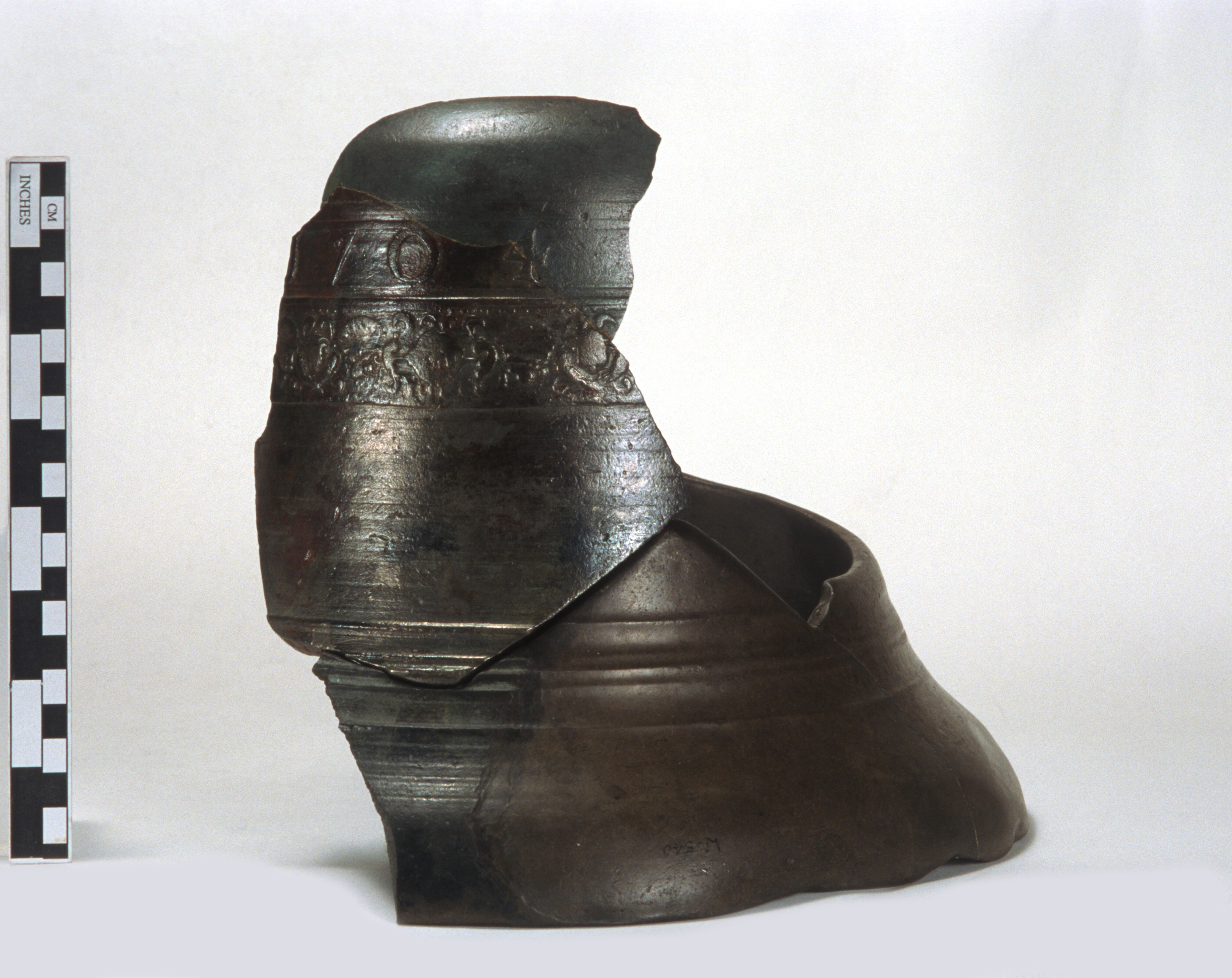
Credit: Western Australian Museum, Department of Maritime Heritage.
The bronze ship’s bell from the shipwreck of Zuytdorp (1727) held in the Western Australian Museum is a fragment in two parts. The bell has two decorative bands below the shoulder on the upper body, and a simple register detail for the belt before the bell flares out at the base. The upper band on the shoulder shows what remains of an inscription—‘1704’.
Many ships’ bells carry the name of the ship—something that makes them prized mementos for individuals who have served on them or communities that are associated with them. This is not always the case. The VOC ship Geldermalsen’s (1752) bell held in the Zeeuws Museum (M86-066), for example, bears the Latin inscription
ME FECIT CIPRIANUS CRANS JANSZ ANNO 1747
Ciprianus Crans Jansz made me in the year 1747 (Jörg 1986).
Another ship’s bell, held in the Scheepvaartmuseum, Amsterdam (S.3772), has a similar style of inscription
GILLES VAN DE GILDE MF 1704
Gilles van de Gilde made me 1704
The Scheepvaartmuseum bell also carries the inscription ‘Z VOC M’, identifying the bell as issued for the Zeeland Chamber of the Dutch East India Company (VOC), located in Middelburg.
Both of these examples refer to the foundry which cast the bronze. Similar types of inscriptions are also found on other large cast items of the period, such as cannons. The part of the inscription that would identify the maker of the Zuytdorp bell is missing, but it can be assumed that 1704 refers to the date the bell was cast. This is three years after the ship was built and fitted out in 1701. This suggests this bell was not part of the ship’s initial inventory but added sometime later and before it was wrecked in 1712.
Keeping time
Ship’s bells were used for communicating time and associated duties on board. This is reflected in how they are referred to in Dutch as both klok (scheepsklok—ship’s clock) and bel (scheepsbel—ship’s bell). This can be seen in the object description records for the Geldermalsen and Scheepvaartmuseum bells mentioned above.
On board a ship the day was divided into six periods of duty known as watches and the striking of the bell communicated the passage of time across those watches. Before the invention of reliable watches, a sandglass (Dutch zandloper) was used to indicate when a half-hour of time had passed: note this example from the Scheepvaartmuseum Amsterdam.
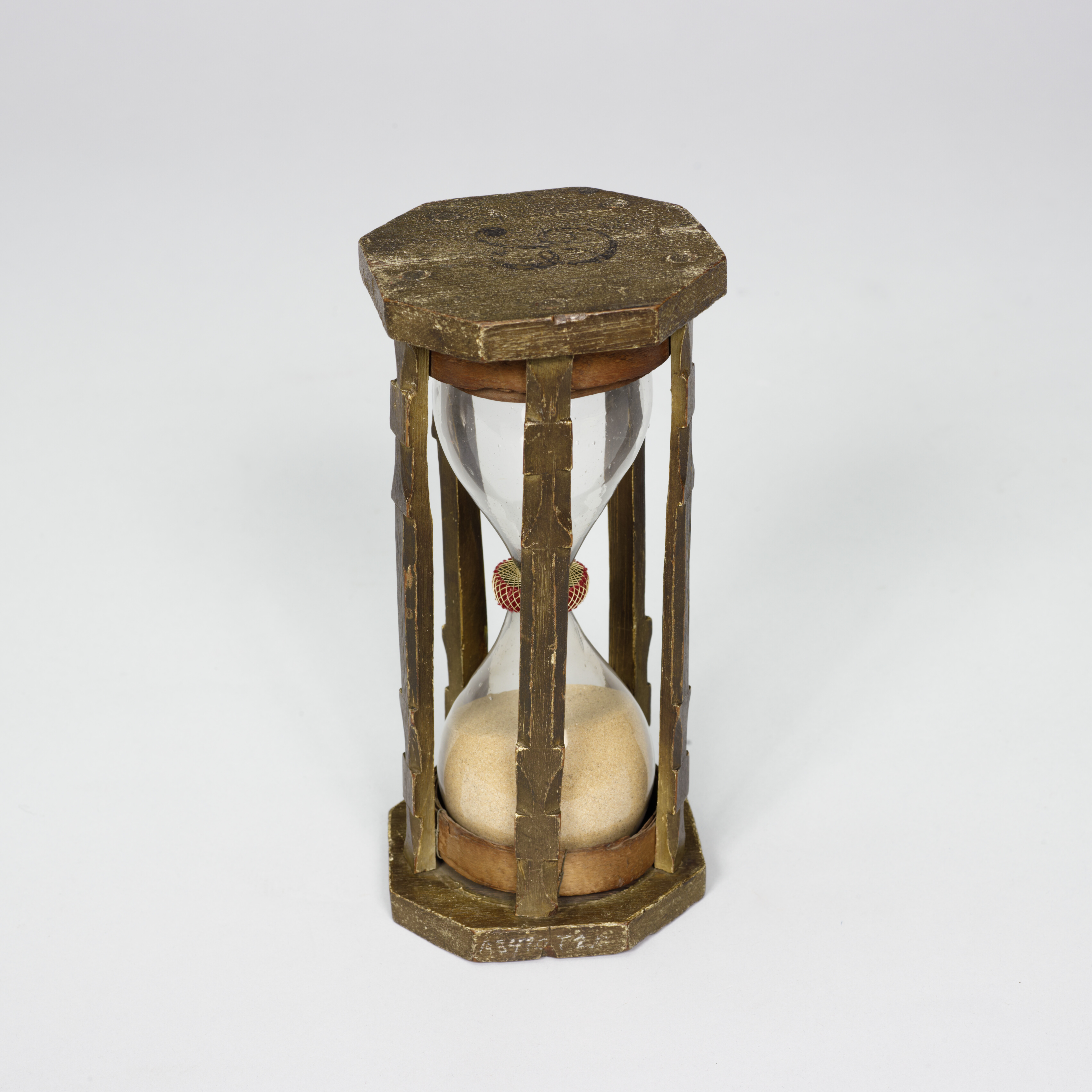
Credit: Collectie Het Scheepvaartmuseum/The National Maritime Museum, Amsterdam.
Unfortunately, the temperature, atmospheric pressure, and the quality of sand, all affected the ability of a sandglass to keep effective time, not to mention that the person on duty had to remember to keep a close eye on the sandglass. This inability to reliably keep time had real world consequences for VOC ships: ships could not accurately calculate longitude without the time and had to rely on dead reckoning. One of the many factors that may have contributed to the wrecking of Zuytdorp was the miscalculation of its location (note Stelten and van Duivenvoorde 2024 for a thorough overview of contributing factors to the wrecking of Zuytdorp).
Archaeological context
The bell was first located in January 1971 by Harry Bingham and Geoff Kimpton, part of a Western Australian Museum diving team monitoring the site. The bell was cemented to the vertical face of the shoreline reef (McCarthy 2006). Working with hammers and geopicks, in what is an incredibly dangerous and changeable diving environment, they were only able to retrieve a section (ZT540) before the seas became too rough and work was abandoned.
The volatility of the conditions was an ongoing concern and limited the effectiveness with which the Museum’s team could access and investigate the site. On the hand full of calm days each year the shoreline reef was readily accessible from either the sea or the land. This unfortunately made the shipwreck site a target for opportunistic souveniring and looting. This included the second part of the bell now held by the Western Australian Museum (ZT4282), which was handed into the Museum under amnesty. It had been illegally souvenired from the site with other artefacts (McCarthy 2006).
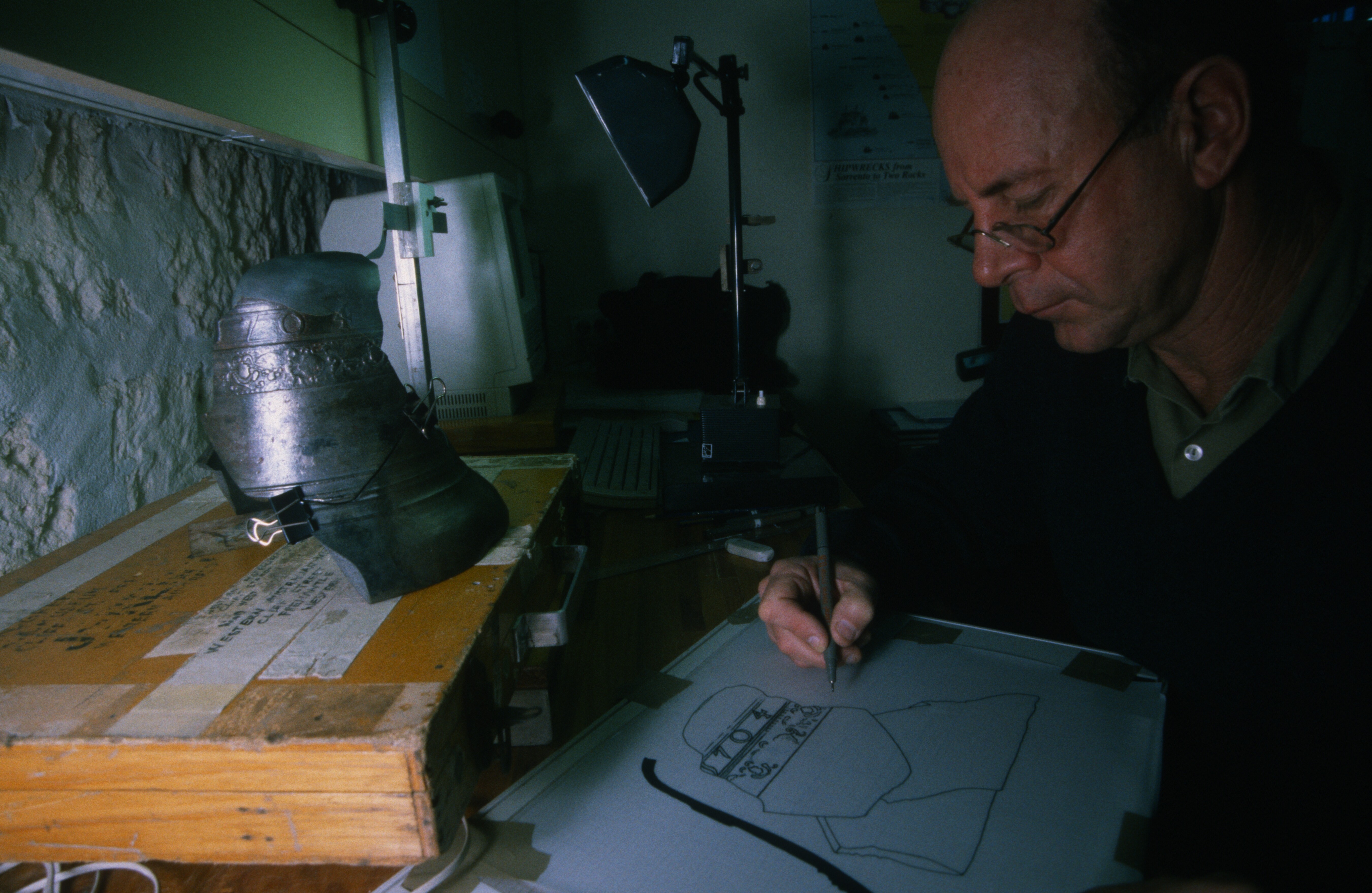
Credit: Western Australian Museum, Department of Maritime Heritage.
The original position in which the bell was found in 1971, in conjunction with the concentration and location of other artefacts across the site, helped archaeologists understand how the vessel came to rest upon the reef, also known as site formation (McCarthy 1998; 2002; 2009; Stedman 2009). Detailed mapping of the site assisted by data from historical ortho-photographs identified that the sea bed was shallower out to sea, than in inshore, where the majority of artefacts came to rest-in a shallow depression within a few metres of the top of the reef, at the foot of what are now called the Zuytdorp Cliffs (McCarthy 1998; 2009). The bell, as heavy as it is, was found cemented on a vertical face of the reef, off the seafloor. In such a dynamic environment, this could only have occurred if it was held in place, against the reef, for a long time.
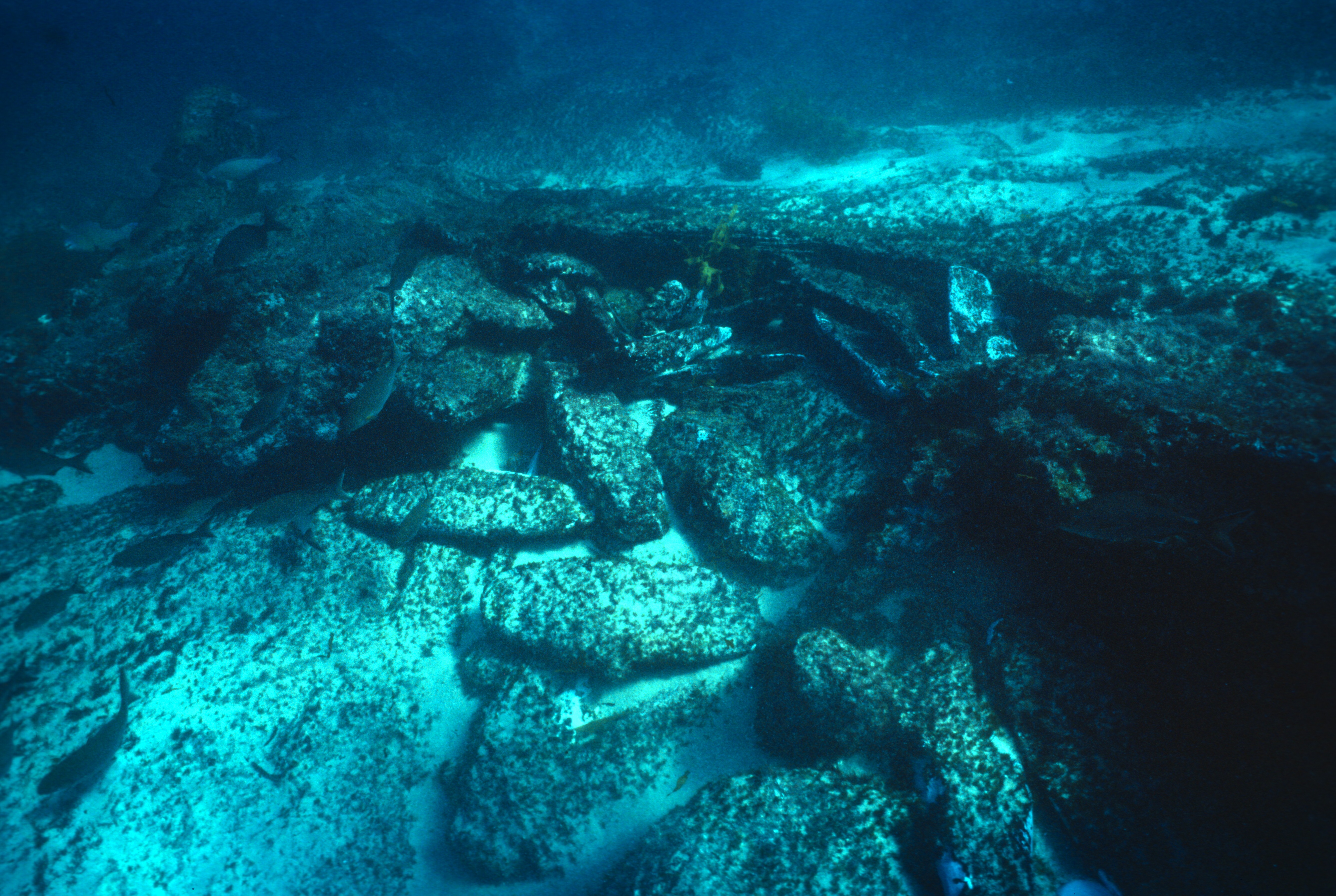
Credit: Western Australian Museum, Department of Maritime Heritage.
Analysis of the landscape and artefact scatter informed the Western Australian Museum's maritime archaeologist that the wrecked ship came to rest on its side, broadside to the cliffs with the bow pointing to the southeast. The data also indicated this occurred because the ship initially struck a shelving reef approximately 100 m offshore, causing Zuytdorp to founder in the shallow water and roll onto its side. The surf then pushed the vessel across the reef, towards the cliffs, at which time loose items on the deck were lost overboard. At some point, the hull breached and the heavy cargo (or paying ballast) of approximately 80 lead ingots were released onto the reef platform, lightening the wreck enough to be pushed over the shallow ridge of the reef and into its final location (McCarthy 1998; 2002; 2009; Stedman 2009). It is here that Zuytdorp gradually broke into pieces. Despite the strength of the surf, the marine environment grew around items, concreting the cannon and cementing the ship’s bell into the reef. It was the location of the ship’s bell off the seafllor and away from the other associated items that helped piece together the final moments of Zuytdorp.
The Zuytdorp bell is on display at the WA Shipwrecks Museum.
References
De Wet T, Teugels JL and Van Deventer P (2023) ‘Bells in the Western Cape of South-Africa,’ Carillon and Bell Culture in the Low Countries 2(1):1-44.
McCarthy M (1998) ‘Investigations at the Zuytdorp sites 1971-1994’, in JN Green, M Stanbury, and FS Gaastra (eds) The ANCODS Colloquium: papers presented at the Australian-Netherlands colloquium on maritime archaeology and maritime history, Special Publication 3, Australian National Centre of Excellence in Maritime Archaeology, Fremantle, W.A.
McCarthy M (2002) Chronological précis of events occurring in Stage 3 of the WA Museum at the Zuytdorp site(s) for the ANCODS meeting December 2002, Report No. 173 [Unpublished], Department of Maritime Archaeology, Western Australian Museum, Perth.
McCarthy M (2006) ‘The Dutch on Australian shores, the Zuytdorp tragedy—unfinished business’, in L Shaw and W Wilkins (eds) Dutch connections: 400 years of Australian-Dutch maritime links, 1606-2006, Australian National Maritime Museum, Sydney.
McCarthy M (2009) Zuytdorp: unfinished business, Report No. 256, Department of Maritime Archaeology, Western Australian Museum, Perth.
Stedman J (2009) An Archaeological Study of Zuiddorp’s Lead Ingots [Masters Thesis], University of Western Australia. Report No. 184, Department of Maritime Archaeology, Western Australian Museum, Perth.
Stelten R and van Duivenvoorde W (2024) ‘Mishaps in the Land van Eendracht: Exploring the Cause of Zuytdorp’s Wrecking’, Journal of Maritime Archaeology 19:407-426.