- references to death, dying, and/or grief.
- images or descriptions of human remains.
In the main gallery of WA Shipwrecks Museum visitors are often surprised to view a full human skeleton on display near the impressive reconstruction of the salvaged hull of Batavia wreck. The name of this skeleton is unknown but forensic science reveals that the ‘(i)ndividual BIB-3 is a male, 20-34 years of age and 1.82 m tall; a cut mark in the frontal bone was likely caused by a sharp-bladed instrument, although it cannot be established if that injury contributed to the death of that individual’ (Pasveer et al. 1998 cited Franklin 2020). This victim was discovered in a shallow grave at approx. 40 cm deep on Beacon Island in 1963 and is part of the complex and horror-filled story of Batavia, which was one of the first recorded contacts with Australia by Europeans in 1629. The VOC Batavia was wrecked, on its maiden voyage, on the Morning Reef of the Houtman Abrolhos on 4 June 1629, a subsequent munity and complex events led to the brutal murders of over 100 men, women, and children on these low-lying coral islands.
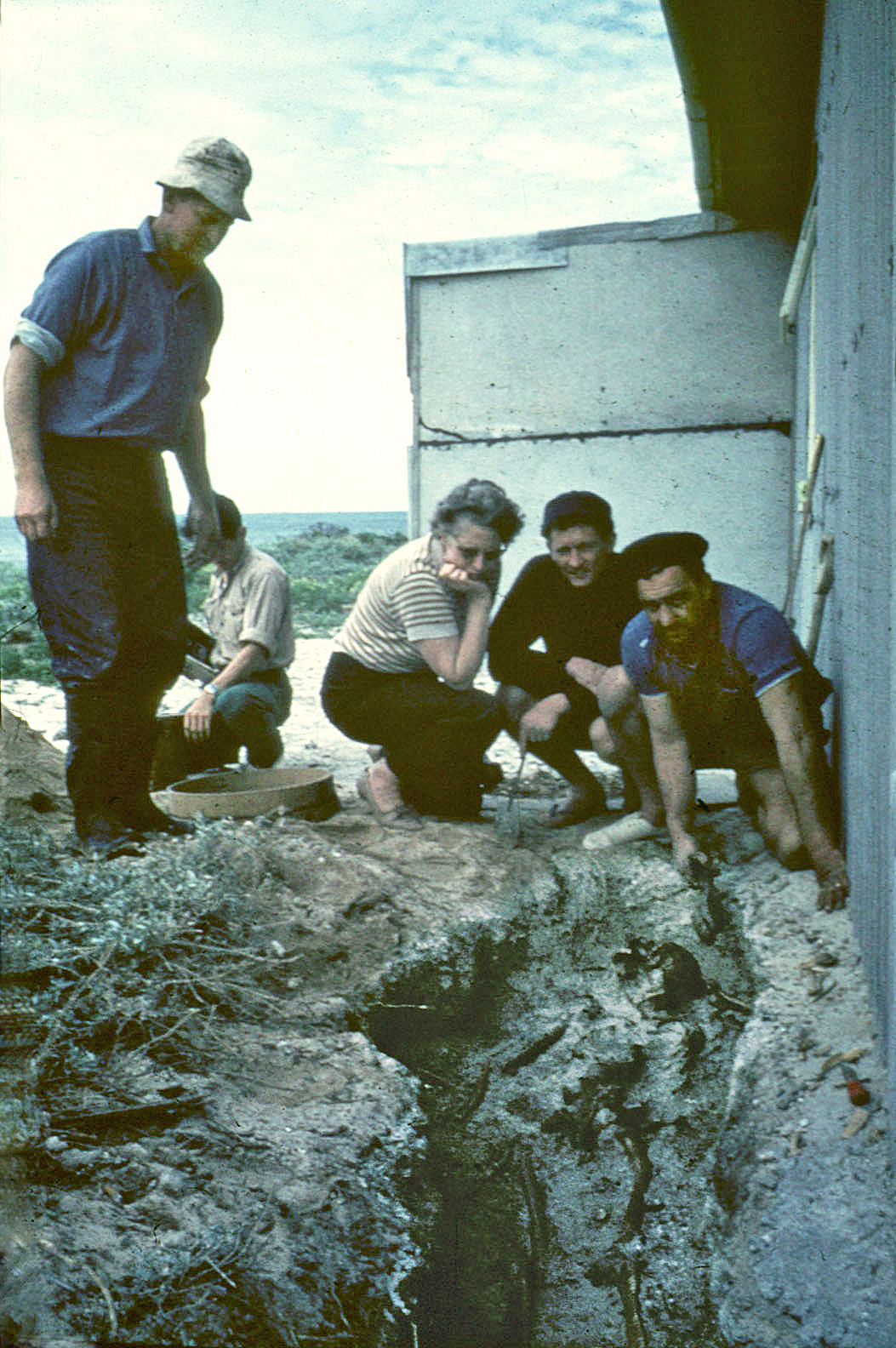
Remains discovered in 1963 with Henrietta Drake-Brockman, Hugh Edwards and George Brenzi pictured. Photograph taken by Merve Brown.
Credit: Western Australian Museum, Department of Maritime Heritage (BT/H/59)
In many ways skeletal remains within the museum context can remind us of the tradition of vanitas painting. Vanitas, a genre within Dutch 17th century painting, often featured arrangements of flowers, fruit, domestic objects such as vases and glassware, alongside symbols of mortality, such as skulls and skeletons. These compositions carried a moral imperative, reminding the viewer of life’s impermanence and the futility of worldly pursuits—as material wealth, titles and honours, hold no value in the afterlife (Schneider 2003). These paintings, often of modest domestic scale, were designed as symbolic moral instruction for the newly wealthy merchant class, whose purchases funded the flourishing new art market. The fabric of Dutch society was driven by Calvinist principals which underlined the importance of the supremacy of God, work ethic, and personal discipline. An example is Vanitas Still Life with the Spinario by Pieter Claesz 1628 (Rijksmuseum n.d.). This sombre tonal work gives the studied impression of an everyday corner of an artist’s studio, with books, notes, and sundry items along with the tools of a painter’s trade, the palette, brushes, and painters’ stick. The human bones and skull are central contemplative devices for this composition and we are therefore reminded that life is deceptively ephemeral. The intention for the viewer is to pause and remember to make the best use of their time, for life is short.
![Vanitasstilleven met de Doornuittrekker [Vanitas Still Life with the Spinario], Pieter Claesz (signed by artist), 1628](https://collections.museum.wa.gov.au/sites/default/files/user/5/2025-11/SK-A-3930.jpg)
Vanitasstilleven met de Doornuittrekker [Vanitas Still Life with the Spinario], Pieter Claesz (signed by artist), 1628.
Credit: Rijksmuseum, SK-A-3930
Book of Vanitas: Last Thoughts and Images of a Batavia Victim, 1629 (Uhlmann 2025) is a contemporary vanitas created in response to the skeletal remains housed in the Shipwrecks Museum. Presented as part of the exhibition First Encounters: Artist Interventions with the VOC Shipwrecks (November 2025 – January 2026), this artist’s book reflects on the metaphysical and ecological dimensions of mortality.
The book imagines the final moments of an unknown castaway from the Batavia tragedy, entangled with flora and fauna of the Houtman Abrolhos—seals, wallabies and birds, endemic to the region. These creatures, which once offered sustenance now surround the skeletal figure and invite new readings.
This entanglement serves as a meditation on the fragile balance between life and death, not only for humans but for all living beings. In a time where fragile ecosystems are under threat, it evokes the shared struggle for existence and the deep interconnectedness between humanity and nature.
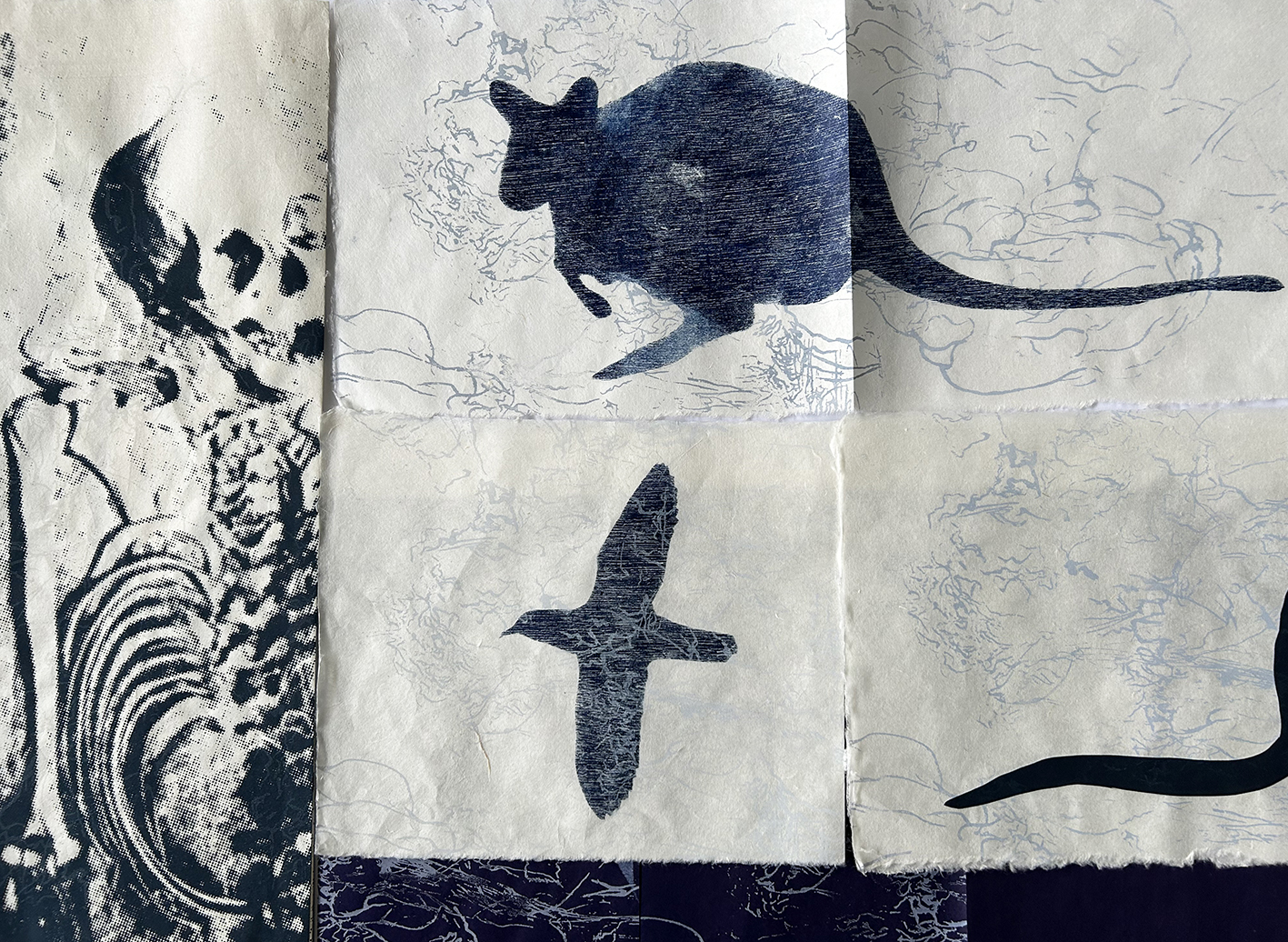
Paul Uhlmann, ‘Book of Vanitas, Last Thoughts and Images of a Batavia Victim 1629’, artist’s book, silkscreen, woodcut on kozo paper, 44cm x2m.
Credit: Paul Uhlmann
Across the globe museums are increasingly reconsidering how to ethically display human remains. This process of reassessment reflects a growing awareness of the cultural, historical, and spiritual sensitivities surrounding such displays. Institutions are exploring new approaches, such as creating rooms which enable visitors to make a choice whether to view the remains, or removing them from public display altogether and repatriating them back to their communities of origin. A standout example is the exhibition Unfinished past: return, keep, or…? of 2025 at the Wereldmuseum Amsterdam, which has decided not to publicly exhibit any of the human remains across their three locations accumulated during their long colonial expansion (Boztas 2025). But one wonders if we were to hide the brutality of the past which is written on the bones of the shipwreck museums’ BIB-3, do we erase reminders of our collective past and airbrush history?
References
Boztas S (4 June 2025) ‘Wereldmuseum Amsterdam suggests new ways to respectfully house human remains,’ The Art Newspaper, accessed 19 October 2025.
Franklin D (2020) ‘Beacon Island Burials: Burial Context and Human Skeletal Remains,’ in Green J and Paterson A (eds) Shipwrecks of the Roaring Forties: Researching some of Australia’s Earliest Shipwrecks, UWA Press, Crawley.
Rijksmuseum (n.d.) 'Vanitasstilleven met de Doornuittrekker’ [Vanitas Still Life with the Spinario], Rijksmuseum Collectie Online, accessed 19 October 2025.
Schneider N (2003) Still Life: Still Life Painting in the Early Modern Period, Taschen, Köln.
Uhlmann P (2025) Book of Vanitas: Last Thoughts and Images of a Batavia Victim,1629 [artist’s book], silk screen, woodcut stencil on Kozo paper dimensions 44 x 200 cm.
Western Australian Museum (n.d.) ‘Beacon Island Burials’, Western Australian Museum, accessed 29 October 2025.
Wereldmuseum Amsterdam (2025) Unfinished Pasts: Return, Keep, or...? [Exhibition], accessed 19 October 2025.