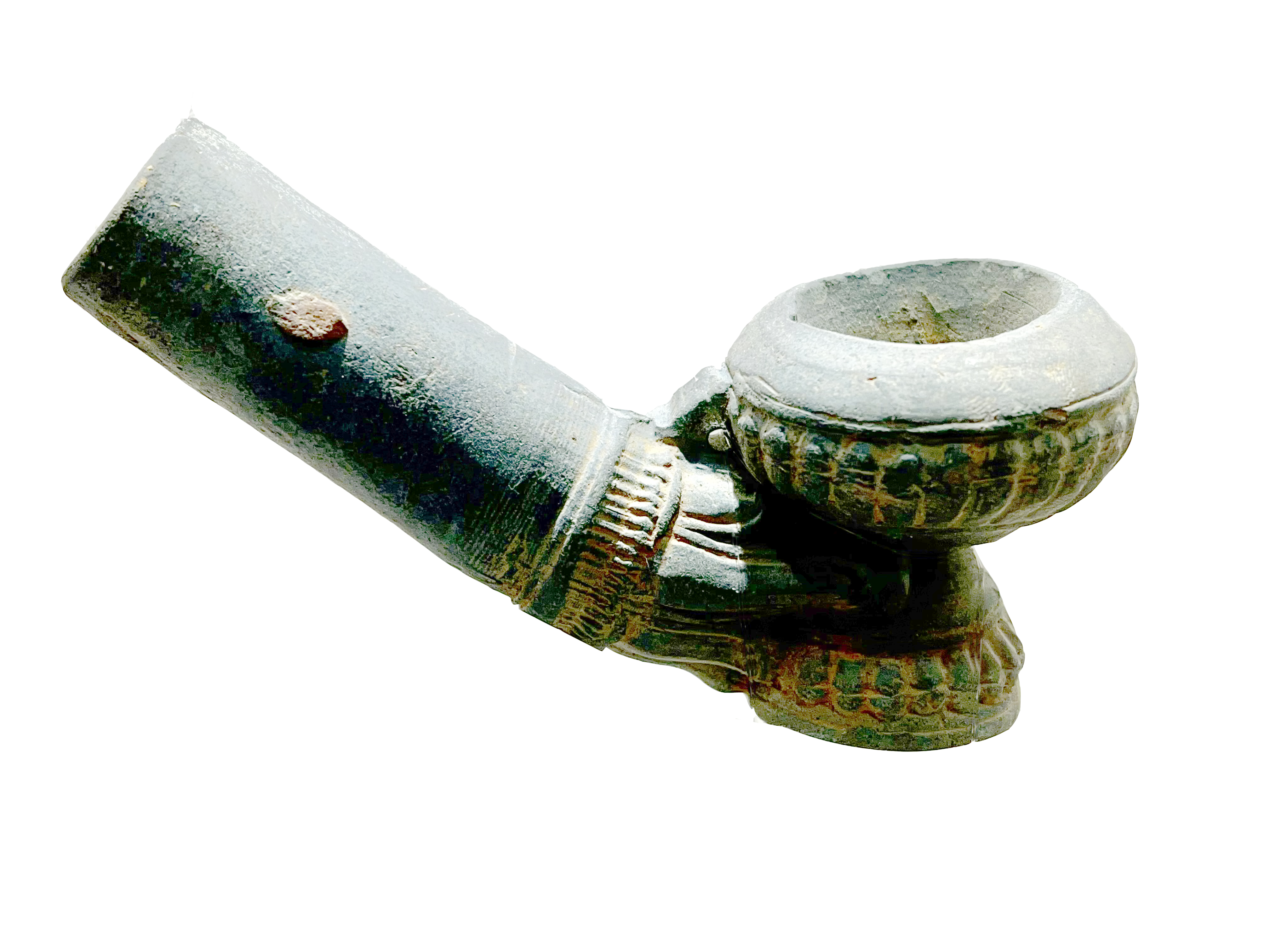
Credit: Western Australian Museum, Department of Maritime Heritage.
During the excavation of the VOC jacht Vergulde Draeck lost in 1656 (Green 1983) an unusual ceramic smoking pipe was discovered. The pipe (GT2056) was found in the lowest level of the excavation and was clearly contemporary with the loss of the ship. Unlike any examples of European pipes of that period, the pipe, was ornate and appeared to be from an Asiatic or Eastern source rather than of Western origin, the decoration resembling an Indian or Hindu–Buddhist tradition. Hein (1984) illustrated similar pipes, both ceramic and brass, during the Thai Ceramic Dating Project seminar held in Adelaide in 1984. The examples were found in Pegu and Ava in Mumbai and in Northern Thailand, respectively. Similar unprovenanced examples of pipes from Northern Thailand were published by Shaw (1981). The subject of these pipes was discussed during the Southeast Asian Ministers of Education Organization (SEAMEO) Project in Archaeology and Fine Arts (SPAFA) meeting on ceramics held in Bangkok and Chiang Mai, Thailand in 1985; where it was noted that a kiln site at Tin Tiang in Laos, close to the Thai border, also produced these pipes.
It is not certain when the pipe left the Indies, it was, however, on board the ship when it departed on its final voyage on 4 October 1655, to be lost on the Western Australian coast 28 April 1656. The presence on the ship in 1656 gives an important date for the production of these pipes, however, it should be noted that the sophisticated level of stylistic development of these pipes, when compared with their European equivalents at that time, is significant.
In Europe, the smoking habit, and the production of clay pipes, is generally accepted to have started at the beginning of the 17th century. By the mid seventeenth century, tobacco was still an expensive commodity and the Vergulde Draeck carried a consignment of European smoking pipes with the typical small bowls. What was smoked in this Asian pipe is, however, difficult to determine; the enormous size of the bowl compared with the European equivalent, suggests that tobacco alone was an unlikely contender, although it could have been supplemented with aromatic plant material. Tobacco was introduced into Asia in the mid- to late-16th century arriving in Japan in 1542 via the Portuguese; and in China via the Spanish in the Philippines. The complex and sophisticated design of the pipe suggests that the design was unlikely to have been developed within the last 100 years. The brass pipes found by Hein showed considerable wear on the decoration, indicating a very long life as a smoking implement—all this suggesting that these pipes predated the introduction of tobacco.
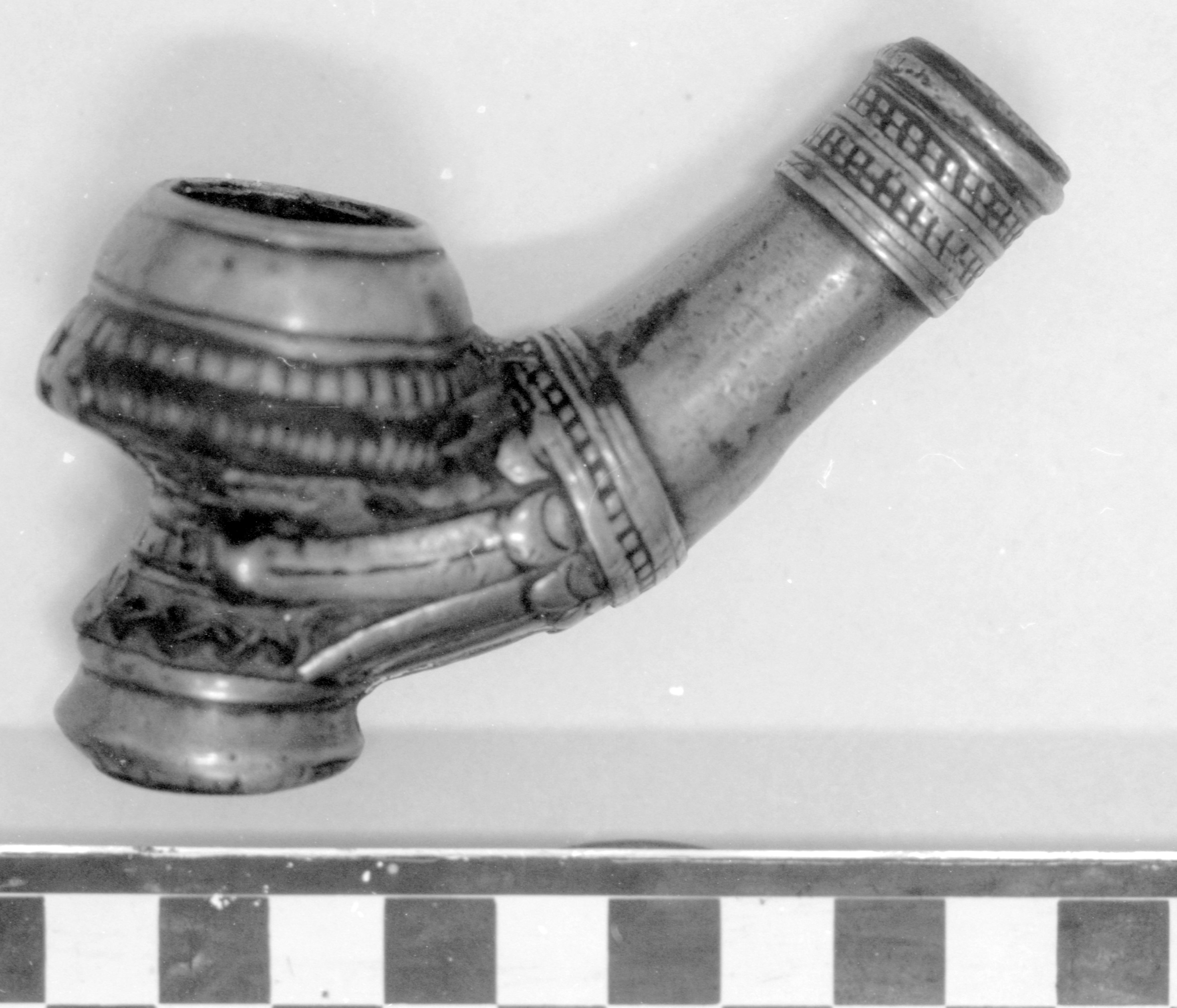
Credit: Don Hein private collection, Thailand, photos taken with permission by Jeremy Green.

Opium is another contender, although the introduction of opium into the region is not well understood. Some authors state it was introduced after the arrival of tobacco. However, Buchon (1979) records that in a manuscript relating to the voyage of the Portuguese ship Sao João and its arrival at Martaban in 1512 it was observed that: ‘…the vessel unloaded opium and that the opium from Aden was so dry that it crumbled “like earth” and had to be sold at a lesser price.’ Clearly, opium was imported into Southeast Asia during the early phase of the Portuguese involvement in the region and probably at an earlier period too. Again, the size of the bowl would tend to preclude opium, particularly because illustrations of eighteenth and nineteenth century opium smoking shows a very small bowl, indicating the expense and potency of the drug.
The final alternative is marijuana (Cannabis sativa) which has a long history of use dating back, in India, at least two millennia, although probably not smoked in pipes until much later. In Southeast Asia, tobacco is widely used for smoking, combined with a mixture of aromatic plant material. Of the alternatives, marijuana seems to be the most likely.
Surprisingly, these types of pipes can still be found in ‘tobacco’ shops in Western countries for smoking ‘alternative’ substances.
It should also be noted that the pipe appears to be unused, showing no evidence of burning or wear, another little mystery. It could be that it was carried as curiosity, as it would not have had any smoking use to a European, or that it belonged to an Indonesian crew member who was returning home. It seems, however, that from the archaeological evidence, smoking pipes were produced in the Southeast Asia region long before they were in Europe.
References
Buchon G (1979) ‘Les premieres voyages portugais à Pasai et à Pegou (1512–1520)’ Archipel 18:127–157.
Green JN (1986) ‘Southeast Asian ceramic smoking pipes. International Journal of Nautical Archaeology 15(2):167–168.
Green JN (1983) ‘The Vergulde Draeck excavation 1981 and 1983’ Bulletin of the Australian Institute for Maritime Archaeology, 7(2):1–8.
Shaw JC (1981) Northern Thai Ceramics, Oxford in Asia.