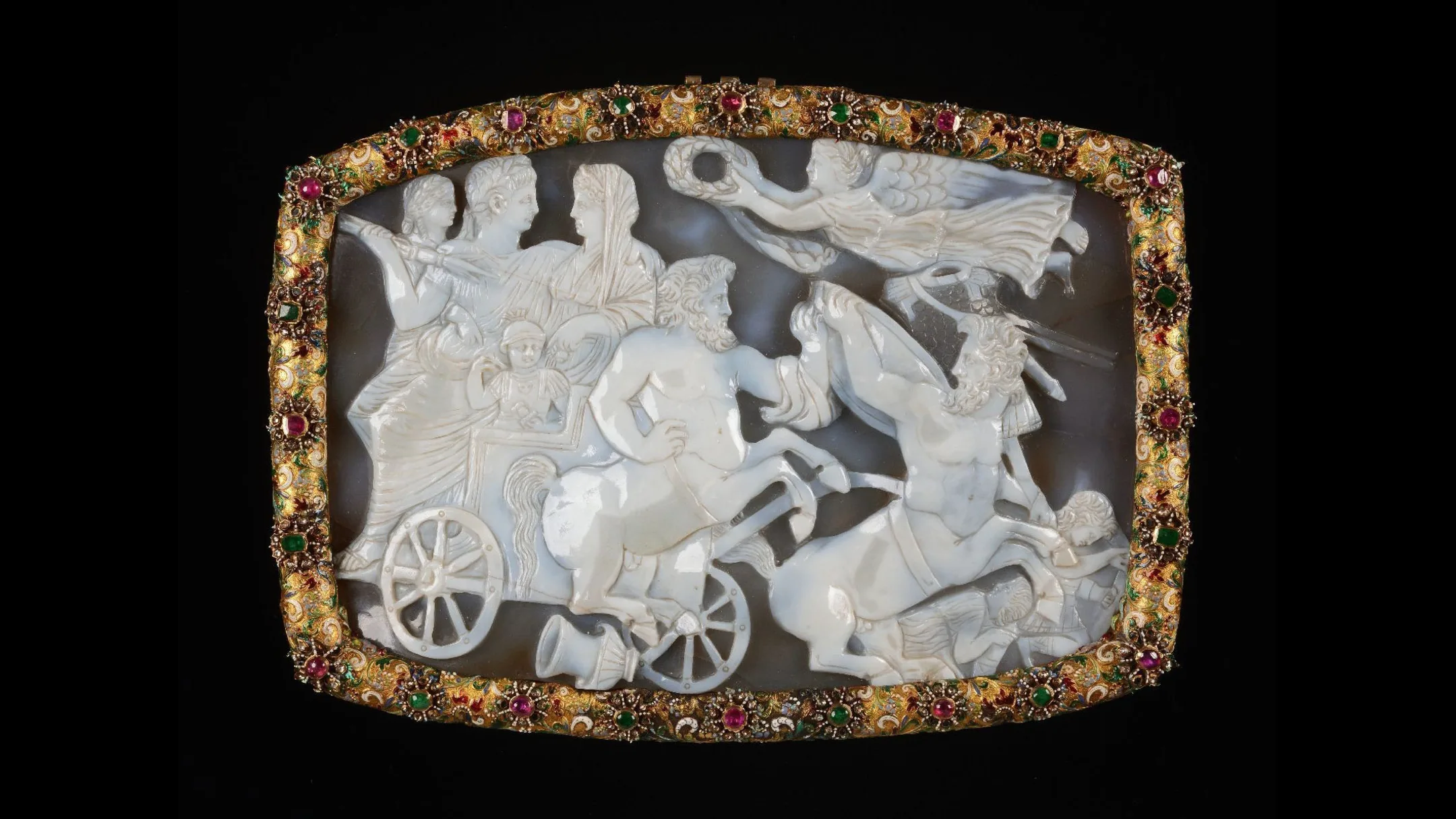
Credit: Rijksmuseum van Oudheden, CC0, via Wikimedia Commons.
In the midst of the chaos and violence of the wrecking of the VOC retourschip Batavia in 1629, one remarkable object survived undamaged. Among the ship’s cargo was one of the largest and most valuable cameos from the Roman world, on its way to a possible sale to an Indian prince. This was the Great Cameo, or Gemma Constantiniana, now in the Rijksmuseum van Oudehen in Leiden, the Netherlands.
The cameo was on Batavia because of a contract signed in December 1628 between the directors of the VOC (the Heeren XVII) and an Amsterdam jeweller named Gaspar (or Caspar) Boudaen. In this contract, he agreed that the VOC, through commandeur Francisco Pelsaert, would act as his agent to sell the cameo in India, where it was expected to make a substantial profit of 60-70%. The VOC would take 28% of this profit, and the balance would go to Boudaen, together with an 8% bonus (Drake-Brockman 1962:88).
Pelsaert was involved because of his previous experience in India. Between 1620 and 1627 he had been active in the VOC’s Indian trade, mainly at the Mughal capital Agra. In 1626, he wrote a detailed report on the possibilities of future trade, especially with the Emperor Jahangir, whose interest in luxury European goods was well-known (Pelsaert 1925).
The cameo’s previous history is largely undocumented. It may have been owned by the artist Peter Paul Rubens, a collector of valuable cameos who had a secret arrangement with the VOC in 1626 to sell some of his ‘agates’ in India. Among his collection was what his friend, the antiquarian Nicolas-Claude Fabri de Peiresc, described as a ‘most stupendous cameo’—but Rubens’ drawing of this beautiful object has not survived.
At 22 x 30 cm, and weighing over three kilos, the cameo is huge, carved from a single piece of sardonyx mounted on a bronze base, with a gilded silver frame containing rubies and emeralds. It appears to depict the triumph of the Roman Emperor Constantine over his rival Maxentius in 312 CE and probably dates from shortly after that event (Rijksmuseum van Oudehen 2015).
Its recovery from the wreck of Batavia was reported in a letter from Antonio Van Diemen to Pieter De Carpentier dated 10 December 1629: ‘The big costly jewel of merchant Caspar Boudaen has also been saved’ (Drake-Brockman 1962:50). The VOC’s Governor-General in Batavia, Jacques Specx, confirmed this shortly afterwards: ‘the great jewel of the merchant Caspar Boudaen has also been salvaged’ (Drake-Brockman 1962:57). Subsequent attempts to sell it in India were a failure and, in 1656, it returned to the Netherlands. By 1823 it was owned by the Pabst van Bingerden family, who sold it to King Willem I for 55,000 guilders (around US$944,000 – $1.256 million today) (Edvinsson 2016).
This cameo is an extraordinary Roman object of great beauty and value. The remarkable story of its survival in the Batavia shipwreck is a reminder that these VOC encounters with Australia are also important as a manifestation of the vast extent of Dutch global trade, expansion, and exploitation in the seventeenth century.
References
Drake-Brockman H (1963) Voyage to disaster: the life of Francisco Pelsaert, Angus and Robertson, Sydney.
Edvinsson R (2016) Historical currency converter (test version 1.0), Historical Statistics website, accessed 20 October 2025.
Pelsaert F (1925) Jahangir’s India: the Remonstrantie of Francisco Pelsaert, trans. W H Moreland and P Geyl, Heffer, Cambridge.
Rijksmuseum van Oudehen (2015) Grote camee van Constantijn (gemma constantiniana), Rijksmuseum van Oudehen website, accessed 20 October 2025.