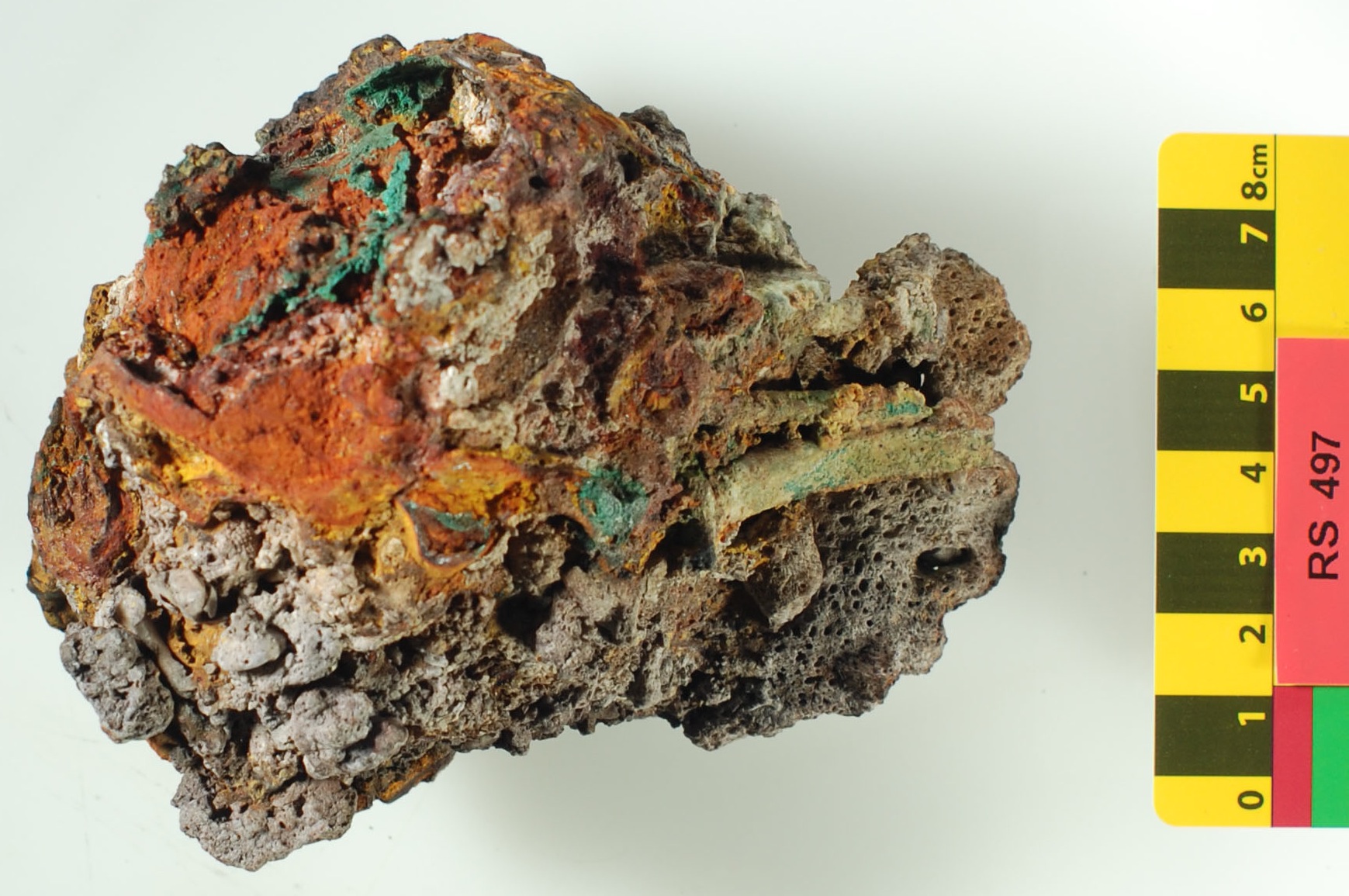
Credit: Western Australian Museum, Department of Maritime Heritage.
How does the ocean remember? Wreckage returns at least two answers. As it incorporates the ruins of lost ships, the sea becomes a reserve of human (as well as nonhuman) pasts. Under just the right circumstances, these seabed memorials may remain available for recovery from the deep. In the meantime, though, they never go totally untouched by the waters that received them. Underwater, wreckage is always being recomposed— re-membered —by oceanic conditions, not to mention oceanic lives. This means that the ‘artefacts’ we retrieve from shipwrecks really express multiple histories, agencies, and provenances at once .
Concretion renders exceptionally vivid wreckage’s ‘material, temporal, and agential multiplicities’ (Quigley 2023a). Consider BAT3882—Concretions, a set of four ‘unidentified’ artefacts salvaged from the ruins of the Dutch United East India Company (VOC) ship Batavia, which wrecked in the Houtman Abrolhos island group in 1629. And consider RS497—Concretions , a lumpy thing hauled up from the remains of Lively (c.1806-7), an English-owned whaling vessel wrecked in the Rowley Shoals, in the eastern Indian Ocean, in the first decade of the nineteenth century. Researchers have determined that RS497 derives, in part, from an iron bolt and sheathing nail: two unpretentious but essential members of the ship’s structure. But it is obviously comprised of much else besides. Rough, irregularly shaped, and multicoloured, it is as much seabed ‘ecofact’ as it is human ‘artefact.’ Better yet, it is more than the sum of its ecofactual and artefactual parts: a ‘dynamic entity,’ in the words of the geographer Caitlin DeSilvey, ‘that is entangled in both cultural and natural processes’ (2006).
RS497 may not be conventionally beautiful, but for me it exerts a weirdly irresistible charisma. To allow one’s eyes to be detained by its intricate and strangely varied contours is to be addressed, and maybe a little discombobulated, by a jumble of materials and organisms, re-membered by the sea during the nearly two centuries of the wreck’s underwater life. This way of looking also prompts us to acknowledge Lively ’s wreck site as a distinctive oceanic place , one that—like Batavia’s submarine grave—has at least as fair a claim to having provenanced concreted artefacts as does the manufactory that produced the bolt and nail, or the yard that built a vessel with them.
Several decades after Lively went down, Herman Melville would write in Moby-Dick (1851) that the ‘business of whaling’ stitches ‘the whole broad world’ together, ‘in one aggregate’ (1:136). With RS497 , stories of South Seas whaling become aggregated anew, growing together with—‘concrescing’ with—Indian Ocean waters, organisms, and processes (Quigley 2023b). In this way, Lively ’s ruins also become networked, through the ocean’s concrescing activity, with Batavia and all the VOC (among other) wrecks that the Indian Ocean has reformed and is still reforming. And so forth: by exhibiting concretion, and by challenging ourselves to admire its odd recompositions, we expand our sense for what memorials are made of, how they interrelate, who remembers them, and how. So doing, we more fully recognize the sea’s shapely presence in the ‘artefacts’ of material culture, and better feel our entanglements with oceans, past, present, and future.
References
DeSilvey C (2006) ‘Observed Decay: Telling Stories with Mutable Things,’ Journal of Material Culture 11(3): 318-38.
Melville H (1922 [1851]) Moby-Dick; or, The whale, 2 vols., Constable and Company Ltd, London, Bombay, and Sydney.
Quigley K (2023a) ‘Concretion,’ Critical Times 6(3): 517-39.
Quigley K (2023b) Reading Underwater Wreckage: An Encrusting Ocean, Bloomsbury, London.