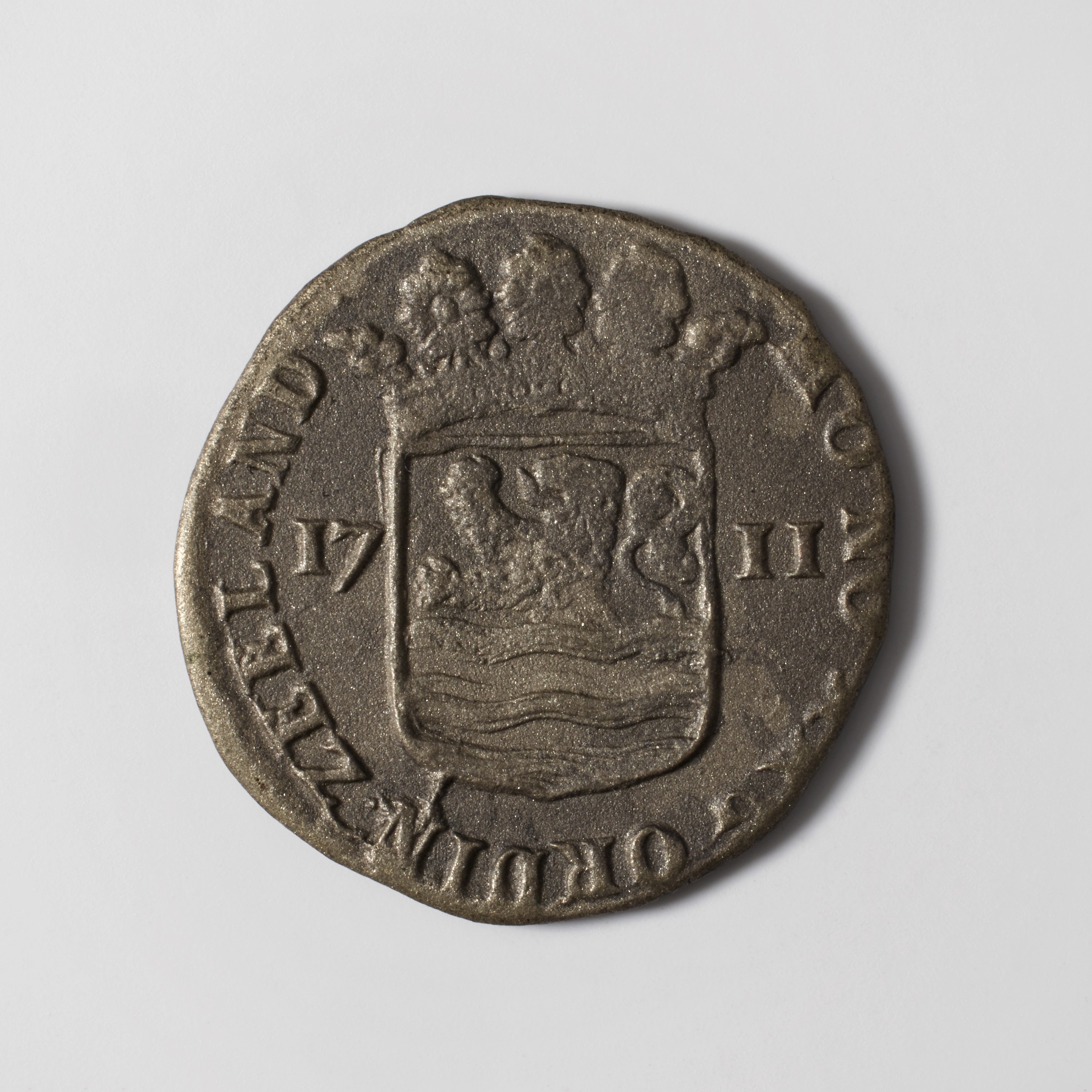
Credit: Australian National Maritime Museum Collection, object number 00052240.
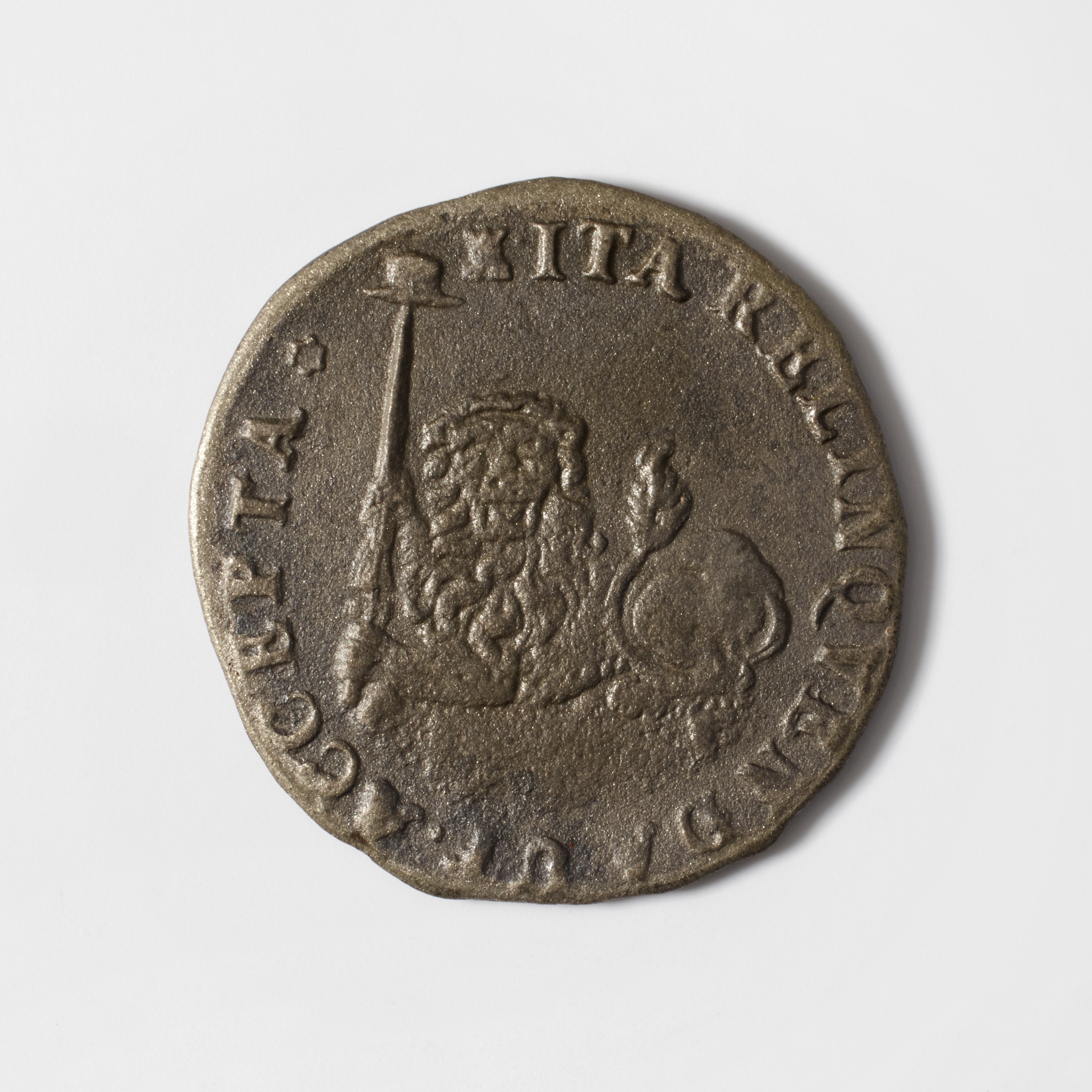
Credit: Australian National Maritime Museum Collection, object number 00052240.
This is a silver hoedjesschelling from the Vereenigde Oost-Indische Compagnie (VOC) ship Zuytdorp. This coin is a type of schelling (shilling), a small change Dutch denomination.
The hoedjesschelling get their name from their iconography. On the obverse, or face of the coin, is the crowned coat of arms of the States of Zeeland. On the reverse, or back of the coin, is a lion couchant (lying with its head raised), holding a lance with a liberty cap on top. The word ‘hoedjesschelling’ in Dutch means ‘hat-shilling’ and this refers to the liberty cap, or hat, that is found on the reverse of the coin (Verkade 1848). The liberty cap was a symbol with classical origins: a hat given to emancipated Roman slaves to signify their freedom (Oddens 2021). The reverse inscription also refers to this idea: the Latin reads: ITA RELINQVENDA UT ACCEPTA ‘to leave as it was received’, which may refer to ensuring the ongoing freedom of the province (Van Der Wiel and Klaassen 1985).
During the Eighty Years’ War, or the Dutch War of Independence/Dutch Revolt (1568-1648) against Spain, the rebel provinces often used coins and other numismatic items as a form of visual media, to spread messages and propaganda against the Spanish Habsburgs (Wise 2019; Stensland 2012). Images depicting ‘liberty’ through the depiction of a liberty cap, in art and numismatics, were very common (Oddens 2021; Schama 1987). The hoedjesschelling were first minted in 1672, a year when France in alliance with England, Münster, and Cologne invaded the Dutch Republic (Prak 2023; Munt 1997). Within the first three weeks of the invasion the provinces of Gelderland, Overijssel and Utrecht had been overtaken, creating turmoil in the rest of the Republic (Munt 1997). These hoedjesschelling’s iconographic focus on ‘liberty’ suggests they were one form of media intended to spread patriotic and inspiring messages to the soldiers, civil servants, and others whose wages were paid by the province, to encourage them in the face of turmoil, as noted by Dutch numismatist Gerard Van Loon (Van Loon 1728 73-74).
The hoedjesschelling were minted in the States of Zeeland between 1672 and 1745, at the mint of Middelburg, which is identified by the castle mintmark next to the liberty cap on the reverse of the coin. They were circulated domestically in Zeeland and also used as trade money until 1692, when a ban on minting schellings was imposed by the States Generaal (an assembly of delegates from the seven sovereign provinces whose duties focussed on the military and foreign policy of the Republic (Grever 1982 125, Van Gelder 1988; Van Der Wiel and Klaassen 1985)). This was done because many of the schellings that were circulating in society had become debased. The coins were minted again from 1698, specifically for the use of the VOC for their operations overseas, which is how they came to be on Zuytdorp (Van Der Wiel and Klaassen 1985).
On Zuytdorp, this coin was one of a larger consignment. On 16 February 1711, the States of Zeeland commissioned the mint master of the Middelburg Mint, Adolphe de Groene, to mint 100,000 guilders worth of small change—schelling and double stuiver coins—to be sent as trade money to the Dutch East Indies for use by the VOC (Nationaal Archief NL-HaNA_1.04.02_7255_0093-94; Van Der Wiel and Klaassen 1985). This newly minted coinage was divided and carried aboard two ships, Zuytdorp and Belvliet (Playford 1996 44). This small change circulated in Batavia and Java in the local economy (Feenstra 2020; Wolters 2008).
The hoedjesschelling of Zuytdorp were all produced at the same time, in 1711. By comparing the coins, it is possible to get a better understanding of the minting process (Wilson 1985). The hoedjesschelling found on Zuytdorp have slight variations in their iconography. Some hoedjesschelling, like this one (00052240), have a star at the end of the reverse inscription, while others (e.g. 00052742, see below) have a rosette above the crowned arms of Zeeland on the obverse and no star on the reverse. These are small differences but show that different dies (stamps that are engraved with images and pressed or hammered into coin blanks to create coin iconography) were used to create these coins. It is also possible to map how the dies degraded over time. 00052240 has a die break on its obverse below the shield to the left, and there are many other coins from the Zuytdorp wreck with this break in the same spot. By comparing the coins, it is possible to see that the break became larger with each successive strike. This provides insight into the degradation of the die as it was used over and over again (Wilson 1985).
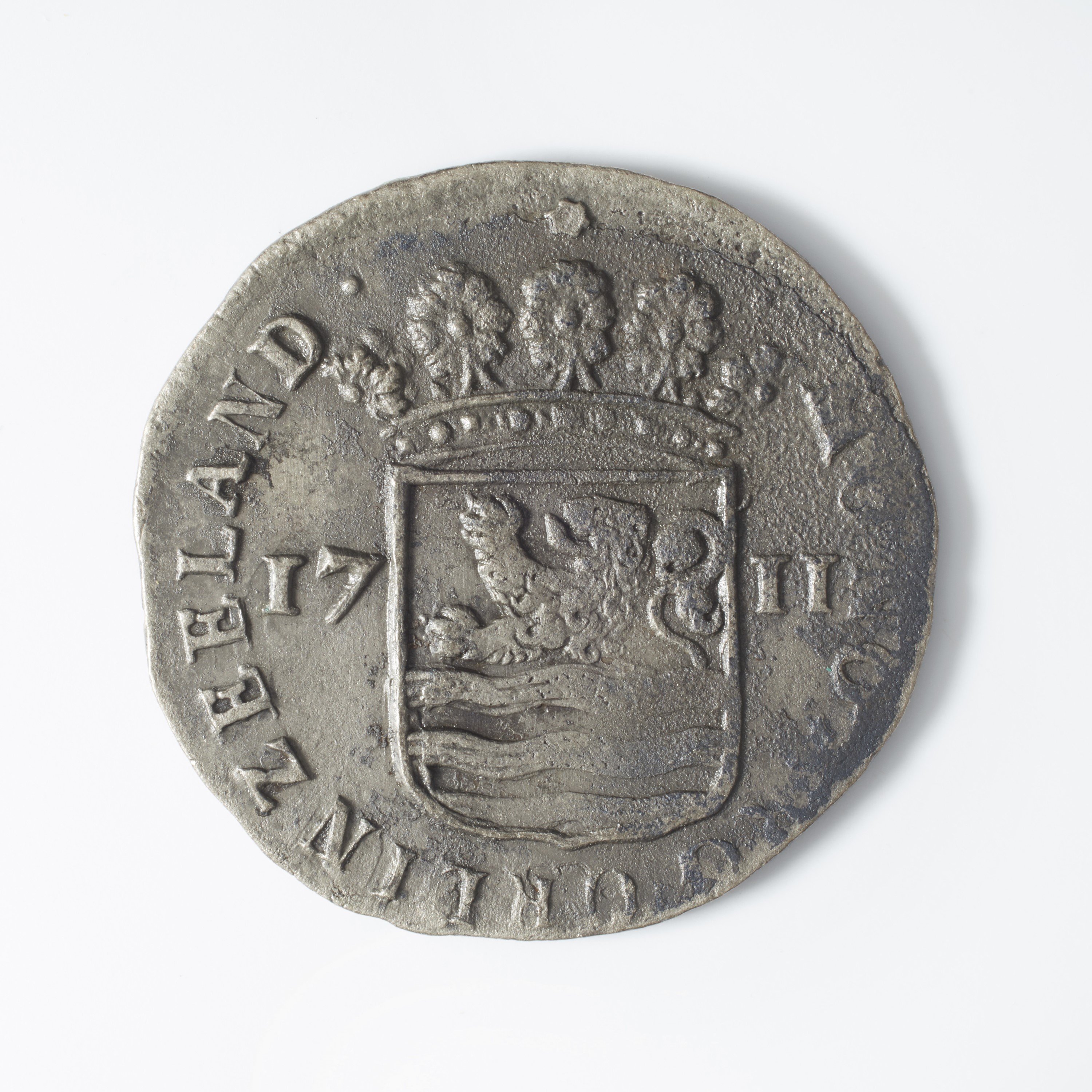
Credit: Australian National Maritime Museum Collection, object number 00052742.
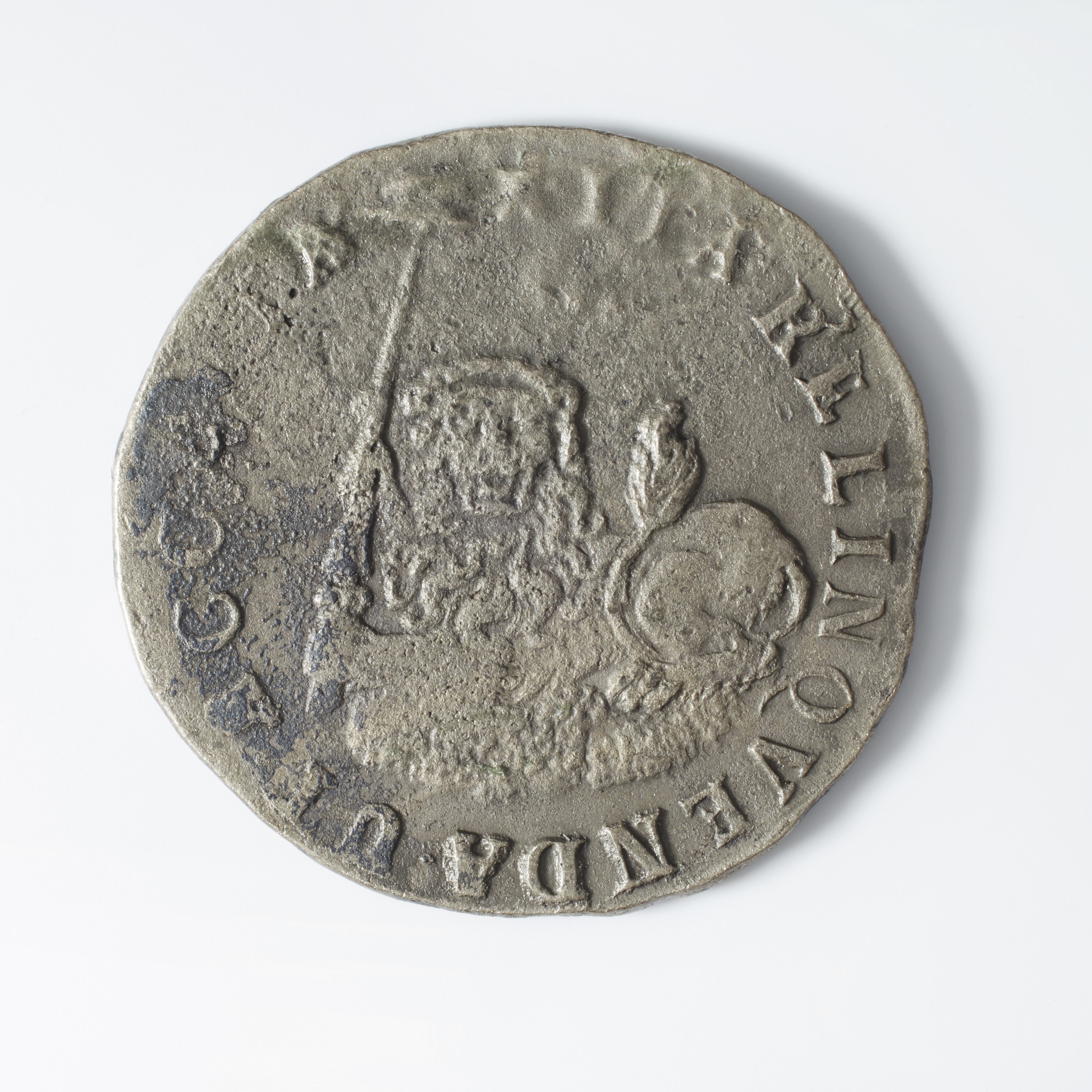
Credit: Australian National Maritime Museum Collection, object number 00052742.
References
Feenstra A (2020) ‘Requests from the Indies. Asian agency in the VOC’s currency supply to eighteenth-century Java’, Journal of the Economic and Social History of the Orient 63:853–891.
Grever J (1982) ‘The structure of decision-making in the States General of the Dutch Republic 1660-1668', Parliaments, Estates and Representation 2(2): 125-153.
Munt A (1997) ‘The impact of the Rampjaar on Dutch Golden Age culture’, Dutch Crossing 21(1):3–51.
Nationaal Archief, the Netherlands; Series 1.04.02, Inventaris van het archief van de Verenigde Oost-Indische Compagnie (VOC); No. 7255, Minuut-resoluties van de kamer Zeeland (1708 jan. 2 – 1714 dec. 31). Entry for 16 February 1711, 93-94. NL-HaNA_1.04.02_7255_0093-94.
Oddens J (2021) ‘You can leave your hat on: men’s portraits, power, and identity in the seventeenth-century Dutch Republic’, The Seventeenth Century 36(5):797–853.
Playford P (1996) Carpet of silver: the wreck of the Zuytdorp, University of Western Australia Press, Nedlands, Western Australia.
Prak M (2023) The Dutch Republic in the seventeenth century, Webb D (trans), Cambridge University Press, Cambridge.
Schama S (1987) The embarrassment of riches: an interpretation of Dutch culture in the Golden Age, University of California Press, Berkeley.
Stensland M (2012) Habsburg communication in the Dutch revolt, Amsterdam University Press, Amsterdam.
Van Der Wiel HJ and Klaassen CJF (1985) ‘De Zeeuwse hoedjesschellingen’, Jaarboek voor Munten Penningkunde 72:50–74.
Van Gelder EH (1988) ‘Reductie en stempeling van de schellingen 1692-1694', Jaarboek voor Munten Penningkunde 75:59-86.
Van Loon G (1728) Beschryving der Nederlandsche historipenningen: of beknopt verhaal van 't gene sedert de overdracht der heerschappye van keyzer Karel den Vyfden op Koning Philips zynen zoon, tot het sluyten van den Uytrechtschen Vreede, in de zeventien Nederlansche gewesten is voorgevallen, Derde Deel, Christiaan van Lom, Pieter Gosse, Rutgert Alberts, Pieter De Hondt, The Hague.
Verkade P (1848) Muntboek, bevattende de namen en afbeeldingen van munten: geslagen in de zeven voormalig Vereenigde Nederlandsche Provincien, sedert den Vrede van Gent tot op onzen tijd, PJ Van Dijk, Schiedam.
Wilson S (1985) ‘Coins from the Zuytdorp’, Journal of the Numismatic Association of Australia 1:24–30.
Wise R (2019) ‘Reckoning the revolt on rekenpenningen: Old Testament jetons of the Eighty Years’ War’, The Rijksmuseum Bulletin 67(2):122–141.
Wolters W (2008) ‘Heavy and light money in the Netherlands Indies and the Dutch Republic: dilemmas of monetary management with unit of account systems’, Financial History Review 15(1): 37-53.