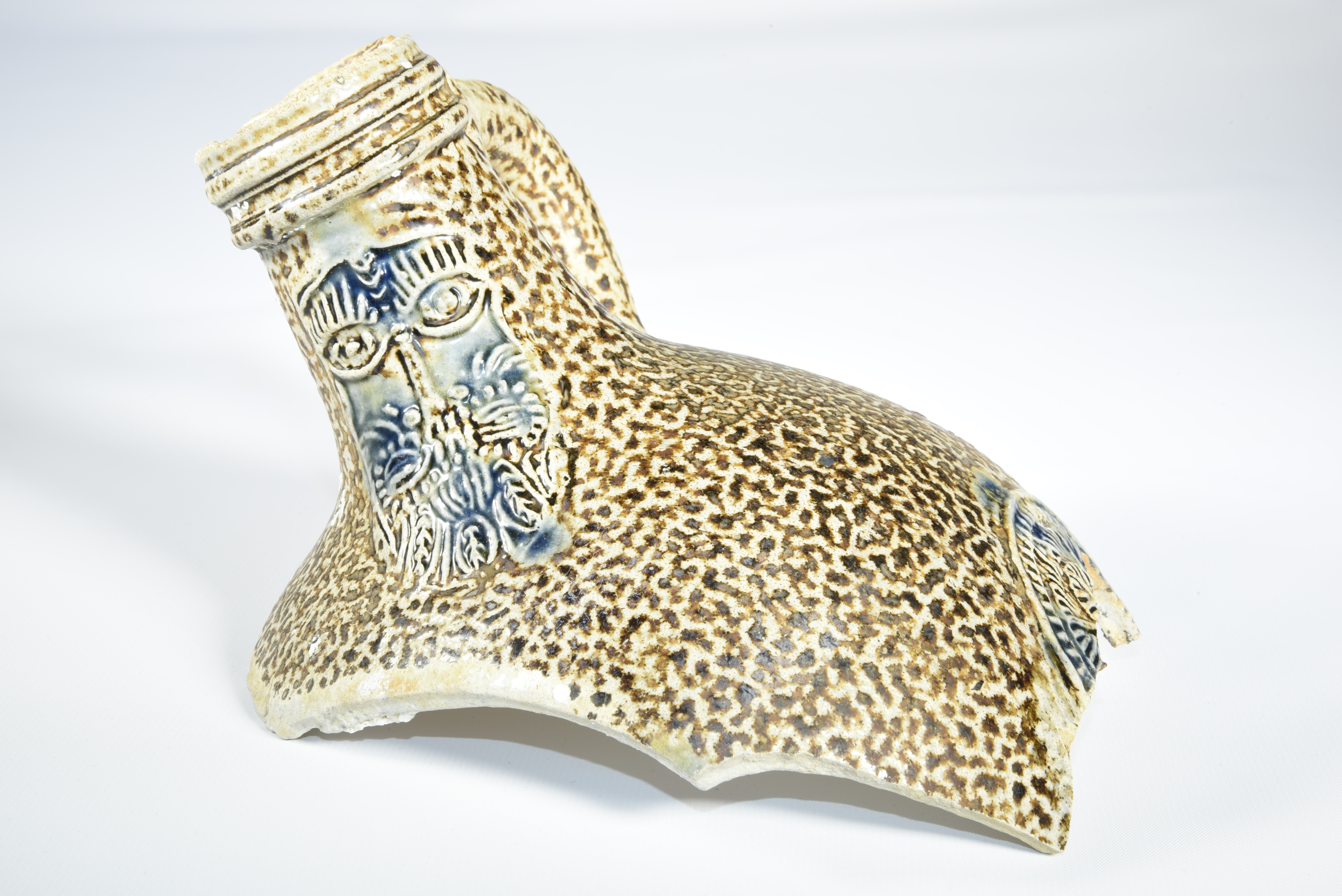
This ceramic fragment is from a Bartmann jug, also known as a ‘Beardman’ or ‘Bellarmine’ jug, from the wreck of Vergulde Draeck (1656). The fragment features a narrow short neck and strap handle, with a stylised bearded face or mask on the neck and shoulder, on the opposite side from where the strap handle is affixed. The shape of the fragment from the shoulder suggests this vessel had a wide, spherical body. This is consistent with a footless Bartmann jug (bottle type) from the first half of the 17th century, before the bottles became more elongated or pear-shaped later in the 17th century (Keller 2024).
The decorative mask on the neck of the vessel, which is the hallmark of the so-called ‘Beardman’ jugs, is stylised: it has large almond eyes with exaggerated lashes, narrow nose, and a rounded beard with three plaits. The stylisation of the bearded mask occurred in the late 16th to early 17th century and is associated with the increase in production of this type of decorated storage vessel (Ostkamp and Snip 2023:201-205). Earlier vessels feature a more natural, serene face with delicate features and flowing beard. Part of one decorative floral medallion on the body of the vessel is visible on this fragment, but it was not uncommon for vessels of this type to carry multiple medallions.
The uneven ruddy-brown glaze with a shiny, pebbly, or ‘orange peel’ finish is typical of an iron engobe slip with salt-glaze. The iron oxides in the clay slip provide the rich brown colour and the salt glaze causes the uneven, mottled finish. This combination is also known as a ‘tigered glaze’. A cobalt blue under-glaze has been selectively applied to the bearded face and medallion, consistent with Cologne and Frechen wares.
These types of vessels were mass-produced in the 16th to 18th centuries from multiple workshops in the Rhineland, in the vicinity of Cologne. Frechen, where this vessel was produced, was a leading stoneware production centre in the 17th century. The vessels were high-fired and valued for their durability, which made them ideal containers for the storage and transportation of a variety of liquids from mercury, as found in the shipwreck of Prinses Maria (1686) (e.g. Amsterdam Museum, KA15180, see also Sténuit 1977:443-444), to consumables such as beer and wine. This led to their distribution far beyond northern Europe, as the expansion of global maritime trade and European colonialism saw European goods transported all around the world. The Bartmann jugs from Vergulde Draeck appear to have been empty and therefore were likely a consignment of cargo for use in the Dutch East Indies (modern day Indonesia) and beyond (Green 1977:482). They instead mark the failure of that consignment to reach its destination and are part of a larger body of evidence for the traces of European expansion across the global south and onto Australia’s shores, however mistakenly that trace was made.
This fragment carries on its inner surface encrustations from coralline algae. This growth is now part of its fabric and is a visible reminder of the oceanic journey from kiln to the western shores of Australia. Overtime, the Bartmann reached a new state of equilibrium in the underwater environment, becoming more marine environment than historic artefact. The removal of material from these sites impacts not just on the individual artefact but adversely impacts the reef itself. Therefore, it is often better to record maritime archaeological sites through observation, rather than removing artefacts from the underwater environment. The site of the Vergulde Draeck wreck is a phenomenal reef to visit for the experienced diver but sadly wears the scars of attempts to remove artefacts by force. Should you visit this site remember, you can ‘take only photos, leave only bubbles’.
Credit: Western Australian Museum, Department of Maritime Heritage
References
Green JN (1977) The loss of the Verenigde Oostindische Compagnie jacht Vergulde Draeck, Western Australia 1656: an historical background and excavation report with an appendix on similar loss of the fluit Lastdrager, British Archaeological Reports, Oxford.
Keller C (2024) A short guide to Rhenish stoneware of the 16th and 17th century, Baartmann Goes Global, Zenodo.
Ostkamp S, Snip W, Koldeweij AM and Mennicken R (2023) Baardmankruiken: steengoed 1200-1950 = Bartmann jugs: stoneware 1200-1950 = Bartmannkrüge: Steinzeug 1200-1950, Uitgeverij Polder Vondsten bv / Vind magazine, Hoorn.
Sténuit R (1977) ‘The Loss of the Fluit Lastdrager’, in JN Green and LH Zuiderbaan (eds) The loss of the Verenigde Oostindische Compagnie jacht Vergulde Draeck, Western Australia 1656: an historical background and excavation report with an appendix on similar loss of the fluit Lastdrager. British Archaeological Reports, Oxford: 403-69.