This single pair of candle snuffers, snuiter or snuiterschaar in Dutch, are the only in-tact pair to have been retrieved across the four Western Australian VOC shipwrecks. These were carefully extracted from concretion under cannon 12 (GT1454) on site in March 1972 by Graeme Henderson as part of the Vergulde Draeck expeditions by the Western Australian Museum in 1971-1972.
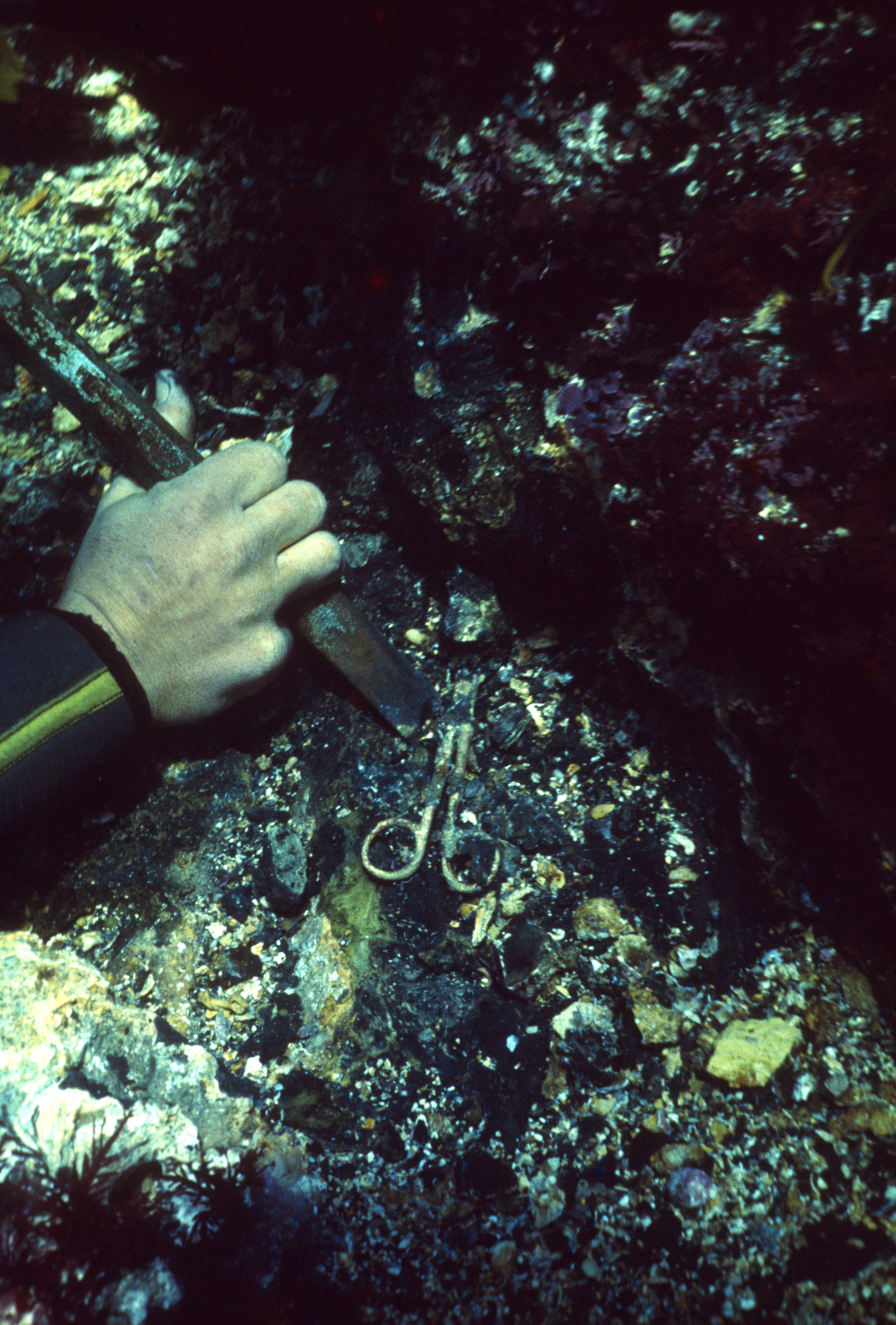
Credit: Western Australian Museum, Department of Maritime Heritage (GD/A/178).
The candle snuffers are made of two elongated brass components, attached by a pin, that pivot open and closed like a pair of scissors, with finger holes at one end, and two blades at the other. They differ from scissors in that attached to one of the blades is a rectangular tray with sides, and on the other blade a rectangular sheet of similar size that acts to close the tray when the blades come together. A similarly designed candle snuffer can be seen prominently in the foreground of a still life painting by Pieter Claesz (1597-1661). In other contemporary depictions, it is common to see the candle snuffer balanced across the shoulder of a candlestick, similar to those also found on the Vergulde Draeck wreck, such as GT737.
![‘Stilleven met brandende kaars [Still life with burning candle]’, 1627, Pieter Claesz (1597-1661). Mauritshuis, 947. Credit: Collectie Nederland.](https://collections.museum.wa.gov.au/sites/default/files/user/5/2025-11/Still_life_Pieter_Claesz_Maurithuis.jpg)
Credit: Collectie Nederland.
Despite being called ‘candle snuffers’, these should be considered wick trimmers because the purpose of the device was not to extinguish the candle, but to cut the wick as the candle burned down. This would have reduced the smoke produced by the candle by removing the expired part of the wick and increased the brightness of the flame. Another partial pair found on the Vergulde Draeck site, GT43, are of a different, and older, style, without a wick trap.
Candle snuffers were important everyday pieces of equipment on a ship. Within the confines of the ship there was very little light, and candles would have been the main source of light. This was necessary, but also risky as fire was a threat to the lives of all on board. Anything that could cause fire (such as burning fuses, candles and lamps) or accelerate a fire (such as gunpowder or alcohol) was heavily regulated on board (Delman 2025). The VOC even temporarily banned all strong alcohol on board ships after the loss of Dordrecht (1630), when an unextinguished wick caused a fire that became uncontrollable when it reached the barrels of brandy in the hold. The small box attached to the blades of this pair of candle snuffers is designed to extinguish the hot embers from a trimmed wick, by either containing or crushing them, thereby reducing the risk of any incident.
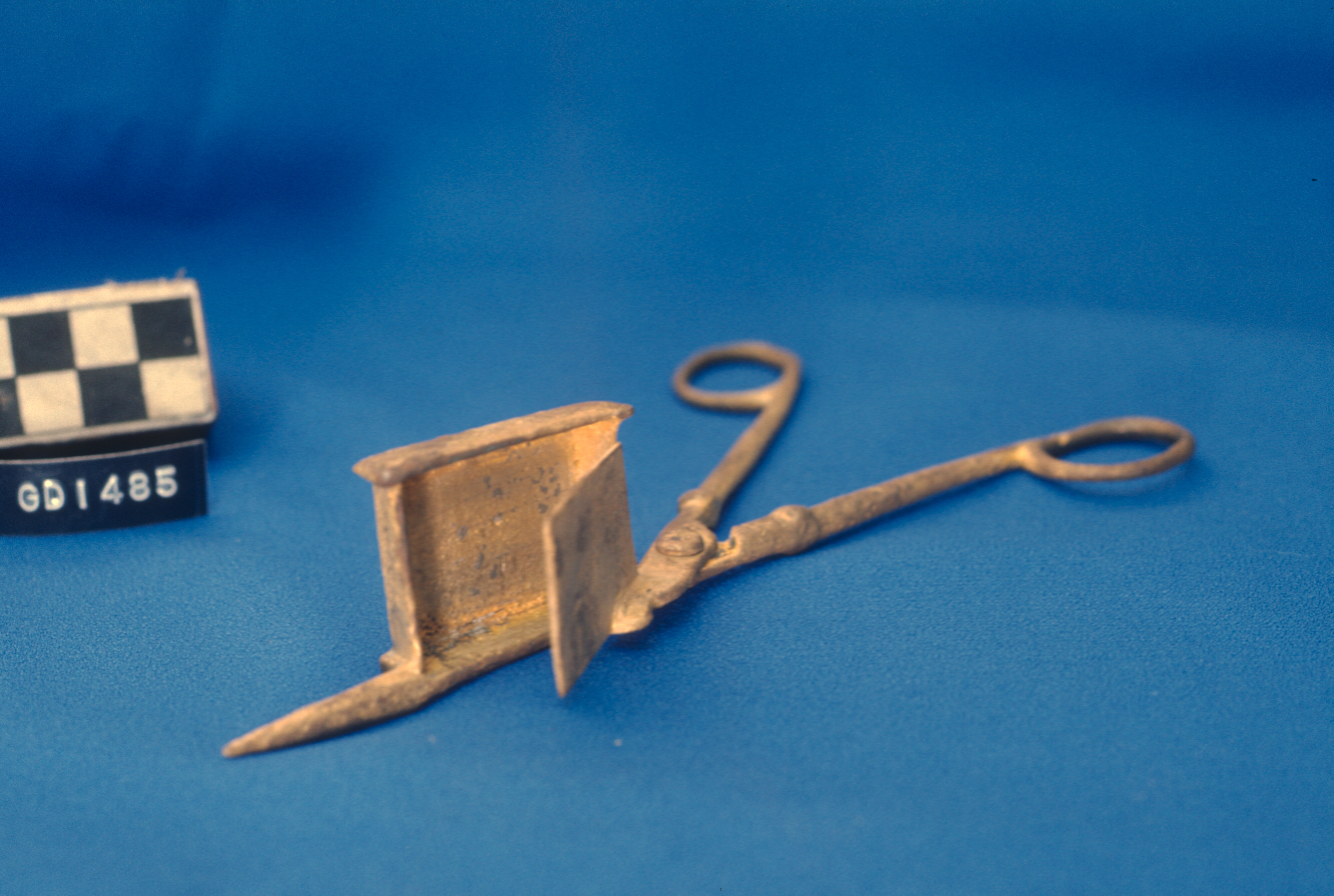
Credit: Western Australian Museum, Department of Maritime Heritage (GD/32/18).
Despite these candle snuffers being the only in-tact example in the Western Australian Museum collections, numerous scissor-like handles have been found without blades that could have been candle snuffers or wick trimmers. This suggests these tools were indeed common across all four VOC shipwrecks. Comparable objects are found in shipwreck artefact collections such as those held by the Rijksmuseum from the wreck of Hollandia (NG-1980-27-H-1618), and those in the collections from Rooswijk, held in the Rijksdienst voor het Cultureel Erfgoed’s Maritiem Archeologisch Depot at Batavialand, Lelystad. These examples are all simple forms, made of basic metals, suggesting they were for utilitarian use on board the ship.
References
Bliss A and #Rosswijk1740 project (2020) ‘Illuminating the Rooswijk’, Rijksdienst voor het Cultureel Erfgoed [Cultural Heritage Agency], accessed 21 September 2025.
Doelman A (2025) Investigating Fire. The dangers of fire on board VOC ships in the seventeenth and eighteenth centuries. [Masters], Universiteit Leiden, Leiden, accessed 21 September 2025.
Green JN (1977) The loss of the Verenigde oostindische compagnie Jacht Vergulde Draeck, Western Australia 1656: an historical background and excavation report with an appendix on similar loss of the fluit Lastdrager, British Archaeological Reports, Oxford.
Stanbury M (1974) Vergulde Draeck: catalogue of artifacts, WA Museum, Fremantle, W.A.