In late April 1656, the Dutch East Indiaman Vergulde Draeck (or Gilt Dragon) collided with a reef off Yued Noongar country, not far from what is now the Western Australian township of Ledge Point. As the vessel broke up and sank it carried, to the seabed, eight chests of silver coins and a rich store of commercial goods. Despite repeated attempts by the Vereenigde Oostindische Compagnie (United Dutch East Company, or VOC) to salvage the ship and its valuables, the wreckage would evade official notice for more than three centuries. Finally, in 1963, a group of Australian spear-fishers were diving about six miles off Ledge Point when they happened upon what looked like a shipwreck with a couple of ‘curved objects sticking out of its bow’ (Edwards 2011). Hauled to shore and examined, one of those objects was identified by a local geologist as a four-foot-long African elephant tusk.
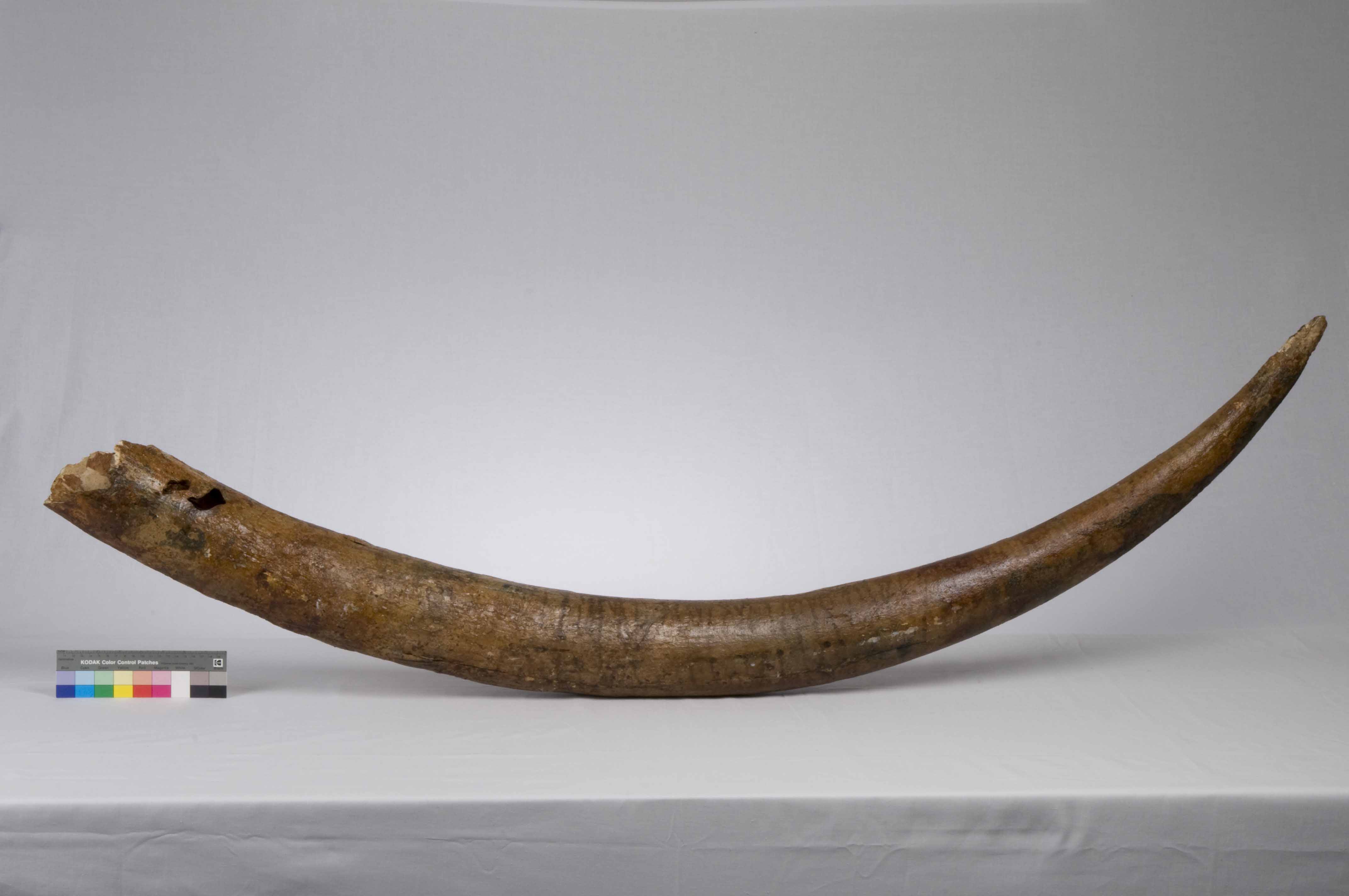
GT1384—Animal, elephant tusk from Vergulde Draeck
Credit: Western Australian Museum, Department of Maritime Heritage
After excavation of Vergulde Draeck began in earnest, in 1972, the wreck site kept giving up tusks and tusk fragments: 119 in all. From the viewpoint of the environmental humanities—an interdisciplinary field that explores entanglements between humans and environments—all those elephant body parts remind us that far from being the exclusive province of Homo sapiens, history is always a ‘more-than-human’ affair (O’Gorman and Gaynor 2020). By inviting elephants inside the scope of our historical focus, we open our eyes to the implications of VOC enterprises for nonhuman lives.
Rather than turning entirely away from human histories, the environmental humanities encourages us to engage the multiple, layered meanings of shipwrecked tusks. This might lead us, for example, to connect the VOC’s Indo-Pacific operations with those of the Geoctroyeerde West Indische Compagnie (Dutch West India Company, or GWC). The GWC was involved in exporting not only elephant tusks but enslaved persons from West Africa. At the same time, an environmental humanities approach takes seriously the question of what Vergulde Draeck’s tusks and tusk fragments mean for elephant lives, including those twenty-first-century elephants whose ancestors may have been hunted, in the name of imperial trade, four hundred years ago.
Of course, similar questions can be asked of elephant ivory found anywhere. What is distinctive, therefore, about submerged tusks like those excavated from Vergulde Draeck? What, to pose the question more precisely, is particularly oceanic about Vergulde Draeck’s elephant remains? And what, for that matter, do those remains tell us about the ocean? Concerns of this sort animate emerging conversations in the oceanic (or ‘blue’) humanities, a subfield of the environmental humanities committed to rethinking the pivotal role played by Earth’s seas in shaping our world.
When it comes to the artefacts of human cultures, such as VOC ships and commoditized elephant tusks, the ocean has often been seen as a place where things risk becoming ‘lost’—and as a place where those things might be located, and ‘rescued,’ at some point in the future (Quigley 2023). An oceanic humanities framework begins from the premise that a shipwrecked tusk, for example, does not merely disappear underwater but commences a novel and complex phase of its existence, a phase some call its ‘underwater life’ (Hyman and Leibsohn 2021).
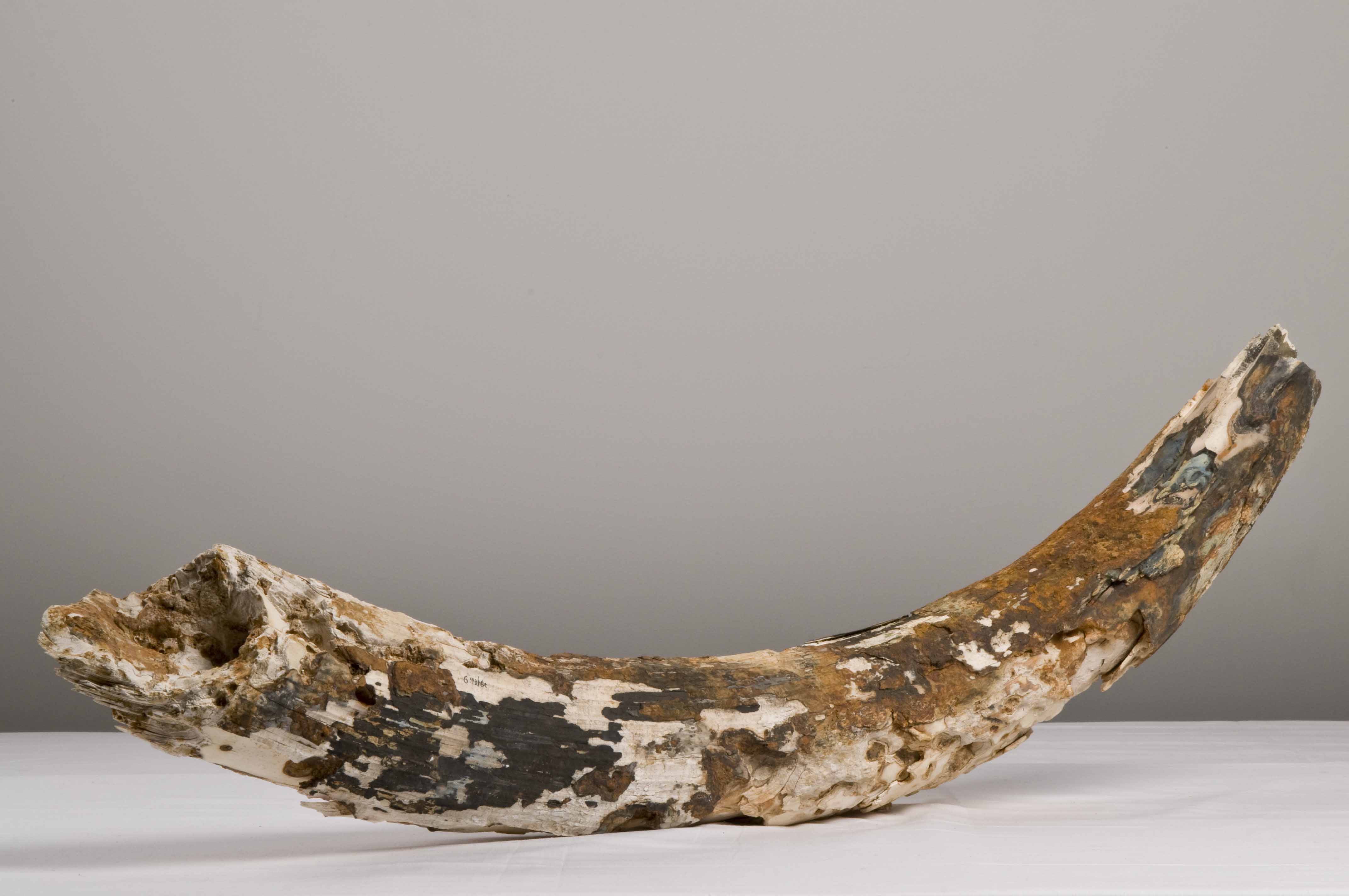
GT691—Animal, elephant tusk from Vergulde Draeck
Credit: Western Australian Museum, Department of Maritime Heritage
By considering shipwrecked tusks through the lens of their underwater lives, we redirect certain logics of marine disaster and recovery. For instance, it is sometimes said that when a submerged artefact becomes physically altered by the oceanic environment, it has been ‘fouled’ (Quigley 2023). An oceanic humanities perspective does not describe such alterations as the unfortunate, hopefully reversible, impacts of an artefact’s drowning. This perspective perceives those impacts, instead, as the compelling signs of all the complex, multispecies, processual interactions that comprise an artefact’s underwater life.
This entails close descriptions of an artefact’s material form, and with tusks in view, such descriptions benefit immensely from the terminology of art practice. For instance, it is customary to characterize tusks like those salvaged from Vergulde Draeck as ‘unworked,’ which is to say not yet shaped into ivory art objects by human hands (de Flamingh et al. 2021). From an oceanic humanities point of view, this characterization fails to acknowledge that the tusks and tusk fragments we observe today have manifestly been worked by the sea for hundreds of years.
What is the payoff, ultimately, of these acts of redescription? There are many ways of answering this question, just two of which I’ll mention here. First, by recognising and studying feats of sea-work, we attune ourselves to the span of time an artefact has spent under water, or what I call its ‘submerged duration’. That span, which often goes curiously unremarked in histories of wreckage, opens a multitude of paths to conceiving the presence of VOC materials in Aboriginal, Australian, and other waters. Second, we answer the call, issuing from a host of disciplines and domains, to more fully reckon with the ocean’s formative agency—as well as with the ways the ocean has been affected by human activity, and above all empire. By lingering with the multiple and stirring provocations of Vergulde Draeck’s tusks, we realise the special value of maritime archaeological collections for the environmental and oceanic humanities—and we imbue those collections with renewed liveliness, urgency, and depth.
References
Edwards H (2011) Dead Men’s Silver: The Story of Australia’s Greatest Shipwreck Hunter, Harper Collins, Sydney.
Hyman AM and Leibsohn D (2021) ‘Lost and Found at Sea, or a Shipwreck’s Art History,’ West 86th, 28(1): 43-74.
de Flamingh F, Coutu A, Sealy J, Chirikure S, Bastos A D S, Libanda-Mubusisi N M, Malhi R S and Roca A L (2021) ‘Sourcing Elephant Ivory from a Sixteenth-Century Portuguese Shipwreck,’ Current Biology 31(3): 621-28.
O’Gorman E and Gaynor A (2020) ‘More-Than-Human Histories,’ Environmental History, 25(4): 711-35.
Quigley K (2023) Reading Underwater Wreckage: An Encrusting Ocean, Bloomsbury, London.