In the early hours of 4 June 1629, not far from then uncharted Australia, the Vereenigde Oostindische Compagnie (VOC) flagship Batavia was careering at speed when disaster struck. The night-watchman, mistaking white reef-water as ‘moonlight on the water’, led the flagship to run aground and be irreparably torn-open on the Morning Reef of the Houtman Abrolhos, it tilted on its side so that everyone had great difficulty in standing (Pelsaert 1994). Over successive days, 300 officers, soldiers, and passengers, including women and children, were rowed to nearby low-lying coral islands. Drinking water was nowhere to be found, and the situation became desperate. The Commandeur Francisco Pelsaert (1590 – 1630) a landsman and merchant, responsible for the welfare of the passengers and rich trade cargo, took the difficult decision to leave on a small yawl (sail boat), eventually making a return trip from Batavia on the yacht Sardam. After three months absence he was shocked, on his return, to find that over 100 men, women and children had been brutally murdered by mutineers led by the under merchant and apothecary Jeronimus Cornelisz (c. 1598 –1629). Pelsaert was forced to form a legal counsel to try, torture, and execute key ringleaders, on the islands. This early European encounter with Australia, which tells a tale of shipwreck, mutiny, brutality, murder and torture, has haunted the imagination ever since and has been the inspiration for several of my artworks.
We know the story due to detailed notes recorded in Pelsaert's Journal, now held in the Nationaal Archief, the Hague. This journal has recently been digitised with accompanying transcription and English translation (Pelsaert 1629). In the 17th century, the VOC emerged as one of the most powerful trading entities in the world. Central to its success was not only its fleet of ships and global reach, but also its meticulous record-keeping—particularly the ship journals that documented every voyage. These journals were far more than navigational logs; they were instruments of control, communication, and historical memory (Bruijn et al 1985).
As an artist, I’m interested in how the materiality of the pages can represent another layer of the narrative, indeed, one can read the calligraphy itself as an image. By employing our imaginations, we can begin to understand how tactile qualities can inform a material witnessing of this object.
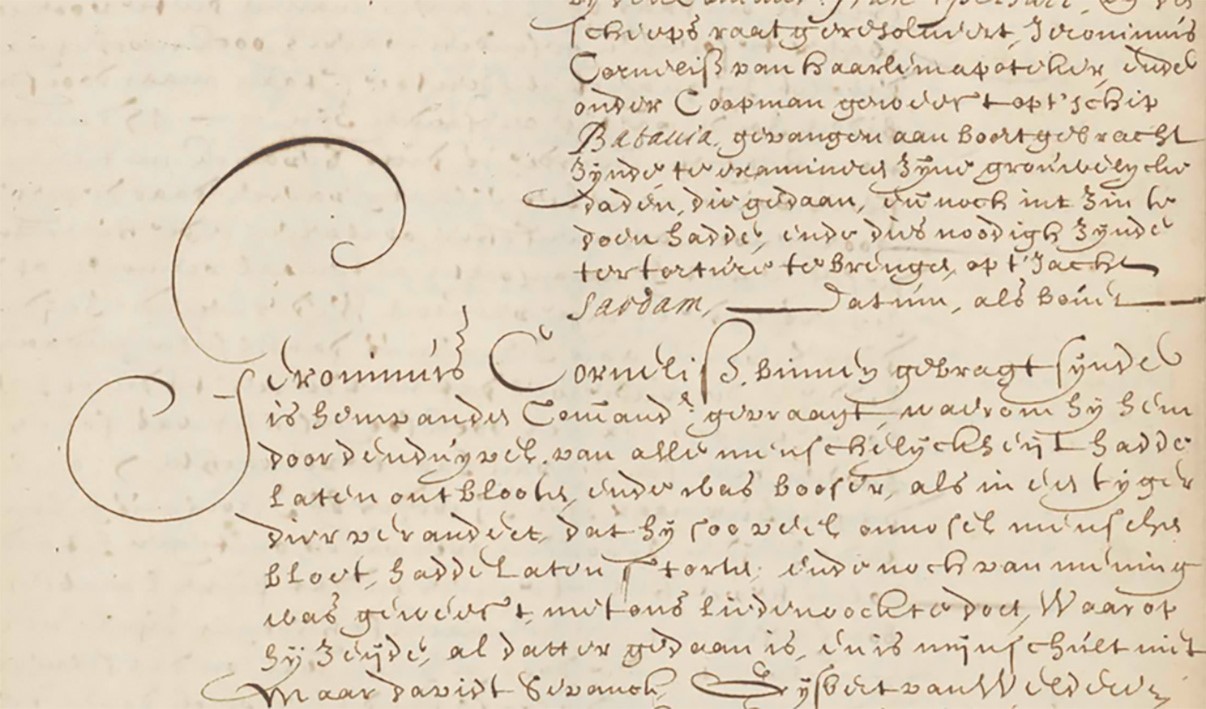
This hand-written manuscript is in old Dutch. It is ‘about 15" long, 10" wide’ [approx. 38 cm x 25 cm] (Burkitt cited in Drake Brockman:92). The heavy European hand-made paper appears yellowed from the passage of time. There is strike through, on the first few pages, indicating ‘signs of dampness’ (Drake-Brockman:92); ink bleeds through the page. Subsequentially, there are odd little shadows and echoes from the other side of the page so that characters give the form of an after-image. Each sheet has a ‘two inch margin’ [5.08 cm] (Burkitt cited in Drake Brockman:92) which occasionally allows the Gothic script additional space for elaborate flourish. The letters are elegant, and one is reminded of the act of learning to write, of slowly forming the letters, of the joy of manually forming legibility on a page.
Written in the first person this account strikes an emotional register with its readers. The Commandeur draws us in with his writing so, at times, it is as if we are there with him struggling to survive, to over-come the hardships.

Credit: Nationaal Archief (NL-HaNA_1.04.02_1098_0539), The Hague, the Netherlands.
Credit: Nationaal Archief (NL-HaNA_1.04.02_1098_0585), The Hague, the Netherlands.
A large part of this Journal concerns the trials of each of the ringleaders of the mutiny. When we are introduced to Jeronimus Cornelisz, on whom blame for the horrors would be asserted, his name is, ironically, beautifully written, the calligraphy swirls into the margins thus underwriting his name as someone the reader must remember.
The Journal, with descriptions of tragedy, murder, brutality, and torture makes for hard reading and yet, moments of unexpected beauty and hope erupt through the narration. It is these moments, where emotional register shifts from despair to hope that focus my attention. For the exhibition First Encounters: Artist Interventions with the VOC Shipwrecks held at the WA Shipwrecks Museum in Fremantle (November 2025 – January 2026), I have created a series of artworks based on objects from the VOC archive. One pivotal moment occurs early in what becomes an epic voyage: aboard a small yawl, Pelsaert and 47 officers, passengers and crew begin their search for help. As they approach the mainland, Pelsaert sees smoke on the horizon – a signal that ignites hope in the hearts of all on board – for where there are people there must surely be water (Pelsaert 1994). This marks one of the earliest recorded encounters with Aboriginal Australia, mediated through the symbol of smoke. The smoke was most likely from Bayungu and Thalanji Country (AIATSIS n.d.). Although no exchange ultimately took place, the sight of smoke offered an important moment of hope for survival.

Credit: Paul Uhlmann.
In my artist’s book, Book of Wonders: Lost Journal of Francisco Pelsaert 1629 (Uhlmann 2025), I explore the tragedy from a decentred, more-than-human-lens. Pelsaert’s account reveals that the crew survived by hunting seals, fish, wallabies, and birds on the surrounding islands. While wallabies, then unknown to the Dutch, are misdescribed as ‘cats’ there is a remarkable moment when, as if fatigued by the accounts of murder and the daily requirements of administering torture, Pelsaert breaks free from the bounds of the colonial narrative and describes these small Tammar wallabies as ‘creatures of miraculous form’ (Pelsaert 1994). He goes on to poetically describe what he has observed and provides a humanistic, scientific account with great care and clarity. For a brief moment these unknown creatures were acknowledged, as beings of great wonder.

Credit: Paul Uhlmann.
References
AIATSIS (n.d.) AustLang, AITSIS, accessed 27 Oct 2025.
Bruijn JR, Gaastra FS and Schöffer I (eds) (1985) The Dutch East India Company's shipping between the Netherlands and Asia 1595–1795. Huygens ING, accessed 27 Oct 2025.
Drake-Brockman H (1995) Voyage to Disaster, UWA Publishing, Perth.
Nationaal Archief, the Netherlands; Series 1.04.02, Inventaris van het archief van de Verenigde Oost-Indische Compagnie (VOC); No. 1098, fols 232-316 [Pelsaert’s Journal], NL-HaNA_1.04.02_1098_539-710.
Pelsaert F (1629) ‘1629 Batavia Pelsaert,’ (de Jong A trans), Maritime Journals, Western Australian Museum, accessed 18 October 2025.
Pelsaert F (1994) The Batavia Journal of Francisco Pelsaert, (van Huystee M trans), Report No. 136, Department of Maritime Archaeology, Western Australian Museum, accessed 18 October 2025.
Pelsaert F (2007) The Batavia Journal of Francisco Pelsaert, (de Jong A trans), Report No. 136b, Department of Maritime Archaeology, Western Australian Museum, accessed 18 October 2025.
Uhlmann P (2025) Book of Wonders: Lost Journal of Francisco Pelsaert 1629 [artist’s book, silk screen, woodcut stencils], exhibited WA Shipwrecks Museum, 2025.
Uhlmann P (2025) ‘In the afternoon we saw smoke on the land’, Payungu and Thalanji Country, Batavia 1629 I [from Pelsaert’s Journal] [oil on linen, 183cm x 122cm], exhibited WA Shipwrecks Museum, 2025.