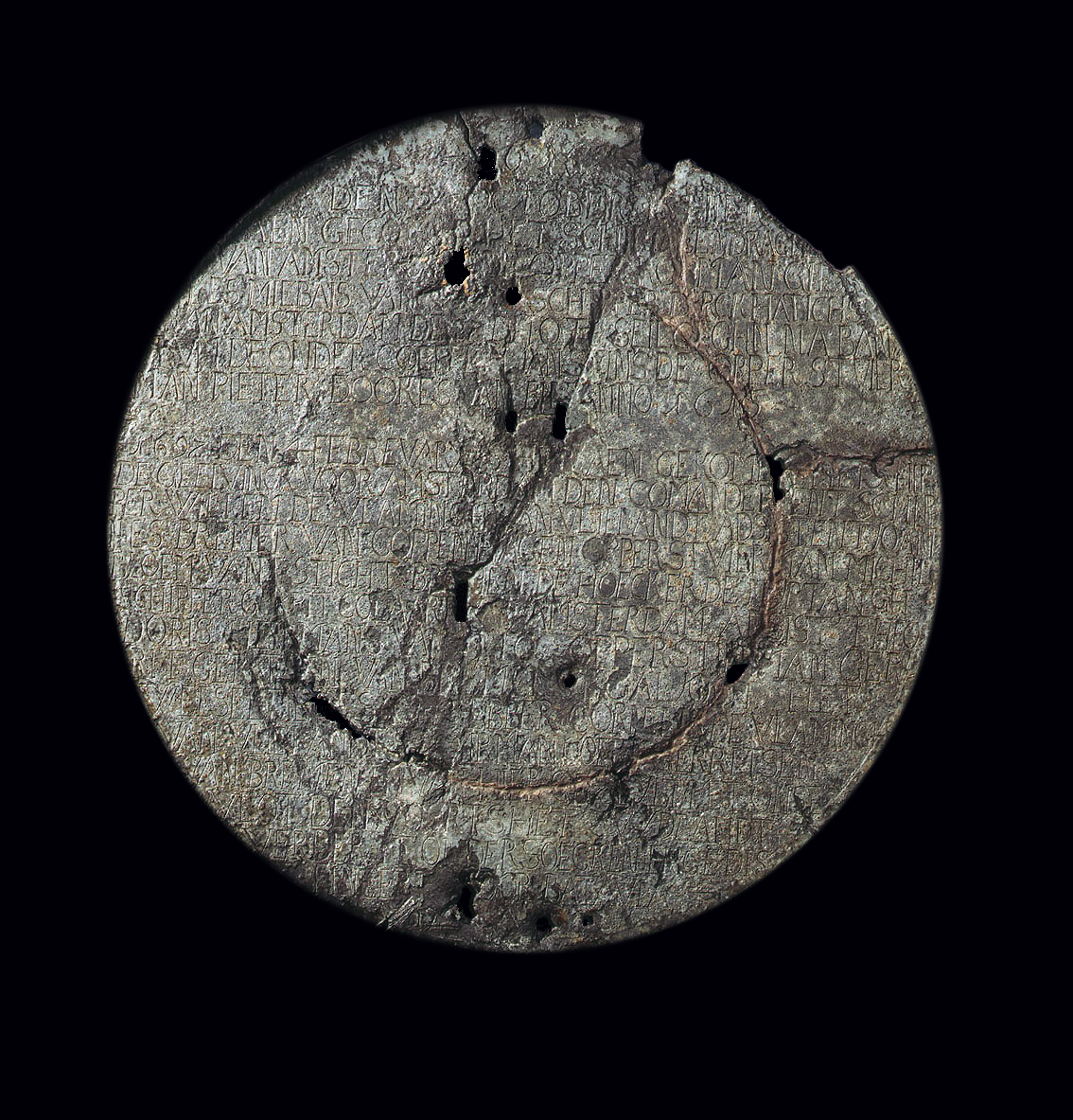
De Vlamingh Plate
Credit: Western Australian Museum, Department of Maritime Heritage
The ‘De Vlamingh Plate’ is a flattened pewter plate (diameter 40 cm) carrying 22 lines of inscribed Dutch text, that was erected on Dirk Hartog Island/Wirruwana on 11 February 1697 under the command of Willem de Vlamingh. The text is in two parts: the first is a copy of the text inscribed on the Dirk Hartog Plate, erected by Dirk Hartog in 1616 and collected by De Vlamingh on behalf of the VOC (now held in the Rijksmuseum); and the second records the arrival and departure of De Vlamingh’s expedition with the ships Geelvink, Nijptang, and Wezeltje, and names the superior officers of those ships. Several holes are punched through the plate from where it was nailed to a post: first in 1697, and again in 1801 when Captain Hamelin from the Baudin Expedition, on board Naturaliste, re-erected the plate alongside one of his own. Hamelin’s inscription has not been located.
The plate’s intercontinental journey to the shores of Western Australia did not end there: the plate was taken back to Europe before finally returning to Australian shores in the mid-20th century. It was collected by Louis de Freycinet on board Uranie in 1818, a French expedition. Despite the expedition wrecking at The Falkland Islands on their return voyage to Paris, the plate, with Freycinet, returned to France and was gifted to the Academie Française. There the item stayed, seemingly forgotten, until it was re-discovered during World War Two. The French Government returned the plate to the Commonwealth in 1947, and in 1950 the Menzie’s government returned it to Western Australia after lobbying by the State Government. It is now on permanent exhibition in the WA Shipwrecks Museum, Fremantle.
The choice made by De Vlamingh to leave an inscription was not unusual. It was customary for mariners to leave inscriptions as evidence of their passage (Broomhall 2016; Van Duivenvoorde 2016; Sigmond 2006), and these often used materials readily available in the landscape, such as rocks or wood. The Carstensz expedition in 1623, for example, reported that they inscribed a similar style of message into a tree. De Vlamingh had already left wooden tablets recording his arrival on Saint Paul and on Amsterdam Island earlier in the expedition. In this way De Vlamingh’s inscription is not out of the ordinary. Its transcription of the content of Dirk Hartog’s Plate is unusual, however, and suggests a recognition of historicity—the quality of being a part of history (Broomhall 2016; Ketelaar 2008; Sigmond 2006; Stanbury 2007). The use of a pewter plate may also reflect this.
De Vlamingh had previously used wooden tablets as inscribed markers at the islands of Saint Paul and Amsterdam. Here, however, he used pewter—a hard durable surface. In this, De Vlamingh mirrored the inscribed plate left by Dirk Hartog. This decision also reflects the landscape both expeditions had found themselves. Dirk Hartog Island lacks large trees or prominent boulders to carry inscription—unlike the large igneous rocks of the Burrup Peninsula and Dampier Achipelago, or large boab trees across the Kimberley, for example. The post believed to be that used to erect the plate (collected from Dirk Hartog Island in 1907) is also believed to come from elsewhere: the De Vlamingh Post (CH1003) has been visually identified as a length of Callitris preissii, Rottnest Island Pine. This suggests De Vlamingh had to utilise one of the lengths of wood they had cut from the trees on Rottnest Island as there was no adequate alternative place or item to which to affix the inscription. Scientific testing to verify the species of the timber is needed to confirm this hypothesis. If the identification is correct, the erection and collection of the De Vlamingh plate is an entangled journey indeed, not just representative of connections between Europe and Australia over the 17th to 20th centuries, but also the landscapes they encountered.
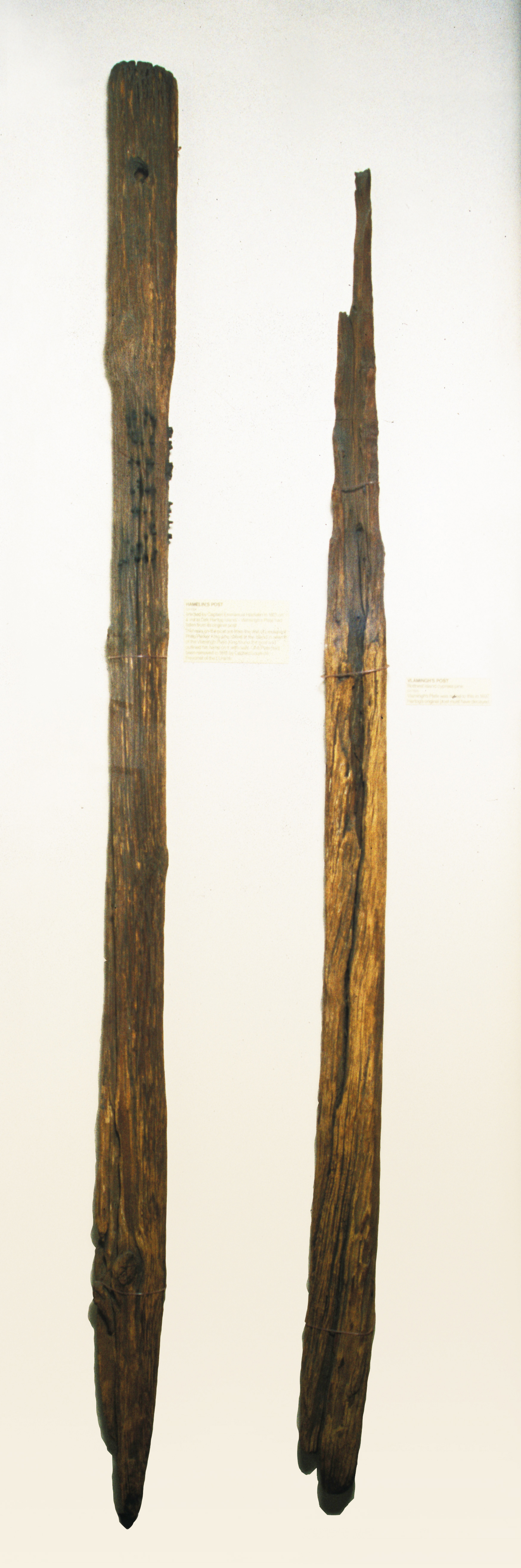
The two posts collected from Cape Inscription on Dirk Hartog Island believed to be that erected by Captain Hamelin (left: DHI251) and De Vlamingh (right: CH1003)
Credit: Western Australian Museum, Department of Maritime Heritage
References
Broomhall S (2016) ‘Dishes, Coins and Pipes. The epistemological and emotional power of VOC material culture in Australia’, in A Gerritsen and G Riello (eds) The Global Lives of Things: The Material Culture of Connections in the Early Modern World, Routledge, Oxford: 145-161.
Van Duivenvoorde W (2016) ‘Dirk Hartog was here! His 1616 inscription plate and Dutch ship communications’, in N Peters (ed) A touch of Dutch: Maritime, military, migration, mercantile connections on the western third 1616-2016, Carina Hoang Communications, Subiaco, W.A: 14–37.
Gibbs M (1996) Dirk Hartog’s Post. A report on the site of the 1616 monument site at Cape Inscription, Dirk Hartog Island and an analysis of historical evidence of the posts erected there, WA Museum Department of Maritime Archaeology Report No. 129, Fremantle, W.A.
Ketelaar E (2008) ‘Exploration of the archived world: from De Vlamingh’s Plate to digital realities’, Archives & Manuscripts, 36(2):13–33.
Schilder GG (ed) (1985) Voyage to the great South Land, 1696-1697. Willem de Vlamingh 1696-1697, C De Heer (trans), Royal Australian Historical Society, Sydney.
Sigmond P (2006) ‘Cultural heritage and a piece of pewter’, in Shaw L and Australian National Maritime Museum (eds), Dutch connections: 400 years of Australian-Dutch maritime links, 1606-2006, Australian National Maritime Museum, Sydney: 72-85.
Stanbury M (2007) ‘The Hartog, De Vlamingh and Hamelin Plates Re-Visited: early European discovery and exploration of Shark Bay’, in Green J (ed) (2007) Report on the 2006 Western Australian Museum, Department of Maritime Archaeology, Cape Inscription National Heritage Listing archaeological survey, Australian National Centre of Excellence for Maritime Archaeology Special Report No. 10, Fremantle, W.A: 79-104.
Terry M (June 2000) ‘Bring a plate’, Signals 51:4–6.
Western Australian Museum. (n.d.) ‘Hartog & de Vlamingh’, Batavia and Cape Inscription.
Western Australian Museum (2001). ‘De Freycinet’, Treasures from the Deep. Western Australian Museum.
Western Australian Museum (2016). Dirk Hartog 1616. Western Australian Museum.