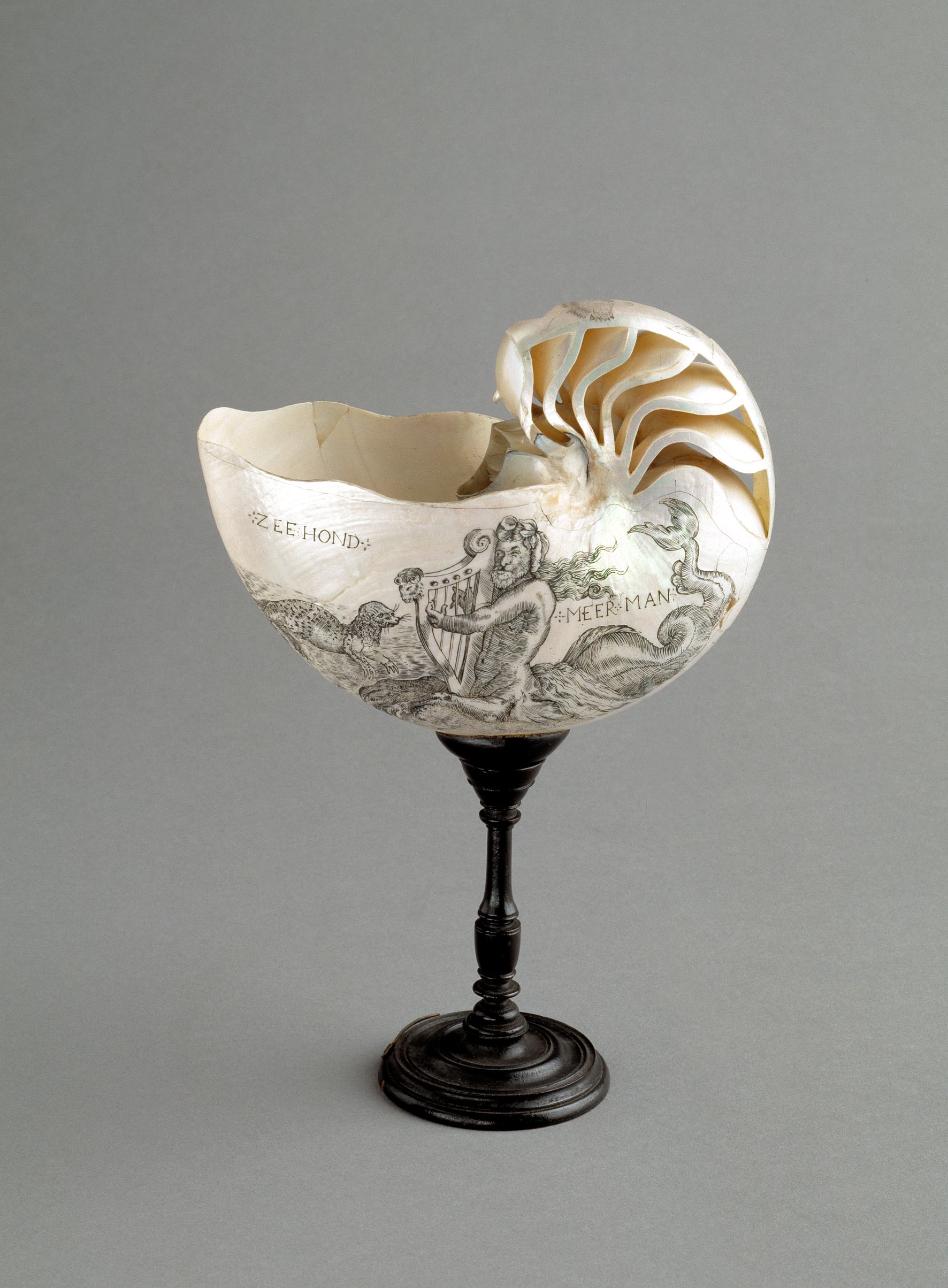
Credit: Rosenborg Castle Collection / The Royal Danish Collections no. 662/85.
In a glass case at Rosenborg Castle in Copenhagen, a silver-mounted shell rests like a frozen ripple of the sea (Figure 1). It is a nautilus cup—part natural wonder, part high-status conversation piece. Carefully engraved with Oceanus, a titan of Greek mythology and embodiment of the great river that encircled the world, the cup is fashioned from the shell of a Nautilus, a tropical mollusc from the Indian Ocean. Nearby lies a cassowary breastbone, once mistaken for a tiger skull. Native to New Guinea and northern Australia, cassowaries are colourful and dangerous birds. This specimen likely arrived in Europe as a living curiosity. Both items, the nautilus cup and cassowary breastbone, were recorded in King Frederik III’s Kunstkammer (art collection) in 1674—but how they got there is unknown. They are now held in the National Museum of Denmark’s collections.
These objects may seem like extravagant oddities collected by a Renaissance monarch. But they also carry a hidden story—one that begins not in Europe, but in Asia. These are examples of VOC objects: things that travelled aboard Dutch East India Company (VOC) ships. They are part of the vast net the VOC spun across the world, and the people—often overlooked—who tied its knots. Their ships were crewed by men from across Europe. Trade was not only about profit, but also about risk, loss, and lives lived at the edge of the known world.
Long before the Danish East India Company found its footing, Scandinavian sailors were heading east—often as hired men aboard Dutch ships. The Sound Øresund (Danish) or Öresund (Swedish)—the strait which forms the Danish-Swedish border, was a key trading hub in the 17th century. Cities like Copenhagen and Helsingør had substantial Dutch-speaking populations, including merchants trading in goods from across the world. Probate inventories from 1597 to 1680 list Asian items—coconut cups, nautilus goblets, coral jewellery, pepper, nutmeg, and porcelain—often owned by people linked to Amsterdam and VOC trade routes.
Some Scandinavian sailors joined the VOC directly from Copenhagen or Helsingør; others found work in Amsterdam, home to a sizeable Scandinavian population. Fifteen Scandinavian men sailed on the four VOC ships wrecked on the Western Australian coast. Thomas Wenzel, from Copenhagen, was among those murdered after Batavia (1629) was wrecked; Thomas Hoose, from Kristianstad, made it home after Zeewijk (1727). Others vanished—lost to sea, thirst, or heat on the Australian coast.
Though the Scandinavian kingdoms had limited direct Asian trade, cities like Copenhagen, Helsingør, and Stockholm received a steady stream of goods through Dutch networks. Some arrived via commerce; others were brought home privately in sailors’ chests.
Some objects ended up in royal collections. In the 17th century, King Christian IV (1588-1648) and his successors built cabinets that mirrored those of other European courts. These royal Kunstkammer housed scientific instruments, paintings, weapons, and exotic naturalia from across the world. The cassowary bones and nautilus cup were recorded there in 1674, alongside coconuts, ostrich eggs, bezoar stones, and Indonesian shells.
Many items were mounted in silver or gold, transforming perishable goods into lasting symbols of power. This painting (Figure 2) from the National Gallery of Denmark by Willem Kalf (c. 1678) evokes the splendour and complexity of this early global trade, where nature and artifice met through the networks of the VOC. At the centre of the painting a nautilus cup like the one from the Kunstkammer gleams. In this way, collection items were part curiosity, part status symbol. But these things didn’t travel alone. Behind each object lies a human journey—a sailor’s risk, a merchant’s investment, a courtier’s taste, or a craftsman’s hand.
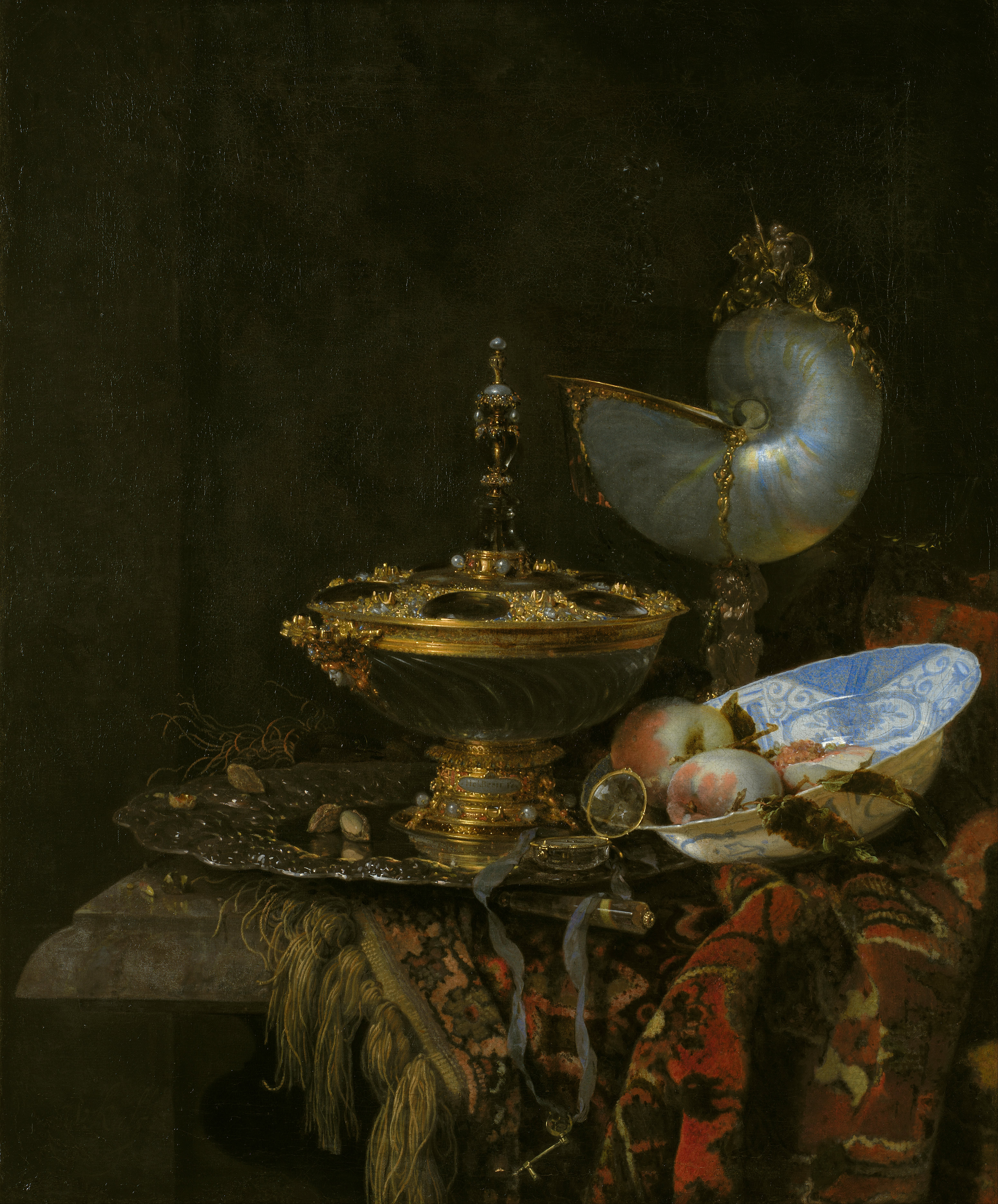
Credit: The National Gallery of Denmark, KBM 1531.
Objects like the nautilus cup and the cassowary skeleton are more than decorative relics. They reflect the reach of the VOC and the entangled lives that moved with it.
In today’s museums, these items prompt reflection on the costs of early globalisation. They speak of beauty, but also of loss—of shipwrecks, of lives cut short, and of the silent labour that moved goods and empires across oceans.
Next time you see a shell in a glass case, imagine the sailor who carried it, the storms survived, the table it adorned. They say you can hear the sea in a shell. Perhaps. But maybe it’s the echo of a journey across the world. We are still learning to listen.
References
Ariese C (2012) Databases of the people aboard the VOC ships Batavia (1629) & Zeewijk (1727): An analysis of the potential for finding the Dutch castaways' human remains in Australia. Special Publication No. 16, Australian National Centre of Excellence for Maritime Archaeology. Department of Maritime Archaeology, Western Australian Museum, accessed 20 June 2025.
The Danish National Archives; Helsingør Skifteprotokoller, 1597–1680; Helsingør Bailiff Archives.
Gundestrup B, Christensen C and Henriksen MH (1991) Det Kongelige danske Kunstkammer 1737 = The Royal Danish Kunstkammer 1737. Nationalmuseet, København.
Gøbel E (2017) ‘Danske i det nederlandske ostindiske kompagnis tjeneste i det 17. århundrede’, M/S Museet for Søfarts årbog, 62:7–30.
Linaa J (2021) ‘The materiality of longing and belonging: Diaspora communities reflected in probate inventories’, in Linaa J (ed.) Urban Diaspora: The Rise and Fall of Diaspora Communities in Early Modern Denmark and Sweden, Aarhus University Press, Aarhus: 191–238.
Sogner S and van Lottum J (2007) ‘An immigrant community? Norwegian sailors and their wives in 17th-century Amsterdam,’ The History of the Family, 12(3): 153–168.
Western Australian Museum (2017) Maritime Archaeology: Artefacts [data set], accessed 20 June 2025.