Why did the Dutch overlook Australia as a territory in which to establish a post, or Aboriginal and Torres Strait Islander people as trading partners? It is well known that the Dutch East India Company was primarily interested in ready commodities rather than settlement and expansion. Their limited interactions with the coastline of Australia very much failed to identify any items that they considered could be easily exploited for monetary gain. To his credit Willem de Vlamingh did appreciate the smell of the pines on Rottnest Island/Wadjemup, Callitris preissii, and an oil was distilled from the collected wood as a sample. But the sample, and other items collected by De Vlamingh during his 1696–97 expedition, were found wanting, and in a letter the VOC’s Governor General and Council at Batavia concluded that along the coastline:
...niet als een dorbar woestland jmmer aende stranden en soo verre sij in ’t lant geweest sijn, sig heeft opgedaen [NL-HaNA_1.04.02_1587_0394]
...nothing has been discovered but a barren, arid and wild land, both near the shore and so far as they have been inland (Robert 1972:163)
If we are to look beyond the clear preoccupation with commodities, there are other values, good and bad, expressed about Australia in the accounts of those that encountered its shores. Some of these observations and perspectives are incredibly relatable, and a far cry from the swashbuckling pictures of glorious exploration and so-called ‘discovery’ painted in some of the popular accounts of maritime history. One such example is the experience of the Dutch mariners with the Australian bush fly (Musca vetustissima).
In a summary of the outcomes of De Vlamingh’s expedition in a letter to Royal Society of London Fellow Martin Lister, Nicolaas Witsen (Director of the Amsterdam chamber of the VOC, and member of the Heeren XVII), one of the aspects of Australia he describes is that ‘There were also millions of flies verrij (sic.) much troubling men.’
This probably refers to an experience upper-surgeon Mandrop Torst recorded in the Nijptang Journal (12 January 1697) while landing on the coast (probably south of the Swan River mouth):
‘t Best ‘er af is, dat men hier geen Ongedierte verneemt: maar men word ’er over dag deerlyk door de Vliegen geplaagd (Torst 1701:17).
The best of it is that no vermin are found here, but during the day one is terribly tormented by the flies (Robert 1972:77).
The mariners of De Vlamingh’s expedition were not the first, nor the last, to be tormented by flies while visiting our shores.
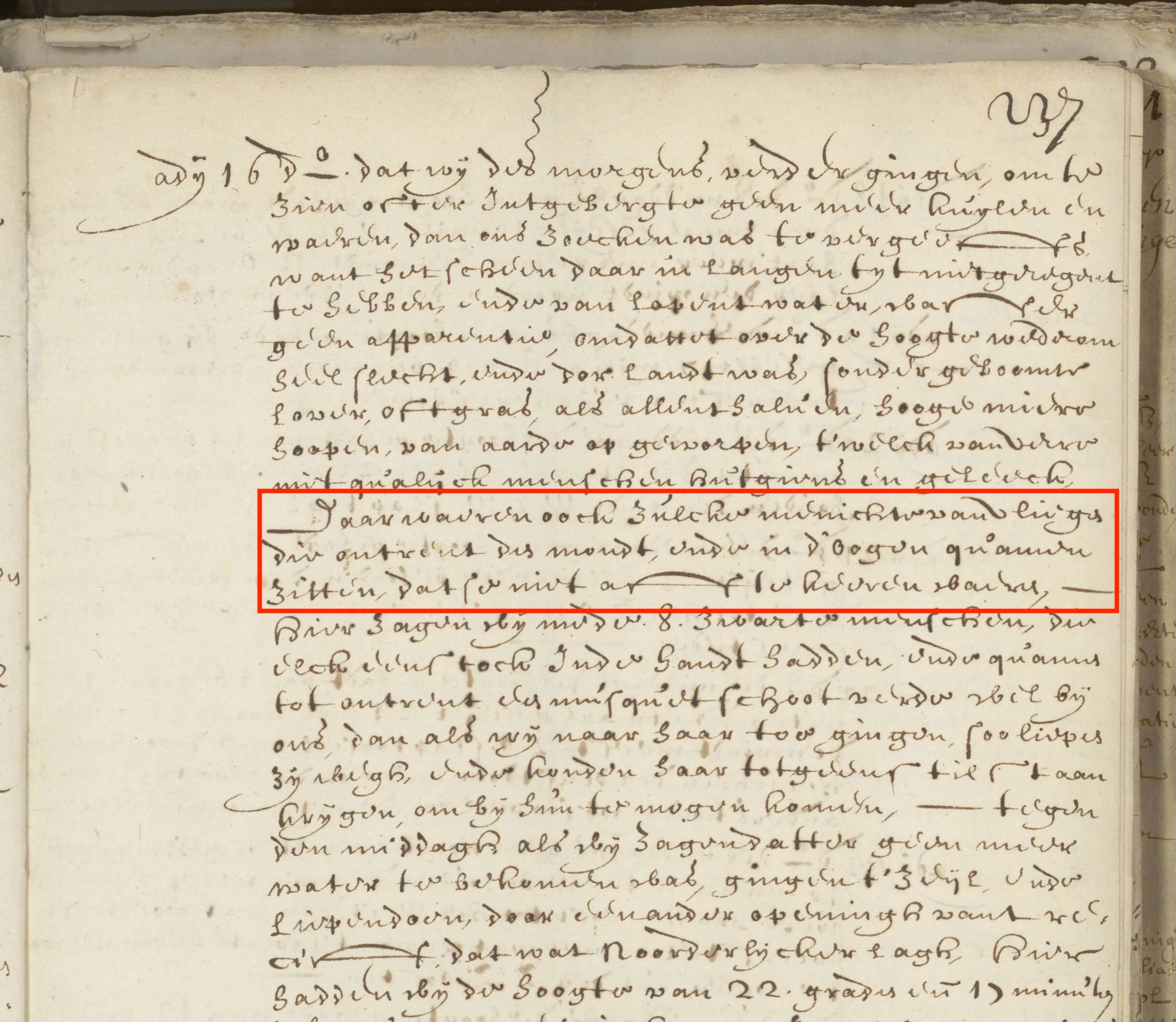
On 16 June 1629 Francisco Pelsaert with a group of 48 survivors from the wreck of Batavia were making their way up the Western Australian coast in a ship’s boat (boot) and yawl (schuit) towards Batavia (Jakarta) to seek aid. They had landed at approximately 23° S latitude to look for water, likely somewhere on the coast between Point Quobba and Coral Bay, and here they observed
Credit: Nationaal Archief, NL-HaNA_1.04.02_1098_0549.
Daar waeren oock zulcke menichte van vliegen die ontrent den mondt, ende in d'oogen quamen zitten, datse niet aff te keeren waeren
There were also such multitudes of flies that came and sat around the mouth and in the eyes that they could not be turned away.
This experience is incredibly relatable to many Australians: when the temperature starts to get a little warm and what seems like a plague of flies appear, endlessly insisting on getting in your mouth and underneath your sunglasses, desperate for any moisture your body might give them.
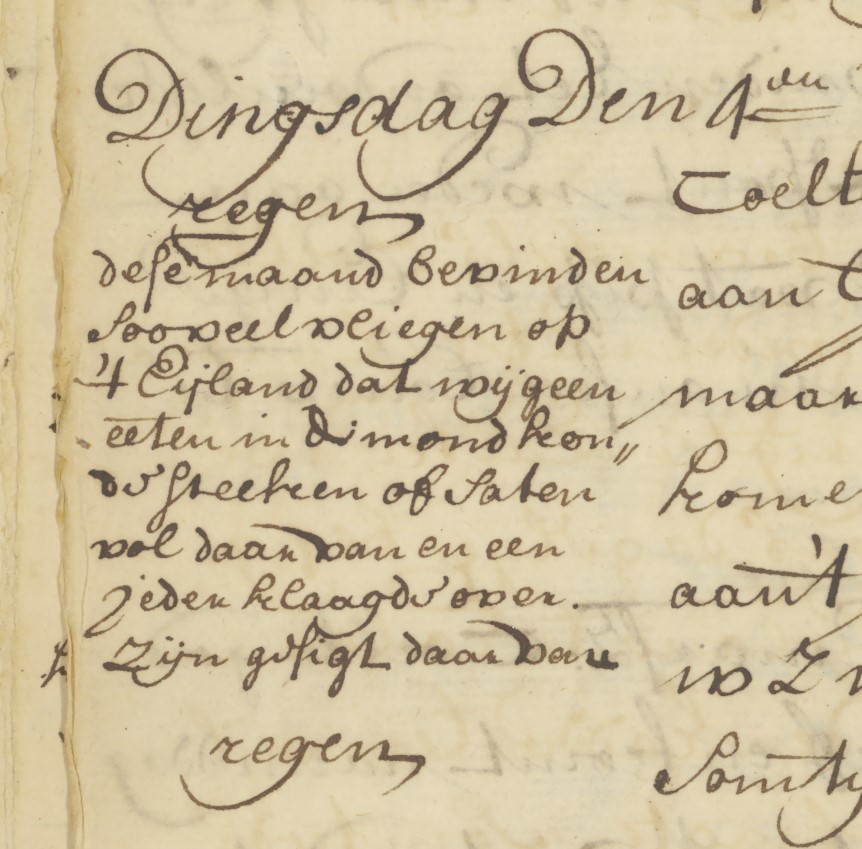
Similar to Pelsaert’s complaint, on Tuesday 4 November 1727, while stranded on Gun Island, the journal of the skipper Jan Steijns records in the marginalia:
Credit: Nationaal Archief, NL-HaNA_1.04.02_9353_0712.
regen dese maand bevinden sooveel vliegen op ‘t Eijland dat wij geen eeten in de mond konden steeken of saten vol daar van en een jeder klaagde over zijn gesigt daar van regen
Rain this month. There are so many flies on the island from the rain that we could not put any food in our mouths without being full of them and everyone complained about their face.
And while we do not have a written account for the voyage of Duyfken along the western coast of Cape York Peninsula in 1606, we can imagine what an experience they must have had to name one of the bays they encountered ‘Vliege Baij' ('Fly Bay'). This naming is preserved in a map held by the Österreichische Nationalbibliothek, Austria. This bay is known today as Albatross Bay.

Credit: Österreichische Nationalbibliothek. Bildarchiv.
These are just a glimpse of the many hundreds of instances where the Zuijdlandt (Southland) is mentioned in the manuscript archives and maps of the VOC that can help us better understand these early encounters, and the resulting picture of Australia that was painted with those words. While some of these accounts, like these describing the humble Australian bush fly, are incredibly human and relatable, other accounts have continued to colour our perception of Australia today despite their clear antiquity and bias.
Scholars such as Wendy van Duivenvoorde and M. McCarthy have remarked, for example, that the observations of Australian Aboriginals contained in the manuscript accounts of William Dampier’s voyages of exploration differ greatly from those contained in the published popular account. The latter was produced through influence of his editors and publishers, and sadly it is this published account which is at odds with his original journal entries and drafted text that perpetuates. The hand of the editor is also apparent on the letter by Nicolaas Witsen to Martin Lister describing De Vlamingh’s expedition: the letter in the archive demonstrating the level of alteration the content underwent before publication in the Royal Society’s Philosophical Transactions (Nelson 1994). Revisiting the original archives is, therefore, incredibly informative and helps set the record straight.
There is a lasting notion of an alternative coloniality in the Australian imagination, one which centres on the ‘what if’ the Dutch had settled Australia instead of the English. After all, the Dutch mapped and marked this land in various ways—for example, the erection of Dirk Hartog’s plate in 1616, Carstensz’s engraving of a wooden plaque when charting south along Cape York Peninsula in 1623 (yet, and unlikely, to be found), and Abel Tasman’s landing and naming of Van Diemens Land in 1642. While these were essentially communications to other mariners, they also marked the landscape and were visual reminders of the extent of the VOC’s maritime reach (Broomhall 2016; Duivenvoorde 2016). Moreover, the popular accounts produced in the 19th and 20th centuries of these encounters continues to influence our understanding of our country and its people—both in the past and today. These imaginings can carry with them certain biases. Diving into the archives and taking the time to read the minutiae of these early accounts of encounter, is a way to start identifying the flies and begin to build a very different cultural imagining and understanding of this period of European encounter with Australia.
Primary sources
Die Fahrt der Duyfken nach Southland 1605/06, Johannes Vingboons. Atlas Blaeu - Van der Hem, Bd. 41:29, fols 111–112, (31), Oesterreichische Nationalbibliothek, Vienna, Austria.
Series 1.04.02. No. 1098. 232-238. Daghregister intverliesen van het schip Batavia, verseijlt sijnde op het Zuytlant, door Francisco Pelsaert. Nationaal Archief, NL-HaNA_1.04.02_1098_539–552.
Series 1.04.02. No. 1587. 402–407 of 398–434. Originele missive door den gouverneur generael ende Raden van Indien gesz aende Heeren bewinthebberen van de Camer Amsterdam in dato 30 november 1697. Nationaal Archief, NL-HaNA_1.04.02_1587_0390–425.
Series 1.04.02. No. 9353. 667-741. Dag register gehouden op't Eijland na het verongelukken van't schip Zeewijk door mij Jan Steijns Schippen op dien bodem. Nationaal Archief, NL-HaNA_1.04.02_9353_0667–0741.
Torst M (1701) Journaal wegens een voyagie, gedaan op order der Hollandsche Oost-Indische Maatschappy in de jaaren 1696 en 1697 door het hoekerscheepje de Nyptang, het schip de Geelvink, en het galjoot de Wezel, na het onbekende Zuid- land, en wyders na Batavia, Willem de Coup, Willem Lamsvelt, Philip Verbeek, en Jan Lamsvelt, t’Amsterdam.
Witsen, Nicholaes Cornelisz. Letter to Martin Lister, dated at Amsterdam, 03 October 1698, EL/W3/54, The Royal Society Archives, London, accessed on 02 October 2025.
References
Broomhall S (2016) ‘Dishes, Coins and Pipes. The epistemological and emotional power of VOC material culture in Australia’, in A Gerritsen and G Riello (eds) The Global Lives of Things: The Material Culture of Connections in the Early Modern World, Routledge, Oxford: 145-161.
Konishi S (2020) ‘The “brilliant shells” of Shark Bay: The emotions of shell-collecting’, Collecting Natural History in Western Australia, edited by Alistair Paterson, Andrea Whitcomb and Tiffany Shellam. Studies in Western Australian History, 35:21–36.
Nelson EC (1994) ‘Nicolaas Witsen’s letter of 1698 to Martin Lister about a Dutch expedition to the South Land (Western Australia): the original text and a review of its significance for the history of Australian natural history’, Archives of Natural History, 21(2):147–167.
Pelsaert F (2017) [The Batavia Journal of Francisco Pelsaert], A de Jong (trans). WA Museum, Department of Maritime Archaeology Reports No. 136b. WA Museum, Fremantle, W.A., accessed 26 September 2024.
Robert WCH (ed) (1972) The explorations, 1696–1697, of Australia by Willem De Vlamingh. Extracts from the two log-books concerning the voyage to and explorations on the coast of Western Australia and from other documents relating to this voyage. Dutch texts with English translation and notes, Philo Press, Amsterdam.
Steijns J (2014) A Translation of the Journal of Jan Steijns, from Document NL-HaNA 1.04.02, inv. nr. 9353—National Archives of The Netherlands, by Adriaan de Jong, A De Jong (trans). WA Museum, Department of Maritime Archaeology Reports No. 317. WA Museum, Fremantle, accessed 4 April 2025.
Van Duivenvoorde W (2016) ‘Dirk Hartog was here! His 1616 inscription plate and Dutch ship communications’, in Peters, N. A touch of Dutch: Maritime, military, migration, mercantile connections on the western third 1616-2016, Carina Hoang Communications, Subiaco, W.A: 14-37.
Van Duivenvoorde W, Wesley D, Litster M, Wonu Veys F, Nayati W, Polzer M, McCarthy J and Jansen L (2019) ‘Van Delft before Cook: The earliest record of substantial culture contact between Indigenous Australians and the Dutch East India company prior to 1770’, Australasian Journal of Maritime Archaeology, 43:27–49.